“Deep Azure” at Sam Wanamaker Playhouse
Jeremy Malies on the South Bank
★★☆☆☆
25 February 2026
Chadwick Boseman’s Deep Azure is overwrought and overlong at two hours 30 minutes but persevere with full attention and you will find moments of transcendence. Dead in 2020 at the age of 43, Boseman was an American actor and playwright whose legacy is significant. He is justly revered.

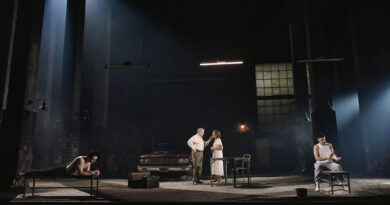
Aminita Francis and Selina Jones.
Photo credit: Sam Taylor.
The play premiered in Chicago in 2005 after which Boseman largely turned away from theatre. He began to write, act, and direct for cinema and television. Having played significant historical activist characters ranging from baseball hitter Jackie Robinson to jurist Thurgood Marshall by way of soul singer James Brown, you have to think that Boseman’s shade will be less than pleased that he is best remembered as Marvel Comics character T’Challa. But he chose to take the role.
I wonder if Deep Azure is well served here by the direction of British-Ghanaian writer and director Tristan Fynn-Aiduenu who scored a success two years ago when he directed For Black Boys Who Have Considered Suicide When the Hue Gets Too Heavy. This revival redresses the balance towards Boseman’s achievements as a dramatist. But the subtlety with which Boseman discusses seemingly perennial themes such as body dysphoria, Black on Black crime, and police corruption is occasionally undermined by humour that is too self-aware and arch. I was reminded of some of the excesses of Jerry Springer: The Opera.
It’s an odd structure – and this is hardly a plot spoiler – in that the hero is dead from the beginning. The narrative is non-linear being presented to us in chunks, and with those chunks often progressing backwards in time. Our hero is Deep played by Jayden Elijah, and the character is in part based on a friend of Boseman’s at Howard University in Washington who died during a confrontation with a police officer. Elijah shows skill when injecting his movements and body language with an ethereal quality as he floats in and out of the action, on one occasion using the stage’s hatch. (Movement direction is by Tanaka Bingwa.)

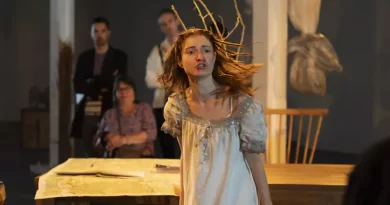
Photo credit: Sam Taylor.
Deep’s fiancée Azure (played by Selina Jones) ends up on a dizzying, hellish mission to track down the killer. Jones is particularly strong when showing the character in a state of revolt against the judgemental behaviour of her peers (both men and women) about body mass and shape. Later, as Azure descends into anorexia and bouts of bulimia, Jones’s technique is subtle as she shows her character stepping in and out of mainstream perception of healthy nutrition.
Aminita Francis springs from the chorus to become Deep’s mother. She and Jones share an affecting scene in which the women evaluate each other and speculate on how they might have bonded in the orbit of the obviously charismatic Deep.
Support is strong throughout the cast. In a Washington Wizards basketball kit, Justice Ritchie plays Deep’s pal Roshad. Ritchie injects much comedy as he shows his character realizing that, like everybody, he is in a hinterland between this world and the afterlife and must deal with the initial terror at seeing Deep. The sports shirt allowed me to tie down the city as Washington; I had been speculating foolishly and missing Boseman’s point that this could be any metropolis.
Staging the play at a venue associated with Jacobean revenge drama suddenly seems all of a piece. Add to this the fact that the dialogue is largely poetry – mainly crisp rhyming couplets that put me in mind of Martin Crimp. There are also passages of blank verse stuffed with assonance and alliteration. Once you are on board with the lyrical language, the venue appears a logical choice after all. Returning from a term studying Shakespeare at Oxford, Boseman resolved to write idiomatic banter with a flavour of urban streets but elevate it to a poetic intensity. A character gives us Hamlet’s morbid “O, that this too solid flesh would melt …” soliloquy and there are snippets of Macbeth.
But at half time, having just become fully involved, I was brought down to earth when one of the pleasant, well-behaved youngsters behind me asked their teacher, “Is that the end or the interval?” Surely Fynn-Aiduenu could have marshalled matters better than that and given the kids more pointers as well as making a few judicious cuts? An obvious cut would have been the extended sequence in which we are asked to conjure up early 20th-century Czarist Russia and reflect on the character of Rasputin. This struck me as plain odd.
But the production is a feast visually and there are standout costumes throughout by Paul Wills. These are at their most striking as we are introduced to a beatboxing set of robotic chorus members who are in some kind of afterlife. The vocal percussion does much to carry everybody along, projecting us into the doomed love story. Later, the chorus is a marching band from a fictitious university (Mecca) which one assumes is Howard University. Yes, the plot is largely fictitious, but you sense that Boseman’s murdered friend is seldom far from his mind. As a result, the piece often has the tone of verbatim theatre and at times put me in mind of The Laramie Project.
The set, also the work of Paul Wills, abounds in golden orbs. As a trail of these ascend to the heavens we are prompted to think of the music of the spheres. Across its various musical elements, the project is ravishing. Some of these are traditional part-singing in Julia Ward Howe’s “Battle Hymn of the Republic”. Elsewhere, co-composers Conrad Murray and John Pfumojena have the chorus singing minimalist solfège syllables in the style of Philip Glass. There is a metatheatrical sequence as we learn how Deep took Azure to the university theatre in order to propose.
The candlelight design by Azusa Ono did nothing for me. Could Ono and Fynn-Aiduenu not have contrived to bring it into the plot a little or somehow make it more meaningful? Similarly, I admired the director’s avoidance of props but the physical theatre (especially the dreaded sequence in all physical presentations of actors pretending they are a car) often palled. At climactic moments, bursts of simulated daylight occasionally come in from the corridor walkways. The upper tier of the venue is used effectively for the chorus and the (permanent) painted ceiling mural showing Roman gods and celestial bodies is an ideal complement to the plot.
The play does coalesce and often takes wing. But it’s quite a gruelling experience with Fynn-Aiduenu neglecting many opportunities to let the dense plot breathe for a while. (He could take a tip or two from Shakespeare in the cited Macbeth.) Boseman remains an important voice and deserves a defter presentation of his signature dramatic work. I wasn’t alone in being relieved when the spheres stopped revolving.