“Republic of Gods – “Republic of Love”, Vienna Festival – Wiener Festwoche, May 2026
Sasho Ognenovski in Austria
1 July 2026
If art being produced at any one time is a benchmark of humanity’s spiritual wealth, then theatre festivals are significant cultural touchstones. Art is created by human beings from themselves and for themselves meaning that gatherings of this kind have huge cultural significance.

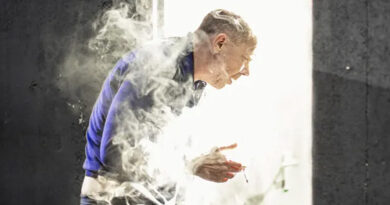
Seppuku: Mishima’s Funeral or the pleasure of dying.
Photo credit: Ximena y Sergio.
For more than seven decades, the Vienna Festival has brought together the world’s most distinguished artists. Over the past two years, under the artistic direction of Swiss theatre director Milo Rau, the festival has undergone profound transformation. By embracing activism and, above all, recognizing the audience as an essential participant in the festival, these last two editions (2025 and 2026) have become focal points of Europe’s cultural and artistic landscape. The events emphasized activism as resistance against corruption and the troubling issue of political interference in cultural policy across all artistic disciplines.
This second iteration of the festival to be held under the motto “Republic of Love” —it is the seventy-fifth edition in all—has seven interconnected sections. “House of the Republic”, “Club of the Republic”, “Tribunal of Faith”, “Council of the Republic”, “Vienna Declaration”, and, once again this year, the indispensable initiative “Resist Now! Together!”
This process consists of debates, open letters, and radical performative interventions. They have been launched by Rau and the Vienna Festival through the “Resistance Now!” tour across Europe, America, and Asia which has already visited 22 cities—Stockholm to Belgrade, Antwerp to Prague, New York to Mosul and Taipei, and Kyiv to Bucharest. Whether through an online reading that connected Iraq and the United States (The Second Coming), a guerrilla festival organized in collaboration with the censored Serbian theatre festival BITEF, a debate in the Ukrainian capital of Kyiv or an alternative Nobel Prize banquet, the Vienna Festival and its international partners remain committed to a fairer, more democratic, more equitable, and more humane cultural policy.
At its artistic core, the Vienna Festival presents theatrical productions and performances by leading theatre artists. The programme opens with The Best Play, Rau’s bizarre production based on the history of the festival from its founding in 1951 to the present day.
Seppuku: Mishima’s Funeral or the pleasure of dying is a provocative performance by the ever-controversial Spanish artist Angélica Liddell that explores the so-called pleasure of dying. It creates a vivid vivisection of the work of the great Japanese author Yuko Mishima. Liddell surveys Mishima’s biography, philosophical ideas about aesthetics, mourning and sacrifice with much of the piece drawing on Noh tradition.
Liddell embraces much of Mishima’s output by integrating his spiritual philosophy with references to contemporary suicides and societal numbness surrounding them. The piece deals with seppuku, a suicide form or ritual historically performed by samurai warriors as a demonstration of loyalty or as restoration of loyalty after perceived problematic behaviour. Mishima committed suicide in 1970.
This complex production has a directorial concept and acting dynamics that shows much understanding of Noh theatre style and judicious use of it as a platform. The piece examines the impulse toward suicide through the prism of political contexts and particular cases of suicide in Europe and wider, while at times also drawing on traditional Western expressions of understanding our existence and modes of departure from this world. In this performance, the Hagakure “shadow of the shadows” spiritual code and the ritual of seppuku ultimately leave a (deliberate) impression of ambivalence through the complex relationship (across all cultures) between pain and pleasure.
Believing in Masks (Credere alle maschere) is a symbolic performance by Italian director Romeo Castellucci. This 40-minute piece actively involves the audience who wear identical masks. The project explores the shifting configurations of identity embodied by the mask across centuries: the ancient ones, modified artefacts from nowadays everyday life, from time to time the significant parts of public life (weapons, props, different types of tools, even the small furniture details etc.) Rich in symbolic resonance and visually arresting, Castellucci’s performance leads us to believe that the mask is not merely a product of human intellectual understanding or misunderstanding, but rather an element of inspiration, despite the fact that we live in an age where financial imperatives are pe-eminent and empathy is increasingly difficult.
9/11 Frames Per Second is an original collaborative project bringing together international artists whose creative visions are inspired by the consequences of the terrorist attacks of September 11, 2001, viewed from four distinct perspectives. There is comparison between the atmosphere of fear following 9/11 and the everyday reality of racism and repression in the United States. Another dichotomy that is analyzed is the contrast between European discourse on terrorism and ordinary civilian life in the Middle East. There is also discussion of the dimensions of Queer desire and bodily horror as well as the deconstruction of Western myths surrounding terrorism. This is an exceptionally dynamic performance that exposes political wounds.
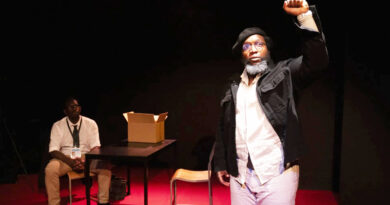
Theatrical offerings also included Dark Noon, written and directed by Tue Biering which has been reviewed by another Plays International correspondent here.
It would be impossible not to mention one of the festival’s most exclusive events, the concert by the legendary Patti Smith which was undoubtedly one of the highlights. Alongside the theatrical productions, there were dance projects and musical theatre. The festival also distinguished itself through exceptional debates and workshops led by theatre artists. Equally significant were the exhibitions and book launches held aboard a boat on the Danube Canal that effectively served as the event’s headquarters.
Returning to the defining characteristic of these two editions of the Vienna Festival, particular attention should be paid to the section entitled “Tribunal of Faith” which was conceived and directed by Rau. Following The Trials of 2025, Rau once again employed the documentary theatre format to address a pressing socio-political issue, this being the role of religions, gods, goddesses, and sacred objects within global capitalism.
Countless religious symbols have found their way into popular culture. American technology giants and dictators in Eastern Europe are reshaping religious doctrines for their own benefit. Through three case studies—involving artistic appropriation, institutional appropriation, and involvement of the political appropriation or even abuse of religious practices, symbols, and principles—The Republic of Gods critically examined not only these individual examples but the broader cultural mechanisms behind them.
In The Republic of Gods, the festival advocates for global communities of faith while simultaneously maintaining a critical awareness of itself and a sense of boundaries. What role do Christian symbols such as crucifixes and incense, indigenous practices such as shamanism, and spiritual expressions such as dreadlocks play in popular culture and within the art market? Where is the boundary between legitimate cultural exchange and intrusive, neo-colonial appropriation carried out by what is, in essence, the capitalist religion of art and commerce? Why do former sacred objects—Egyptian mummies, Benin bronzes, and Aztec ceremonial headdresses—continue to reside in European museums? What becomes of our gods and goddesses when Putin, Trump, and radical Islamist regimes appropriate passages from the Bible and the Qur’an to legitimize their own rule?
The Vienna Festival raises many painful questions concerning political interference in theatre and in the arts more broadly. Resistance carries not only institutional and financial implications; it concerns the uncompromising appropriation of theatrical creation itself and the intrusion into artistic discourse particularly in countries that have yet to complete their democratic transition.
The performances presented at this festival are not merely part of the world’s spiritual bloodstream; they are also gestures of activism aimed at fostering tolerance and recognizing diversity. Diverse theatrical concepts, innovative interpretations of classical works and contemporary themes confronting today’s audiences become a powerful constellation of messages, warnings, and artistic directions whose critical force remains as historical testimony to an era in which falsehood and authoritarianism are becoming mainstream instruments of social identification.
Perhaps the common denominator uniting many of the performances is the perpetual struggle for freedom of speech, a struggle that not only refuses to disappear but becomes increasingly articulate and tangible at a time when war returns to us like a recurring nightmare. This may well be what the Vienna Festival represents, a reaffirmation of human dignity which must ultimately be liberated from the chains of autocracy and restored to its rightful owner, the human being.
Having experienced some of the performances and gained a flavour of what this monumental festival offered in its seventy-fifth edition, one inevitably wonders: do we still need gods? What do we imagine when we lift our eyes toward the vast, imagined density of the heavens? Should humanity’s visualization of God ultimately lead us back to our vision of the Paradise —that is, to truth?