“The Last Black Messiah”, Jack Studio Theatre
Jeremy Malies in South London
★☆☆☆☆
9 May 2026
It was one big roll call, a list of activists for Black rights and victims of racist violence. I scribbled the names of activists W. E. B. Du Bois, Marcus Garvey, Harriet Tubman, Malcolm X, James Baldwin, Angela Davis, and Medgar Evers. A victim list included Emmett Till, Rodney King, and Yusef Hawkins.

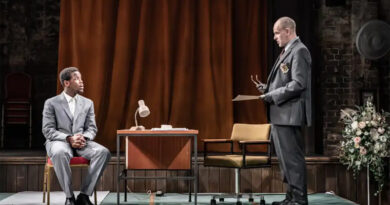
Photo credit: Henry Hu.
This is a two-hander in which the playwright, Emeka Agada, also plays the main character. The character is Dr Oku, a senior (and ostensibly charismatic even inspirational) academic at historically black Howard University in Washington, DC.
Oku is now incarcerated for an alleged politically motivated crime and has nearly killed a guard while inside. He is to be executed shortly. Mention of Huey P. Newton suggests that Oku’s alleged crime may have been associated with the Black Panthers.
Oku is visited by a former student, Asante, played by Kenneth Butler. No doubt using the political science background he has acquired from Oku’s tutoring, Asante has become a mainstream journalist on an unspecified high-quality newspaper or magazine. It would be difficult to write any kind of review of this play – it’s hardly a plot spoiler since all is exposed early – without revealing that Asante has been turned by unspecified, sinister authority figures, most probably in the FBI.
It’s all so formulaic. Asante is posturing as if he is conducting a legitimate for-the-record journalistic interview and when he encourages Oku to truly confide in him, he switches off the tape recorder. I thought to myself, “I bet he’s wired!” and experienced a moment of tension as Asante tapped at Oku’s chest. I expected a percussive sound. There was none.
A surprise! In the next mini-scene, Asante is wired. When Asante’s conscience is pricked and he rebels against his handlers (it’s probably the presidency of George H.W. Bush) his family home is staked out and his children spoken to in sinister terms with the recording relayed to him. (Voiceovers are by Treci Dominique.)
Only with talk of “an oppressive system that makes us all lie passively” do we catch a flavour of what might have been Oku’s motivational teaching. Much of the dialogue remains resolutely page-bound, some of it is trite and lame. “How do you like your coffee? Like my women – black!” Followed later by, “You can’t bullshit a bullshitter!” Did these not jar with director Nathaniel Brimmer-Beller? I get it that there is a need for idiom but none of the dialogue captures what is supposed to have been a Socratic teacher–pupil relationship. And when the aim is loftier, the tone becomes platitudinous. “I love America, but I do not love what she has become.” Really!
The quality of dialogue does not match the huge freight you might expect from the major figures referenced constantly, and there is no wit or elegance to the form of the play. Even the stagecraft is clumsy and Brimmer-Beller might have been more inventive. I particularly disliked a clunky sequence in which Oku injects himself with black tar heroin. Butler is unable to acquire detail gradually or hint at a process of his character becoming angry by degrees. He simply explodes when a situation demands it.
Howard University with its numerous Rhodes and Fulbright scholars not to mention two Pulitzer Prize winners deserves better. And audiences deserve better for sure. But my main reservation is the unanswered question – and I believe I stayed focused throughout. Why is there a supposition that a career as an orthodox journalist would promptly make an Oreo of a Black man and prompt him to become a Judas? It’s never explained.