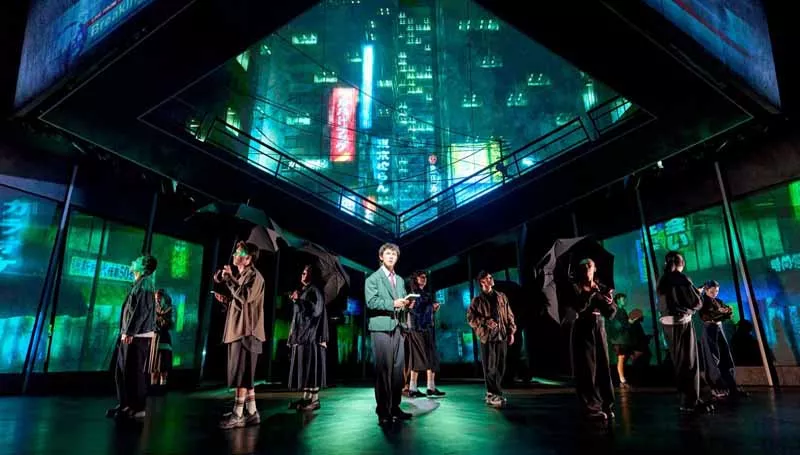
“Death Note: The Musical” at the Barbican
Franco Milazzo in Central London
★★★★☆
13 August 2026
Screen-to-stage musicals are, let us be honest, well-intentioned money grabs which leave people wondering whether absolutely everything must now be set to music. They tend to fall into one of three categories: bad and flashy (e.g. Burlesque), bad and loud (e.g. Beetlejuice), and bad to the bone (e.g. Trainspotting). There are notable exceptions – Groundhog Day broke box-office records at the Old Vic before flopping on Broadway then, perhaps to stay true to its premise, repeated history by coming back to the Old Vic for another sell-out run. With many devoted fans of the 2006 anime by Tsugumi Ohba and Takeshi Obata clambering for a ticket, this adaptation Death Note: The Musical about Japan’s most homicidal stationery item makes a decent case for joining them.
It has taken the scenic route to get here. Frank Wildhorn – Broadway’s least critically loved and Asia’s most bankable American composer, whose last manga musical Your Lie in April reached the Harold Pinter Theatre in 2024 – wrote the score, with English lyrics from Jack Murphy and a book by Ivan Menchell, over a decade ago, only for it to premiere in Japanese translation in Tokyo in 2015. Seoul, Moscow, and Rio followed; London had to make do with a pair of concert stagings in 2023. This Barbican run has been directed by Stephen Whitson and choreographed by Fabian Aloise, whose stripped-back work on Evita and Sunset Boulevard here gets a rather bigger toy box. This is the first time the show has been fully staged in the language it was written in, with a planned Broadway transfer already pencilled in. The 50 performances in London will serve as the audition tape for New York; some things never change.
Sandwiched between last year’s smash hit Fiddler on the Roof and next year’s much-anticipated Sunday in the Park with George, the macabre Death Note: The Musical is not on paper the obvious choice for the Barbican’s summer attraction. Star pupil Light picks up a black notebook deliberately abandoned by a mischievous shinigami (“god of death”) called Ryuk. Once the teenager opens it and reads the handy instructions, he discovers he can kill anyone by writing their name in the Death Note while picturing their face. Soon enough, violent criminals across Tokyo are dropping dead in swathes.
The reaction is mixed: the public celebrate the hero they christen “Kira” while a police taskforce (headed, awkwardly, by Light’s father) tries and fails to find the mass murderer. Enter “the world’s best detective”, a mononymous oddball called L, to uncover the killer’s identity. When he gets close and ships in a dozen FBI agents, Light simply writes them into his book. Pop star Misa finds a second Death Note of her own and, after speaking with her protective shinigami Rem, goes on her own hunt for the mysterious Kira. All the while, L closes in.
Telly Leung brilliantly embodies the apple-loving demon Ryuk, who descends to hang with the “boring” mortals mostly so he can snaffle the apples he craves. His every movement piques interest and his comic timing is excellent; such proficiency at scene-stealing suggests the police may be hunting the wrong criminal. That leaves Xander Pang’s Light – technically the lead – often looking like a guest at his own party. More equal is the pairing of sweet Rem (Grace Mouat) and lovelorn Misa (Stephanie Zaharis): both phenomenal actors and singers, and their duets and solos bring the house down. Between them, Colin Ryan impresses as the eccentric L, a detective who looks like he hasn’t slept since the millennium, his behaviour more wired than a datacentre.
Less than killer is Jon Bausor’s set design. A mid-air metal balcony which rises and lowers to portray the realm of the shinigami is more about function than style, while down below the office and school sets whizz horizontally back and forth on the same busy mechanism. L’s lair is less a nod to The Matrix and more a frantic shake of the head, albeit without the sushi recipes. More impressive are the shinigami costumes by Sachiko Nakahara: Ryuk in a black exoskeleton, Rem in shimmery silver, and Jerasu got up as a slate-grey living statue.
Wildhorn’s songs barely scratch the surface of sophistication but this pop-rock aural panorama is none the worse for it: unashamedly catchy stuff, at its best when the staging is doing the heavy lifting alongside it. Mouat’s “When Love Comes” is a real rocket and the standout ballad of the night. Zaharis’s back-to-back “I’m Ready” and “We All Need a Hero” form the double-whammy that establishes Misa as rather more than a wide-eyed love interest, and her heart-stabbing “Half a Life” – in which she spells out how far she will go to find Kira – is another highlight.
Purists should note that much of the manga has been left out or rewritten to produce a plot that grabs those coming fresh to the story. The otaku can sit smug in the knowledge that, even though the evening ends on an incredibly bleak note, many of the source’s most brutal elements are only hinted at or quietly ignored.
Stage design aside, this is a highly polished piece of work which earns its place in the Barbican’s schedule. While most musicals see any kind of coherent or plausible plot as an optional extra to be drowned in a vat of gloopy sentimentality, here the twisting plot pays dividends. Somewhere between the balcony and the ballads, a notebook full of names becomes the most gripping prop in London. Write that down.