Summerfolk at the Olivier, National Theatre
Jane Edwardes on the South Bank
★★★★☆
19 March 2026
Going home, after watching the National Theatre’s production of Maxim Gorky’s Summerfolk, I see an enticing poster suggesting that there is a better time to be had in the Malvern Hills than standing on the Bakerloo platform in the middle of London. It must have been a similar feeling that drove many Russians at the beginning of the 20th century to decamp to their dachas in the summer. It’s a trend that Lopakhin anticipates in Chekhov’s The Cherry Orchard when he buys up the orchard belonging to Madame Ranevsky and her brother, in order to chop down the trees and build dachas for the new middle classes.

Arthur Hughes and Adelle Leonce.
Photo credit: Johan Persson.
Gorky was well aware of The Cherry Orchard, and had met and corresponded with Chekhov. But whereas Chekhov understands and sympathizes with his characters, even the feckless and indolent, Gorky, who was already a friend of Lenin’s, is more judgemental and is supportive of changes to Russian society that he feels are inevitable. His ambitious play portrays a group of lawyers, engineers, clerks, and property developers, and their discontented wives. Several of them have pulled themselves out of poverty but have little concern for those they have left behind. They are self-obsessed, spiteful, and unaware of what is going on in the world. During the summer, they drink, seduce, whinge, gossip, and drink some more. How they complain!
The cast is large. In this hard-hitting and often funny adaptation by Nina and Moses Raine, there are 22 actors. It is an engrossing ensemble piece, impeccably directed by Robert Hastie. It takes a while to work out who everyone is as they criss-cross the stage, all dressed in white and cream costumes, in front of the wooden skeleton house that belongs to Paul Ready’s Bassov, a loud-mouthed lawyer, and his restless, beautiful wife Vavara (Sophie Rundle). In the second half, the action moves outside onto the house’s terrace surrounded by woods and water in Peter McKintosh’s seductive design, the greenery enhanced by Paul Pyant’s lighting.
At the start, Vavara is waiting impatiently for the arrival of Daniel Lapaine’s Shalimov, a writer she much admires. But when he comes, she is shocked initially to discover that he has lost all his hair, and subsequently that he is just as vain and self-centred as everyone else. Lapaine gives a delightfully precise performance as a somewhat prissy man who loves flattery, but feels over-burdened by his fans’ demands that he comes up with profound comments on the human condition. He is cruel to the statuesque Kaleria, who needs little invitation to recite her overwrought poetry, and is wickedly performed by Doon Mackichan.

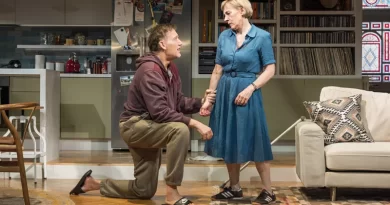
Daniel Lapaine and Adelle Leonce.
Photo credit: Johan Persson.
Alex Lawther is outstanding as Vavara’s unhappy, lost brother Vlass, who falls for a doctor, the much-older Maria (Justine Mitchell). Mitchell amusingly, but also sympathetically, struggles with the appeal of having a lover, while also very aware that her hair is grey, that the relationship will be mocked, and that Vlass may well leave her eventually for someone else.
Most of the men make passes at Vavara at some point or other. But although unhappy in her marriage, she rejects them all. Vavara is not an easy part for Rundle to play. At times, she seems like just another idle, beautiful woman. Finally, she lets rip after overhearing her husband and his friends’ misogynistic comments. But she is not just making a feminist point, she is also condemning her family and neighbours for not realizing that there is more to life than making and keeping their money and that they would do well to look beyond their narrow horizons. She is Gorky’s spokeswoman, and apparently when the play was first performed in St Petersburg in 1904, the students in the balcony cheered her on, while the wealthier theatregoers booed in the stalls, much to Gorky’s delight.
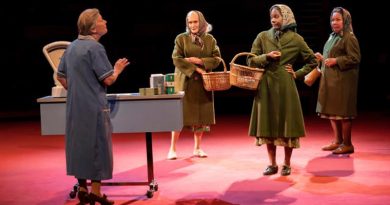
Vavara and Maria want to find some purpose to their lives. It is not clear how aware they are of the abject poverty of the peasants glimpsed onstage who are left to clear up the mess. It is a feature of Hastie’s compelling production that the servants in the house as well as the peasants outside become increasingly aggressive and hostile during the course of the play. These are the sort of people who will rise up disastrously in 1905, only one year after Summerfolk opened, and again, more successfully, in 1917. With hindsight, one can’t help wondering whether the obnoxious, hard-headed Suslov (Arthur Hughes) will not fare better in the revolution to come than either Vavara or Maria.
Nina and Moses Raine’s script, which loses nearly an hour off the original, is peppered with curses and anachronisms as if to draw a comparison between then and now. It is also extremely funny at times, far funnier than I remember Nick Dear’s version being for Trevor Nunn’s production, also at the National in 1999.
This is the first new production of Indhu Rubasingham’s regime to be an out-and-out success. She chose well when she picked Hastie to be her deputy. At just under three hours, the play is not short, but it’s surprising how quickly time passes while watching Hastie’s engrossing production.