Bloodsport: After Helen of Troy by Ava Pickett
Jeremy Malies in East London
★★★★☆
13 September 2026
Ava Pickett is an embodiment of the Jane Austen dictum that you should write about what you know. And what Pickett knows (her true worldview is of course cosmopolitan and urbane) is Essex. So it should be no surprise that she sets the aftermath of the Trojan Wars on the county’s approximation to a sunshine coast. The focus of the play is Clacton which could not be more topical in terms of civil war but that is accidental since the writing process dates back to the early 2020s.
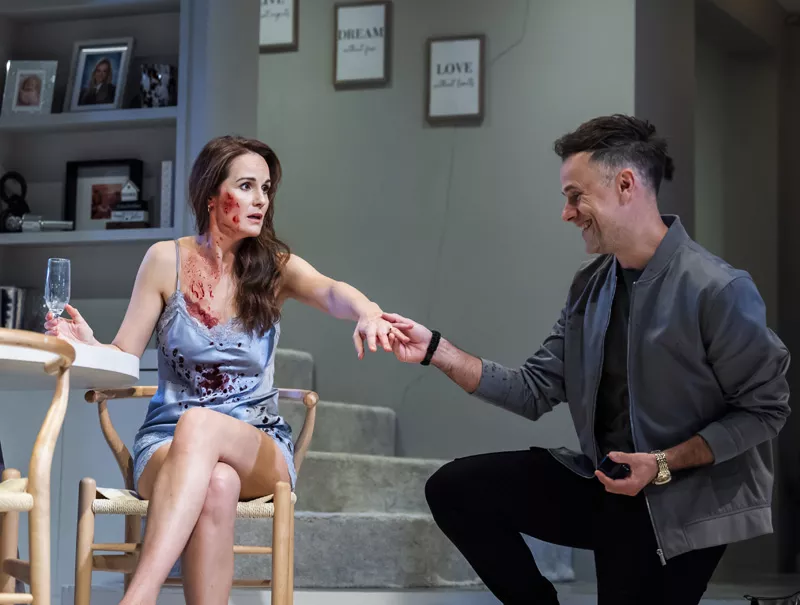
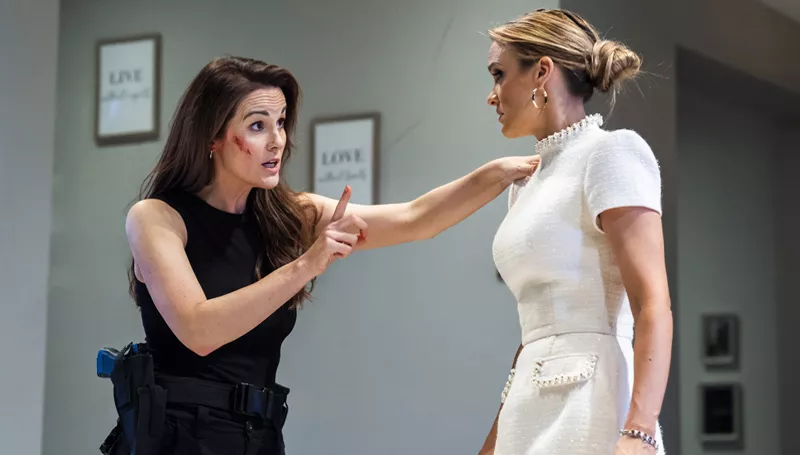
Michelle Dockery and Jay Taylor.
Photo credit: Pamela Raith.
This play is nowhere near the equal of 1536 but still riotously funny. The narrator of the play – he is styled as Messenger but explains things in between acts like a Greek chorus – is Ethan Moorhouse. And Messenger seems to recoil from the general reek of Sparta with its happy hours in J.D. Wetherspoon, rancid kebab shops, and lashings of Paco Rabanne worn by muscle-bound army generals who are calling the shots while drinking shots of Archers and lemonade.
Messenger has an interesting variation on the genesis myth in which Zeus unfolded his hand to simultaneously create the Thames Estuary and routes for budget airlines to spin Arachne-style webs of contrails out of City Airport.
Helen (Michelle Dockery of Downton Abbey) allowed the unseen Paris to shag her in a nightclub cloakroom so precipitating the bit of bother that was the Wars. The aftermath bubbles away in the flares exploding outside the living room of Cee who approximates to Clytemnestra and is played by Laura Aikman.
The action begins when Helen is brought home by her brother-in-law, steroid-munching Mario played by Gerard Monaco. He is the Agamemnon figure while Jay Taylor is the comparatively insipid husband, Marcus – Menelaus in the source material. Director Lisa Spirling deftly outlines what has gone before early on as Marius dusts off an old wedding ring and goes down on one knee in the hope that things with Helen will revert to how they were.
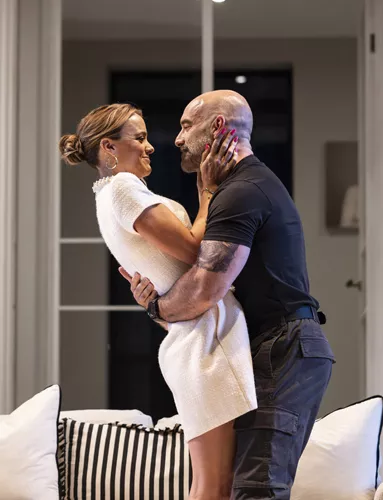
Laura Aikman and Gerard Monaco.
Photo credit: Pamela Raith.
Often given to laughing inappropriately, I cackled amid what I contend was a dead press night audience as Messenger told us that Paris got his comeuppance when being jumped in a pub car park just off the M25. And Messenger does not like this New England which is “all scorched earth and fucking oat milk”.
Pickett deals with bigger questions than superficial lifestyle choices of course though she is strong (and amusing) on things like fake tan and Botox. The large questions include the treatment of women as chattels, with Mario’s manhandling of Cee hinting at the extent of the abuse that goes on behind closed doors.
Other general topics include what makes a good mother. There is an excellent scene in which Spirling shows her directorial chops in having Emma Monnickendam as Hermione (the simpler names are left untouched) quiz Helen at length. It’s the most moving sequence of the night in which we learn that, as a sixth former, Hermione was expected to do an assignment in which the class asked their mothers about the birthing process and early bonding. “I didn’t love you enough!” brought a gasp from the stalls as a compelling Dockery delivered Helen’s explanation of putting romance and sexual attraction before family.
Pickett gives Helen speeches that freshen the perennial question of whether her beauty – even with a bit of lipo – has proved a blessing or a curse. Equally strong is a consideration of destiny and free will.
In the original, unseen Iphigenia cops it when a stag is killed illicitly and she is sacrificed to the gods so that the becalmed Mycenaean fleet can head for Troy. Here she is killed in a budget hotel in Sunderland! Laura Aikman is the equal of Dockery for intensity and fluency as she asks Mario whether Iphigenia’s killers included some of his own men.
Criticisms? Only trifling – I liked this very much. Pickett could avoid the debate as to whether Helen left for Troy willingly or not. It has been discussed for 2,900 years with Homer kicking matters off. On the subject of previous roles, I felt I heard both Dockery and Aikam occasionally reminding themselves to drop ‘h’s. Voice coach Claudette Williams might want to work on this as the run continues.
The action on stage never moves from Cee’s living room which she has got up in a limp attempt at minimalism using shades of beige. There are (no doubt) unread coffee-table travel books amid the vulgar Ikea-style accessories. It’s all of a piece for a social set where Cee serves champagne to her guests only to admit that she truly prefers Prosecco.
Set designer Polly Sullivan captures the carnage outside by having a denuded tree lean across the proscenium arch. She is also responsible for Cee’s vaguely sixties textured cocktail dress and unfussy military fatigues for other characters. Dockery may have a gift for it (it certainly has not been acquired when playing Lady Mary Crawley in Downton) but fight co-ordinator Enric Ortuno ensures that Helen is credible when wielding blades and an assault rifle.
Returning to Moorhouse as Messenger; he benefits from the often excellent cod blank verse as well as extended references to England as “She” – in other words a body or garden politic. This is a technique that Pickett used effectively in 1536. Here, Messenger echoes the political metaphor techniques in Richard II as Queen Isabel eavesdrops on a gardener discussing the state of the country. Pickett manages all this without grandstanding. I can’t be alone in anticipating her next project with relish.