“Under the Shadow” at Almeida Theatre
Neil Dowden in North London
★★★★☆
12 June 2026
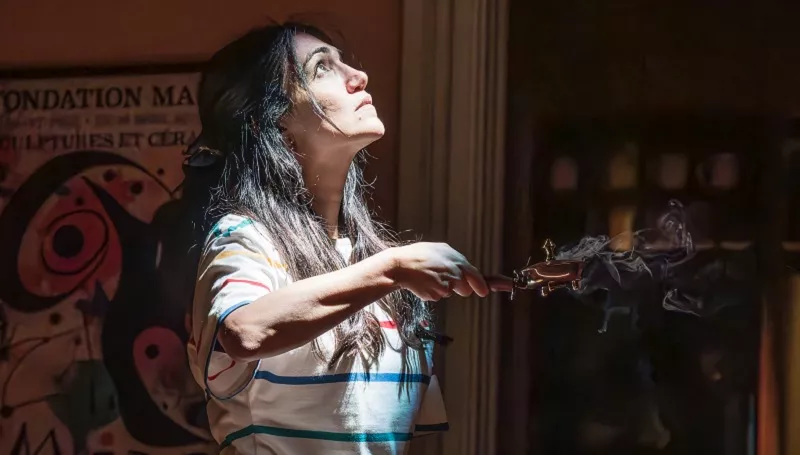
Under the Shadow has been adapted by Carmen Nasr from Babak Anvari’s 2016 British-Iranian, Persian-language film. It’s a supernatural horror story – with a feminist twist – set in Tehran in 1988 during the “War of the Cities” in the Iran–Iraq War when each country bombed each other’s cities. Horrific enough in itself, but here there is the added element of djinns – ancient Middle Eastern spirits – who travel via the winds of the missiles to menace and even possess the inhabitants of an apartment block. Its allegorical chill makes a powerful impact in Nadia Latif’s terrifically atmospheric production.
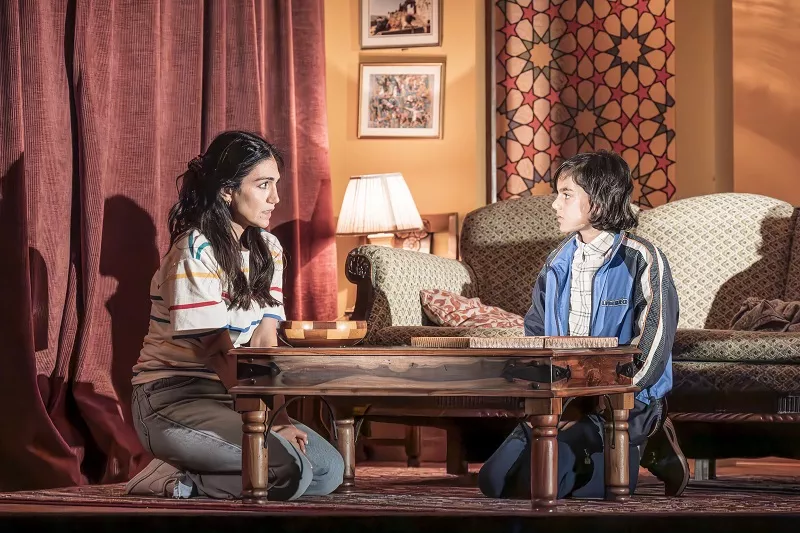
Leila Farzad and Jago Agrawal.
Photo credit: Marc Brenner.
At the outset the war seems quite far away from Tehran – present mainly in TV news reports – but that is about to change. Shideh’s doctor husband Iraj has been called away to the frontline leaving her to look after their seven-year-old daughter Dorsa. Shideh is already feeling trapped because she has just heard that she will not be allowed to return to her university medical studies, from which she has been suspended due to her political activism, while Iraj wants them to have a second child. He urges her to take Dorsa and stay with his family in the safer north, but Shideh is determined to stay and fight for her career. Then the bombing starts.
When the air-raid alarms sound, they and their neighbours take cover in a bomb shelter – but one unexploded missile penetrates through the ceiling of their apartment. After this strange noises are heard from above, then Shideh sees a monstrous shape in the shadows. Meanwhile, Dorsa’s protective doll has gone missing, and she falls into a fever. The women in the building in particular become convinced that evil djinns are present, leading to a mass exodus – leaving Shideh and Dorsa to fend for themselves.
Under the Shadow is an unusual mixture of war drama and macabre mythology, domestic conflict and sexual politics – but it works well. The djinns – which can be traced to pagan beliefs a long time before they appear in the Koran – here represent deeply pernicious strains in the society of post-revolutionary Iran. The pressures of war exacerbate superstitious fears, while already existing divisions are exploited. Shideh is forced to beg to be readmitted to medical school but is treated with disdain as a woman not conforming to the strictures of the Islamic Republic, while even her liberal husband wants her to focus just on their family. At times there is a feeling that her enforced sense of guilt may be driving her to nightmarish delusions in this twilight conflict zone.
There are subtle indications of female repression near the start when Shideh draws the curtains before watching a (presumably illicit) Jane Fonda workout video, as well as hiding a bottle of wine she is sharing with a neighbouring woman when the doorbell rings, and the way she always puts on a head covering before answering a door. And perhaps Dorsa’s anxieties are partly imbibed from her mother – who has recently lost her own mother – who doesn’t give her all the attention she wants.
Under the Shadow is yet another show in a growing trend of adapting films for the theatre, but Nasr (who wrote The Maladies for the Almeida Young Company in 2022) has done a good job with a story whose claustrophobic setting is well-suited to the Almeida stage. After a short prologue in total darkness with the sounds of war all around, it starts off in a low-key way, with even a few moments of humour amidst a fairly ordinary domestic set-up. But gradually the sense of unease and suspense is cranked up, leading to jump-scare moments under Latif’s tight direction.
Ben Stones’s impressively detailed set design shows us a normal family home with murky depths, while after the interval a missile pokes through a fractured ceiling. James Farncombe’s eerily flickering lighting amidst power cuts and Donato Wharton’s tremendous sound design of gunfire, explosions, and creepy noises immerse us in the tense drama, while illusion consultant Scott Penrose’s effects are genuinely unsettling.
Leila Farzad gives a committed performance as the beleaguered Shideh, engaging our sympathies as she struggles to cope with all the challenges and threats, both tangible and intangible. Playing Dorsa on press night, Erin Jemmotte also convincingly portrays a vulnerable girl in a frightening adult world, with Nicholas Karimi the well-meaning but pressurized Iraj. Souad Faress is a reassuring presence as the motherly Mrs Fakur. Mona Goodwin is the amusingly gossipy Mrs Ebrahimi with Rachid Sabitri as her pragmatic husband and Rohan Berry as their adopted mute child Mehdi who first whispers about djinns. Nadia Albina conveys real intensity as the increasingly neurotic Pargol who cares for her sick father played by Bijan Daneshmand (who also appeared in the original film).
Under the Shadow resonates even more today with the current war in Iran when civilians have similarly been terrorized by aerial bombardment, while women’s position in society is even more precarious. The stuff of nightmares, it’s a real-life horror story.