“Once” at Pitlochry Festival Theatre
Mark Brown in the Scottish Highlands
★★★★☆
13 June 2026
The appointment of Alan Cumming – who is truly a global superstar of screen and stage – as artistic director of Pitlochry Festival Theatre (PFT) was nothing short of a coup for the “theatre in the hills”. The return to his Highland Perthshire roots of the star of The Good Wife and the US version of The Traitors has, no doubt, generated interest in PFT among people who had never previously heard of Pitlochry or its repertory theatre.
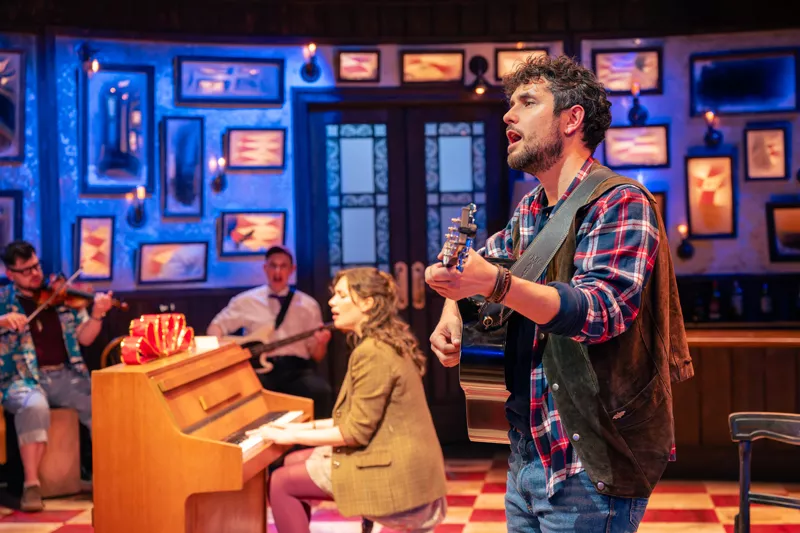
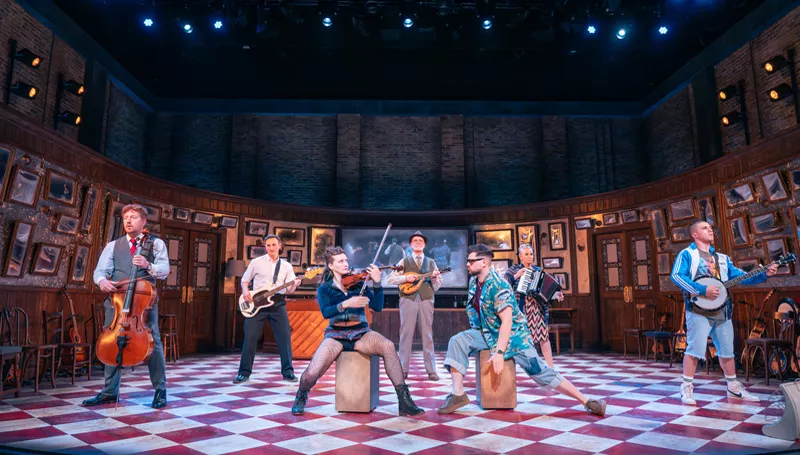
Photo credit: Tommy Ga-Ken Wan.
The playhouse – which occupies an idyllic spot overlooking the River Tummel – is, surely, among the most beautifully situated theatres in the world. Cumming’s pulling power will, no doubt, benefit the venue tremendously (a fact of which the board is clearly aware, as evinced by the almost life-sized, full-length photo of its new artistic director, seemingly mid-joyous jump, that occupies pride of place in the PFT foyer).
However – while Cumming’s appointment was a breathtaking and surprising masterstroke – it does carry a considerable logic in theatrical terms. For all his fame as a screen performer, the actor has always maintained his stage career on both sides of the Atlantic.
Cumming has returned to stages in his homeland with some regularity, notably performing in National Theatre of Scotland (NTS) productions The Bacchae by Euripides in 2007, his one-man Macbeth in 2012 and Burn (his solo homage to Scotland’s national poet) in 2022. Most recently, he reunited with Forbes Masson, Siobhán Redmond and Patrick Ryecart – his co-stars in 1990s TV sitcom The High Life – in a much-loved and uproarious stage musical version of the airline comedy.
Which is all to say that the celebrated actor’s homecoming brings much more than transatlantic glamour to PFT, it comes with a genuine passion for theatre, and for Scottish theatre in particular. That passion is expressed abundantly in Cumming’s first Pitlochry season.
The season includes: Inexperience, the latest drama by Scottish playwright Douglas Maxwell (13 June – 4 July); Lear, Finn den Hertog’s Shakespeare adaptation in which the great Scottish actor Maureen Beattie plays the titular lead (4 July – 1 August); a re-staging of Oliver Emanuel and Gareth Williams’s award-winning musical A History of Paper, starring Cumming himself alongside stellar Scottish actor Shirley Henderson (9 August – 12 September); and Samuel Beckett’s Happy Days, in which the outstanding (and aforementioned) Ms Redmond plays Winnie (18 September – 10 October). In more than 30 years of reviewing live drama in Scotland, I confess I have rarely (if ever) been so excited by a season in one of the nation’s repertory theatres.
Indeed, the tone of Cumming’s inaugural programme is set excellently by its opening show. There could hardly have been a better way to get things underway than with this restaging by director John Tiffany of his multiple Tony Award-winning Broadway production of the musical Once.
Based on John Carney’s cinematic romance from 2006, adapted by Irish dramatist Enda Walsh, Tiffany’s production opened in Cambridge, Massachusetts in 2011, before, ultimately, transferring to Broadway in 2012. Its residency in the Scottish Highlands – which is part of a veritable renaissance in Caledonian musical theatre – attests to its on-going popularity.
Set in Dublin, the piece tells the story of Guy (an Irish busker with a set of autobiographically anguished love songs) and Girl (a young Czech music lover living in the Irish capital). Guy has an estranged lover who has taken refuge in New York, while Girl is semi-separated from her child’s father, who is living back in Czechia.
Walsh plays the story with a straighter bat than might have been expected by many who are familiar with his oeuvre (Disco Pigs, The Walworth Farce, Arlington). The play – which uses the songs that Glen Hansard and Markéta Irglová wrote for the film – stays largely within the tramlines of its genre.
That said – naturalistic and heart-tugging though it is – Walsh’s stage adaptation (like Carney’s screenplay) refuses to surrender to saccharine sentiment. That is evident – not only in its touching-but-unconventional conclusion – but also in Walsh’s occasional swerves into the kind of highly original, Bible-black comedy that so often characterizes his work.
The representation of the Czech émigrés in Dublin, for instance, overflows with gorgeously tangential, off-the-wall comedy. However, it is also underpinned by a sympathetic pathos about the migrant experience of employment that would be lost on the masked, far-right pogromists of Belfast and their rioting cousins elsewhere in the UK.
Tiffany’s beautifully honed production enjoys typically bold choreography by the director’s regular collaborator Steven Hoggett. It also has splendid design by Bob Crowley, in the shape of a Dublin bar, complete with handsome wooden panelling and stained glass (on which, prior to show time, audience members are invited to purchase from a selection of alcoholic beverages).
The 10-strong cast of actor-musicians deliver the piece – including Falling Slowly, winner of the Academy Award for Best Song – with tremendous skill and energy. Dylan Wood’s Guy is heartfelt, vulnerable and charming, with just enough grit in the oyster to avoid becoming a teddy bear in human form. Lydia White is compellingly and humorously charismatic as the no-nonsense and quirky Girl.
If the leads shine, the rest of the cast follow impressively, with Charlie West, for example, marvellously daft as music shop owner Billy (who is unembarrassed to trail after Girl like a lost puppy). Allison Harding is also memorably hilarious in the role of Girl’s daunting mother Barushka.
Once is a romantic musical which – as one would expect of Walsh and Tiffany – carries a substance and an emotional undertow that are absent from many works in the genre. This excellent rendering of it gets Cumming’s tenure at PFT off to a fine start.
Until 27 June: pitlochryfestivaltheatre.com