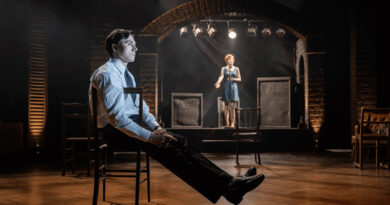
“The Abduction from the Serail”, Théâtre des Champs-Élysées
Andreas Rey in Paris
★★☆☆☆
8 June 2026
The opera is directed by Florent Siaud under the baton of Laurence Equilbey and her orchestra Accentus in a co-production with the Grand Opéra d’Avignon and the Insula Orchestra. Audiences who know and love this opera – so personal to Mozart and such a precursor to The Magic Flute as it allowed him to express humanist ideals of benevolence and forgiveness – will no doubt feel, alas, that this production is an open goal spurned.

Photo credit: Vincent Pontet.
But perhaps we should begin with the strong elements of this production? Romain Fabre’s design features white background elements against a wall of open triangles. These are torn by a large, deep blue gash. The approach illustrates, with much clarity, how the closed world of the serail is opened up by an “elsewhere”, a “further away” with the idea of deeper aspirations. This idea is embodied by the two Oriental couples, and further more from the world made rigid by a forceful order through an impulse that is both profound and more human, with Pasha Selim’s permission for the two couples to leave this environment.
The audience may, perhaps due to the approach of the French director, perceive a sort of passive resistance by the women during the scene where Blonde stands up to Osmin, and when Konstance confronts the Pasha. But otherwise, it needs to be said that neither the protagonists’ faces projected onto the stage curtain by video designer Eric Maniengui nor Samuel Hercule’s sound add anything to the production.

Photo credit: Vincent Pontet.
It should also be said that the acting is often too broad brush, notably that of tenor Brenton Ryan as Pedrillo whose constant clowning almost makes one forget the character’s mischievousness, an aspect that is a foreshadowing of similar qualities in Figaro and, above all, Papageno. Unsubtle acting becomes increasingly irritating as the drama unfolds or even neglected as in the cases of sopranos Jessica Pratt as Konstance and Manon Lamaison as Blonde. Samoan tenor Amitai Pati as Belmonte fares relatively well but this only serves to highlight the shortcomings of his colleagues. The performance of the German actor Uli Kirsch as Pasha Selim, the only non-singing role, is also adequate, but lacks any great creativity and consequently ends up being part of background activity. The comic antics of the Croatian bass Ante Jerkunica, meanwhile, seem somewhat exaggerated at times but overall he is more natural than the others.
Unfortunately, the disappointments do not end there. It needs to be said that under Equilbey, the orchestra do not do justice to the verve and sparkle of Mozart’s score nor do they find its delicacy. Problems begin right from the overture during which the percussion and flutes, playing the Turkish motifs, sound heavier to the ear than the strings which are presenting the oriental motifs. Problems continue throughout the Singspiel with a lack of vivacity and charm; one is tempted to say a lack of life. These issues combine to deprive the orchestra’s playing of any real interest.
And what can one say about the voices? It isn’t until the final phase of the piece that they finally begin to coalesce. But between the lifelessness of Pratt’s metronomic technicality, Pati’s lack of vocal brilliance, and Manon Lamaison’s sometimes incomprehensible German, the first half of the show proves a struggle. The clear, articulate and distinct singing of Ryan and Jerkunica could have stood out, but the former’s over-the-top acting and the latter’s forced comedy spoil just about every notable incident. Not to mention that the balance with the orchestra is often to their disadvantage and that the chorus, in its meagre headcount, fails to captivate the listener either primarily on the grounds of a lack of conviction.
Ultimately, this production lacks life, sparkle and naturalness. In a word, it lacks … Mozart.