“Arcadia” at Tom Stoppard Theatre
Jane Edwardes in the West End
★★★★★
2 July 2026
When Tom Stoppard died last November, only two months before this production opened at the Old Vic, director Carrie Cracknell must have felt a heavy responsibility. Arcadia is widely believed to be Stoppard’s greatest play and the last thing that anyone would have wanted was a mediocre revival so soon after his death. There was no need to worry. Her production sensitively celebrated the playful, moving, and intellectually challenging nature of the play as it ingeniously shifts between the 19th and 20th centuries. Now it has deservedly transferred to what was the Duke of York’s Theatre and which has now been renamed Tom Stoppard Theatre. Hurrah!
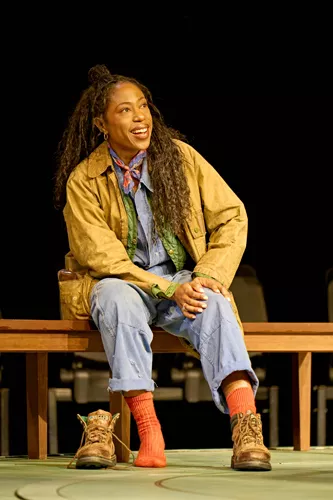
Nikki Amuka-Bird as Hannah Jarvis.
Photo credit: Manuel Harlan.
Recent productions have shown that Stoppard’s early plays are not as emotionally arid as previously thought, but they can’t compare with Arcadia in which we become deeply invested in the child prodigy Thomasina and her quick-thinking tutor Septimus Hodge. Some of Stoppard’s plays can feel like a succession of dazzling scenes, but here we are eager to know what happens next.
Like all recent productions at the Old Vic, Cracknell’s was set in the round, in the schoolroom of Sidley Park where all the action takes place in 1809, 1812, and 1993. Almost inevitably, the in-the-round setting is more tokenistic in the West End. A few people sitting on the stage does not provide the same intimacy for all, especially if you are sitting in the back of the stalls.
There can be no walls to witness both past and present, but instead designer Alex Eales has focused on Stoppard’s theme of time past, time present, and time future in which our universe will cool down to the point of extinction (quite hard to imagine currently!). The stage revolves as if echoing the movement of the planets, lights hang down from the ceiling, and two giant ellipses overlap above the stage. Isis Ainsworth’s Thomasina reaches for the stars at both the beginning and end of the play.
A few cast changes have been made since the Old Vic. Nikki Amuka-Bird takes over as Hannah, who in 1993 is exploring the death of classicism and the emergence of romanticism as symbolized by the hermitage that was built in the gardens of Sidley Park. To a somewhat elusive character, Amuka-Bird brings considerable warmth and humour. Her sparring partner Bernard is played by Oliver Chris, who is a bundle of narcissistic energy, a highly motivated academic who sees scholarship as a competitive sport and should have “God I’m Good” (he’s not talking about morality) inscribed on his gravestone.
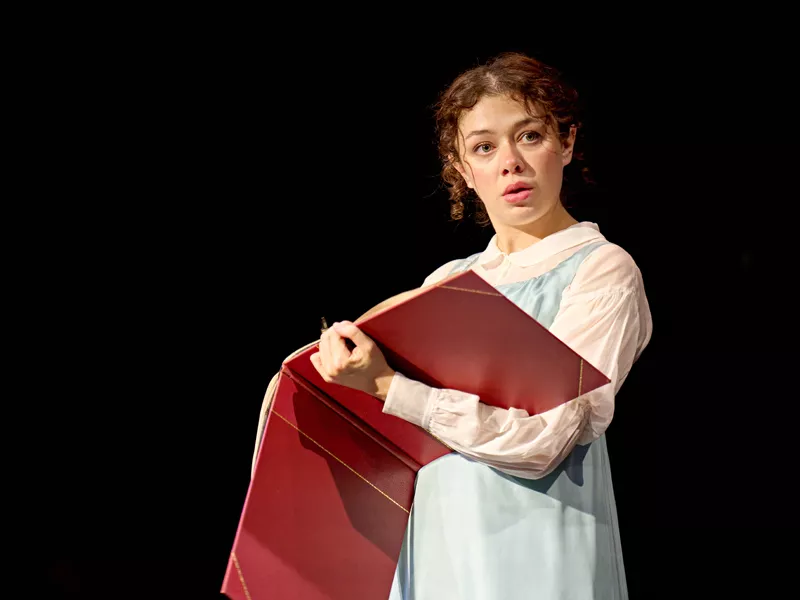
Isis Ainsworth as Thomasina.
Photo credit: Manuel Harlan.
In the 19th century, Yolanda Kettle is now an elegant Lady Croom, the cool, sardonic lady of the house, whose sexual adventures are possibly designed to punish her husband (who we never see) for destroying the calm, classical beauty of their estate and transforming it into what she considers to be a gothic nightmare.
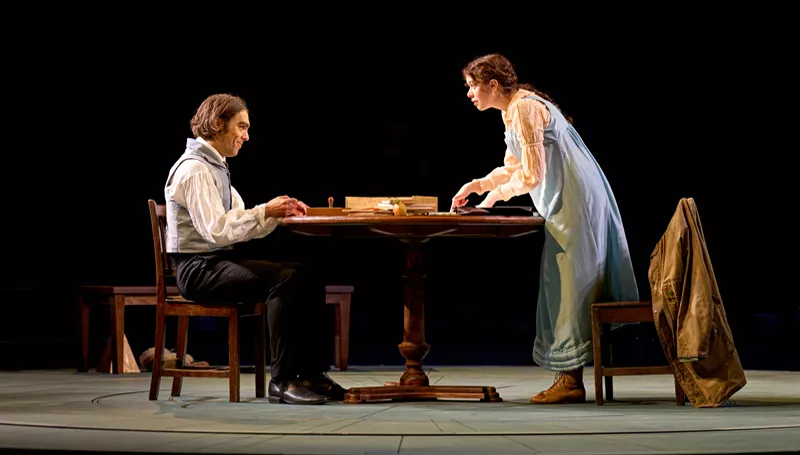
Although there are some mysteries that remain at the end of the play, the audience is mostly in the privileged position of knowing what Hannah and Bernard are desperate to find out. In the dazzling first scene, Thomasina and Septimus’s studies are interrupted by the ludicrous Ezra Chater (a beautifully judged performance by Matthew Steer) who has discovered that Septimus has had sex with his wife in the gazebo and is demanding satisfaction. By appealing to his vanity, Seamus Dillane’s engaging Septimus mollifies Chater to such an extent that by the end the poet is inscribing his latest book to him, one which Septimus is about to lacerate in a review. The circumstances of the duel, and whether Lord Byron the poet could have been one of the protagonists, is what consumes Bernard, little realizing that the truth is even more bizarre than anything he could imagine.
Sex, the great disruptor and opponent of determinism, initially appals the young Thomasina who is more interested in exploring ideas that are still being studied by Valentine (Angus Cooper), one of her descendants in the 20th century who has inherited her scientific brain. Discussion of iterated algorithms and Fermat’s Last Theorem has given the play a reputation as being challenging. It can be difficult to follow, particularly when Valentine is explaining the nature of his work with the house’s game book to Hannah. But Hainsworth is disarming as the gauche young girl who is preoccupied by such mysteries as why you can stir jam into rice pudding and not out of it, and how there must be an equation for nature’s leaves as well as for crafted cabinets. If computers had been invented when she was alive, she would have discovered the formula that was eventually pinned down more than a hundred years later. It is devastating when Hannah casually mentions that Thomasina died in a fire on her 17th birthday. Suddenly the red sash on her dress becomes horribly prescient.
There are echoes that carry through from one period to the next throughout the evening, from the tortoise that might have survived with a change of name, to the apple that the non-speaking, intuitive Gus (Matthew Doswell) gives Hannah, the leaf of which is examined by Thomasina. But gradually the two periods become increasingly intertwined, until finally Septimus waltzes with Thomasina on one side of the stage, as Hannah waltzes with Gus on the other. For a play that is full of big themes, it is also scrupulously concerned with the tiniest of details. I saw and cherish the memory of Trevor Nunn’s first production in 1993, but Cracknell’s is no less impressive and will no doubt be remembered with equal enthusiasm.