
“Endgame”, Pleasance at EICC, Edinburgh
Mark Brown at the Edinburgh Fringe
★★★★☆
30 August 2026
In the midst of the cultural sprawl of the Edinburgh Festival Fringe, it is easy for a really good Beckett production to be overlooked. No-one wants to spend their hard earned cash and their precious time on a half-baked, semi-professional stab at an opus by, arguably, the greatest dramatist of the twentieth century.
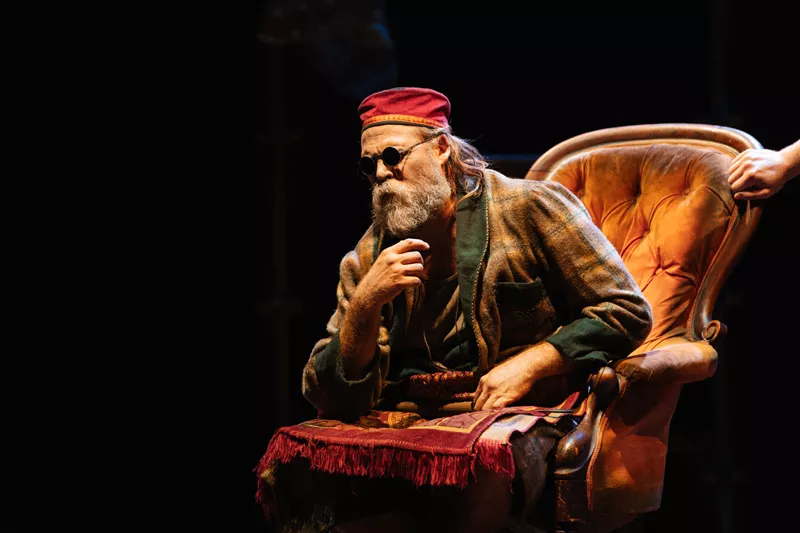
Henry Maynard as Hamm.
Photo credit: Michael Lynch.
So, unless one knows the producing company to be people of seriousness and ability, it’s easy to skip over a Krapp’s Last Tape or a Happy Days as you browse the Fringe brochure. Thankfully, among many theatre lovers, the name of English company Flabbergast carries a premium.
Innovative, experimental, deeply interested in the theatrical paths taken by such great practitioners as Jerzy Grotowski and Jacques Lecoq, Flabbergast arrived at this year’s Fringe following a tour of their stunning take on Shakespeare’s Macbeth. Like the company’s take on “the Scottish play” – which is visceral, musical and clearly the product of serious exploration – their Endgame (which ends its Fringe run today) achieves an admirable combination of nuance and robustness.
Directed by the company’s artistic director Henry Maynard (who also makes for an excellently imperious – yet subtly vulnerable – Hamm), this is an intellectually, psychologically and emotionally compelling staging of a play that is often described as Beckett’s favourite among his own dramas (in fact, he said it was the one that he “disliked the least”).
Endgame is played on a set which – with its two windows placed high above the action to the left and right of Hamm’s central position – has been compared to the interior of a human skull. We soon learn from the dialogue that the authoritarian Hamm (who is blind and cannot stand), his servant Clov (who cannot sit) and Hamm’s parents, Nagg and Nell, (who are literally legless and live in a pair of ashcans) are playing out their existence in a post-apocalyptic world.
Clov is instructed regularly to mount his ladders and survey the exterior scene, as Hamm seeks confirmation that it contains nothing but desolation and death. I have never felt comfortable with Anglo-Hungarian theatre theorist Martin Esslin’s definition of this (and other Beckett scenarios) as “absurdist”.
Jean Genet, Eugène Ionesco and Edward Albee – alongside whom Esslin placed Beckett in his pantheon of “absurdists” – explored human life through a series of absurd, even surreal situations. By contrast, Beckett’s plays are more concerned with an excavation of the existential conundrum of our universal condition.
The profundity and the bleak, Vaudevillian (as opposed to absurdist) humour of this are expressed memorably in Flabbergast’s production. For instance, Simon Gleave’s excellent Clov (taking his lead from the metatheatrical jokes threaded through the play) offers the audience a wry, restrained expression of music hall self-congratulation upon completion of a simple task.
Is there a cultural-political dimension to Clov – who is more palpably resentful of his servitude than we often see him – being played with an Irish accent? Certainly, Maynard’s domineering, self-regarding Hamm is decidedly of the English upper classes.
Assisted by movement director Matej Matejka’s fine, thoughtful choreography, the entire cast – including Derek Elwood and Annabel Arden as the pitiable, yet darkly funny, Nagg and Nell – give performances that are bolder, more confident and, paradoxically, more nuanced than we tend to see in British stagings of Beckett. Flabbergast simply do not make run-of-the-mill productions, as is evinced by this respectful-but-innovative Endgame.