“Electra/Persona” at the Lyttelton, National Theatre
Neil Dowden on the South Bank
★★★☆☆
4 September 2026
Electra/Persona is a fascinating if flawed hybrid by Australian auteur Benedict Andrews after Sophocles and Ingmar Bergman. This new play is a multi-layered mash-up of the classical Greek tragedy and avant-garde psychodrama movie that explores personal identity and role-playing. Unlike Ivo van Hove’s Toneelgroep Amsterdam production of Persona staged at the Barbican in 2017, which was presented as a double bill with an adaptation of Bergman’s TV film After the Rehearsal (linked only by their theatrical connections), this work attempts a fusion with multiple references to Electra (and even some repeated lines) in the succeeding Persona. If this daring experiment doesn’t quite come off, it’s still a compelling piece of theatre that boasts stellar performances from Cate Blanchett and Nina Hoss in alternating roles.

Nina Hoss and Cate Blanchett.
Photo credit: Monika Rittershaus.
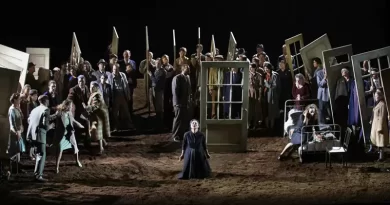
The show is given an extra edge at the outset as a member of the audience in the front row is asked to flip a coin to decide which parts are played by Blanchett and Hoss (both wearing black tops and trousers, barefoot, with fair hair pinned back). This is by no means a new idea of course but it fits in with the recurring theme of duality, and adds tension to the drama that all takes place on Magda Willi’s monumental flight of wooden steps that suggests an ancient tiered theatre.
On press night, the shorter Electra section features Hoss as Electra and Blanchett as Clytemnestra, with each daubing their face with white chalk in a nod to the Greek mask. The tragedy begins with an extended guttural cry from Hoss. It’s a love/hate, daughter/mother relationship, with Electra traumatized by the murder of her father Agamemnon at the hands of his wife as, carrying a hammer, she thirsts for a revenge that goes against the grain of her nature.
The climax is a crime re-enactment in which the protagonists dress up to play different roles. At their mother’s insistence, Electra puts on Agamemnon’s military jacket while her younger sister Chrysothemis wears a pure white dress as their eldest sister Iphigenia to replay her sacrifice made by their father in order to go to war with Troy. Clytemnestra (garbed in her husband’s fur coat that she wore to his funeral) acts the part of a loving wife before murdering Agamemnon in his bath. Electra then puts on her brother Orestes’ tracksuit top as she (vicariously) kills her mother’s lover Aegisthus (spitting fake blood onto his face) before attacking Clytemnestra herself. It’s a kind of dramatherapy in which the characters – like us – come to understand their different perspectives. But there is also a surprising amount of humour with all three knowing how to press each other’s buttons.
We then see Hoss’s Electra stop talking mid-performance when (after a pause while the set is cleaned up) she morphs into the selective mute actress Elizabeth being looked after by the nurse Alma (Blanchett) as we move into the Persona part of the show. As in the film, it explores Jungian persona as social mask. This apparently caring relationship descends into a psychological power struggle with Alma’s need to fill the silence with her own words being used by Elizabeth in an almost vampiric way, suggesting an actor’s feeding on people around them for their art. For much of the time Hoss points a video camera at herself so that we see on a screen her facial reactions enlarged, though later Blanchett becomes the focus. The characters’ fluid identities start to merge as the drama intensifies, so that finally with the use of two cameras their faces blend into one in imitation of Bergman’s famous image.

Cate Blanchett and Nina Hoss.
Photo credit: Monika Rittershaus.
Using a live video feed works well here as another layer of performing, showing Elizabeth’s expressions even when she has hidden herself under a coat (though following the two protagonists backstage on camera is becoming a bit of a theatrical cliché). Andrews has updated some elements of the story such as substituting a reference to the Vietnam War for war in the Middle East and having Elizabeth use a smartphone rather than a letter to message the doctor about Alma’s sexual orgy and abortion confession. He has changed Elizabeth’s (unseen) young son to a daughter in an attempt to connect it more strongly with the Electra theme of dysfunctional mother/daughter relations, while props such as the fur coat and hammer are carried over from the earlier part of the show. But it does tend to feel like two very different stories are being forced together.
If all the elements don’t completely gel or convince, it’s a typically bold venture by Andrews to rewire classic dramas for contemporary audiences. His similarly adventurous compatriot Simon Stone’s The Oresteia (now running at the Bridge Theatre) is a modern take on Aeschylus’ trilogy that includes Electra and Clytemnestra variants. Andrews has previously directed Blanchett several times on stage (especially for Sydney Theatre Company) and Hoss once (in The Cherry Orchard at the Donmar Warehouse last year) – and here he elicits fully committed performances from both actors.
Having starred as a sparring couple in the 2022 classical music movie Tár, once again the electricity between Blanchett and Hoss is notable. Blanchett is imperious as Clytemnestra, unapologetic for her killing of Electra’s father though she makes us understand where this fierce vengeance comes from, and there is maternal warmth as well as domineering frustration towards her daughter. The emo-like Hoss is trapped in an obsessive cycle alternating between raw grief and burning anger, but with moments of yearning for her former closeness to her mother. The dynamic between Elizabeth and Alma is even more ambiguous, with Hoss giving a virtuosic, almost wordless performance as an actor retreating into herself in what may be an ultimate expression of passive aggression, while Blanchett’s compassionate but vulnerable nurse movingly disintegrates into self-doubt and guilt.
There is good support from Ella Lily Hyland doubling as the more complaisant Chrysothemis who wants to “move on” from the vicious circle of family tragedy as well as distant doctor Anna, with Patrick Robinson playing both the fatally out-of-his-depth Aegisthus and the Husband longing for his wife whoever she really is.