“A Slow Fire” at Jermyn Street Theatre
David Wootton in the West End
★★★★☆
28 August 2026
The trope of the last people alive, surviving an apocalypse, has been a feature of Western literature since the Romantic period. However, it has frequented the stage only since the Cold War and the threat of nuclear disaster. Now, as humanity faces the extreme effects of the Climate Crisis, the subject seems more necessary than ever. As a result, Simon Stephens’ new drama A Slow Fire is beyond relevant in its exploration of emotions and actions that might be brought into play when managing in the aftermath of catastrophe.
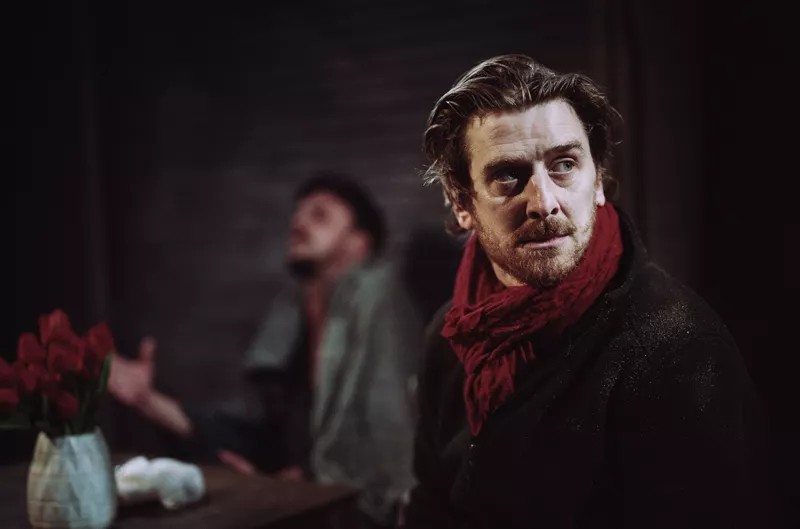
Ian Toner as Reece.
Photo credit: Alex Brenner.
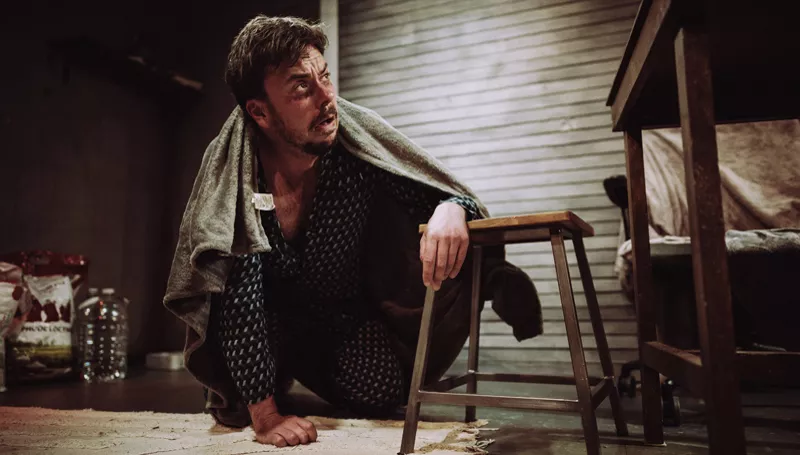
On entering the confined auditorium of the Jermyn Street Theatre, the signs of a survivalist lifestyle are strongly in evidence. In a bunker-like lock-up – with a roll-up door in the back wall – sacks of rice and bottles of water are stacked in a corner, nightlights are ranged along the skirting, while bedding is laid out on the floor (in a set designed by Andrew Clancy). This image is slightly softened by the surprising accompaniment of instrumental versions of popular songs from between the World Wars.
As the play begins, two men are sitting around a small table, deep in discussion. Initially, they seem to be on a date, and some of their exchanges are awkward and nervously expressed. Then, gradually, it emerges that they are engaged in a form of role play and rehearsing an episode in Reece’s life, with Ashton taking the part of Reece’s former girlfriend Taylor.
Soon, it transpires that this form of role play is one of their chief coping mechanisms. It allows them to relive and review their own pasts, and gain insights into those of each other, while also demonstrating mutual attentiveness, and thus respect. And yet the effect on the audience is disorientating, as it attempts to collect biographical clues while distinguishing role play from direct conversation.
Though Reece and Ashton are both dressed for the cold (in costumes designed by Migle Ryan), Reece is ready to brace the outdoors, while Ashton, wearing pyjamas beneath his peacoat, is a homebody, and, despite taking exercise, suffering increasingly from illness. Reece describes his exploration of parts of the city, so informing the content of some maps that Ashton is making. The place names that he specifies increasingly sound fictional, and again disorientating in their effect.
A contrast appears to develop between Ashton representing the theoretical and Reece the experiential, and Reece is willing to brave the uncertainties of experience. He says that he has noticed that tracks have been removed from the railway, with the disturbing implication that there are not only other survivors, but that they have their own, perhaps destructive, agenda. Yet, when Reece later questions the worth of Ashton’s maps, Ashton explains that “if we lose the ability to make maps … then we could lose the understanding of where we are in space … I won’t let that happen”. Reece may be more in tune with the immediate, but Ashton is looking ahead, and both are trying to live hopefully.
When Christmas Day arrives, they mark the three years that they have spent together. Though Reece is missing Kye, the son that he has had with Taylor, he and Ashton manage to inject some festive spirit into the occasion by singing a number by The Ink Spots and dancing together to it. Reece even invites Ashton to share his bed as “it’s Christmas” (there being some suggestion in the role plays that Ashton is gay).
The first intrusion into their domestic life occurs when Reece is out. Ashton answers a knock at the door and faces a disturbed young woman who launches into a repetitive litany. She lists things that have been burned, from the general and tangible, like paper and trees, to the specific and abstract, like the Latin language and classical music, before ending with the phrase “then Presley came”. After exhibiting some strange behaviour, she disappears.
The second intrusion is from Presley himself, who, arriving with a handgun while pleading “Please don’t kill me”, is looking for his sister Mary. But, as he also brings fresh meat, which he says is pork, and a generator, which will power their record player, he is allowed to stay. The conversations that he instigates help elucidate both the situation outside and the relationships within. However, he proves to be a catalytic figure who ultimately forces Reece to decide what he truly values.
A Slow Fire is presented at the Jermyn Street Theatre as a co-production with the Irish company Glass Mask Theatre (it was first staged in Dublin earlier this year), and is performed by a strong cast of Irish actors. As Ashton and Reece, Ross Gaynor and Ian Toner well articulate both their idiosyncrasies and their complex and touching bond. Fionn Ó Loingsigh provides a suitably uncomfortable presence as Presley, and Holly Demaine an almost otherworldly one as Mary.
The play is intriguing and absorbing, and is powerful in demanding that the audience considers what really matters to us and to our humanity when faced with extreme circumstances. Both Stephens’ writing and Rex Ryan’s direction, though generally assured, could be tightened to increase the tension. And the Irish elements of the production cannot help but suggest an even greater contribution to dystopian drama, that of Samuel Beckett. But A Slow Fire is a serious and substantial response to the burning issue of our time.