“Malory Towers” at Theatre Royal, Brighton
Simon Jenner at the Brighton Festival
23 May 2026
★★★★☆
“It’s far darker than I remembered” an audience member muttered. In fact, Emma Rice adds nothing gothic to Enid Blyton’s 1947 schoolgirl tale Malory Towers. After last year’s North By Northwest, Rice and her company seemed high on spectacle, but emotionally thinner than in their best work. With Malory Towers, Rice and her team are back on top form, reviving their 2019 hit. It plays at Theatre Royal Brighton till May 23 then tours. The range of co-producers suggests its scope: Alexandra Palace Theatre, Belgrade Theatre, HOME Manchester and Liverpool Everyman & Playhouse. This revival boasts Arts Council and other funding, signalling a deeper reach as these bodies demand.

Rice herself describes her adaptation as “a happy Lord of the Flies”, with the removal of adult authority figures. More than that, it’s a tribute to her mother from a poor family, who miraculously made it to such a school then university. Apparently innocent, there is a genuinely dark vein of the original that Rice does not have to strive to bring out. Rather, she lets it work out towards the end of the first act, and then through the second act to erupt at the end with a genuine offstage event. Conflating six Malory Towers books, Rice has seamlessly wrought a narrative lasting 125 minutes with interval.
There is singing and cabaret-like numbers, morphing from contemporary back to the 1940s and earlier with the first ensemble number, Louis Prima’s “Sing, Sing, Sing” from 1936. There is a sense of exuberance, theatrical artifice climaxing with the school production of A Midsummer Night’s Dream, and elements previously seen in Wise Children. Choreography is by Alistair David and there are new songs by Ian Ross and Nigel Lilley, with some of these tailored for the cast, with numbers addressed to Sally the organiser for instance. (Ross’s “Hush Now! Sally”). Anchoring all this is Stephanie Hockley as Irene DuPont, the musical French girl. Buckley not only sings – mesmerizingly – in a Piaf standard (“Mon manège à moi”) but plays an upright piano downstage, directing musically.
There’s a framing device set (now) in 2026, with characters enacting their selves of nearly 80 years earlier. Cleverly it suggests a girl like Mary-Lou is knocked out by a bully like Gwendoline and in a state of unconsciousness dreams 1947, which leaves her changed. With authority figures removed, offstage Miss Grayling (the voice of Sheila Hancock) intones at key points near the opening and the end. So those school tablets are carved in sonic stone: to “be a woman that the world can lean on.” And “goodhearted, loyal women unafraid to forge new futures.” These are things privileged even over scholarship: quite a radical notion in the Clement Attlee world of meritocracy and promoting women in academia. But much of the postwar ethos indeed does seep through. And one of its traumas.

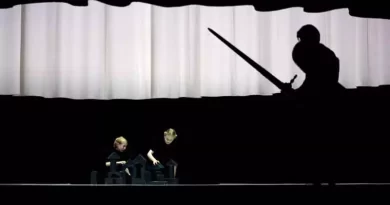
Lez Brotherston’s set is dominated by a huge arch window like a magic casement open to fairyland, augmented by some intricate lighting from Malcolm Rippeth. There is Lyndie Wright’s puppetry at certain points and Simon Baker’s sound and video design stencils everything from a moving map as the girls train it from Paddington to Penzance, to cloud-capped towers overlooking the sea. The beginning with station and moving map gives on to everything from seascapes through a violated set for A Midsummer Night’s Dream (and a restored one), to opening completely for the puppetry (the diving is a delight); and a silhouetted cartoon horse galloping over the top to the rescue. Not a little like ET on a bicycle stencilled against the moon. It’s blissfully realized, extremely tight and graphically outstanding. And from Beth Carter and Stuart Mitchell there are cartoon-enhanced animations of the dream-sequence scenes, moving towards Simon Baker’s animation of a literal cliff-hanger ending that closes the first half.
The seven-strong cast emerge in the school train – several scenes recall how much J. K. Rowling is indebted to Blyton here – where characters are established; though we have been sneaked a preview in the 2026 prologue.
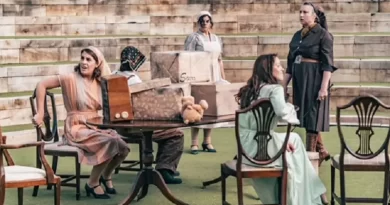
Mary Lou Atkinson is taken by Eden Barrie, perfectly inhabiting one of those shy tall people who surprisingly get bullied by someone shorter. Kev McCurdy’s fight direction provides some visceral dormitory savagery. Barrie is excellent at the almost-said, the swallowed and the finally resolute, but managing to edge this with a sense of hard-won confidence. At one point Mary Lou has to tell courageous Darrell (what a name for 1947) she is sent to Coventry and the graphics appear, synched to writing. “But I can sing” Mary Lou adds; and later Barrie indeed helms the finale: “Fairy Queen”. And they can all sing too.
Mary Lou’s antagonist Gwendoline (Emily Panes on this occasion) wields the most difficult part. Panes is horribly convincing. Self-preening, a natural star, or so she thinks, she pulses a fragile narcissism and a not-so-fragile viciousness picking on Mary Lou as the most vulnerable. Panes intimates a secret pain but Blyton doesn’t allow an easy resolution. It’s only an event off-stage after a pretty cataclysmic one onstage (for the others) that brings out what you’d never expect. It’s not predictable. Panes’ “Daddy’s Little Girl” comes with a moment of painful dramatic irony.
Alicia Johns (Molly Cheesley) also holds a secret. Clever in a creative way she launches a raft of jokes to hide an insecurity the girls (though not the audience) miss. Cheesley cracks her one-liners and vulnerability with a winning panache that never seems redundant. Robyn Sinclair’s role as Darrell Rivers lights up the dormitory and much else with intrepid gestures and convincing quick-fire temper. Vocally Sinclair is quite thrilling as the wronged righter of injustice. Sinclair manages to facially bunch up a fire as if it’s painful not to release it, but it can, with a different generous force.
Bethany Wooding’s Sally Hope whip-cracks the part of organiser, exuding the sensible child of improvident actors who can’t wait to palm her off to a boarding school. Wooding shows this has dealt its own wounds. She has to change gear abruptly as the too-controlling director till reined in.
Finally, appearing only shortly before the end of Act One, Wilhelmina or “Bill” Robinson dropping both original name and “honourable’ is a wild aristocrat who has only ever had private tutors. Zoe West towers in non-uniform jodhpurs and never relinquishes them for school wear. West enjoys a fine solo in “Thunder” – again, nearly all do – and exudes a shrill northern freedom, despite the blue-blooded lineage.
It’s been said that the Second World War brought Blyton the fame she has never since lost: adventurous escapism in a world of peril. But Blyton hit upon what others have followed. For the same reason as detective stories, even in times of peace this ideal world bounded by the limits of school – however dark Hogwarts becomes – never loses its appeal of sanctuary, working out a salvation.
Diversity of all kinds is encoded, casting following the original production’s choices. What emerges though in Rice’s vision is the warmth of the characters that this cast deliver radiantly. That is even beyond the characters’ possessing the sheer talent and brave new post-war world these soon-to-be young women will plunge into. There are sentimental moments – redeeming Gwendoline might seem to stretch things – but it’s a world we need to believe in. And it’s still an outstanding production.