Black Comedy at Orange Tree Theatre
Neil Dowden in South-West London
★★★☆☆
28 May 2026
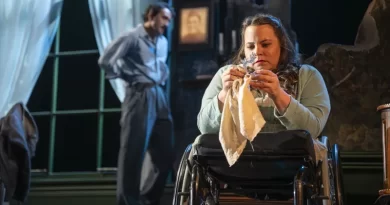
Having died 10 years ago aged 90, Peter Shaffer is enjoying a bit of a revival in the centenary year of his birth. A well-received production of Equus is currently playing at Menier Chocolate Factory, while it was recently announced that Welsh National Theatre will stage Amadeus next year (starring its artistic director Michael Sheen). Now his less familiar and much less intense Black Comedy has opened at Orange Tree Theatre. Despite its title, this is a full-on farce, in which light and darkness are inverted, rather than a work of dark humour. Caroline Steinbeis’s precisely choreographed slapstick staging goes all out for the comic jugular without trying to illuminate the play in a new way.

Photo credit: Sam Taylor.
The one-act Black Comedy was premiered in 1965 by the National Theatre in Chichester (with a starry cast including Albert Finney, Maggie Smith, and Derek Jacobi) to follow Strindberg’s Miss Julie – rather bizarrely, but presumably acting as light relief. Subsequent productions featured Shaffer’s earlier work White Lies (later retitled The White Liars) as a curtain raiser, though last time it was staged in London in 1998 it was part of an inspired comic double bill with Tom Stoppard’s equally tricksy The Real Inspector Hound. At the Orange Tree, Black Comedy is performed alone, so at 75 minutes without an interval just about an evening’s worth of entertainment – it may be short on time, but it’s long on laughs.
The topsy-turvy evening began before the show itself with the audience entering the venue through a different route from usual via backstage due to the ongoing refurbishment of the theatre. Then artistic director Tom Littler announced that the performance would start 15 minutes late because of a “meltdown” on the District line holding up so many people. But with free drinks offered to cool us down this seemed a fittingly immersive pre-show for a play that thrives on being off-kilter.
Indeed, it begins with a recorded announcement asking audience members to switch off any luminous devices including mobile phones and smartwatches as we will be plunged into darkness – making clear this is “literal not metaphorical”. Then after a moment the lights were all switched back on with a warning to those who haven’t switched off that “we can see you”, followed by complete darkness again. The comic chaos has begun.

Joe Bannister, Jason Barnett and Simon Manyonda.
Photo credit: Sam Taylor.
We hear a couple on stage talking together and getting intimate – they can evidently see each other but we can’t see them. We gather that sculptor Brindsley and his fiancée Carol have “borrowed” a neighbour’s antique furniture to embellish Brindsley’s apartment for the expected visit of a millionaire art collector interested in buying his work. But when there’s a power cut the lights come back on in the auditorium so we can see the characters while they apparently fumble about in the dark – while when a match is lit the lights dim.
The couple are soon joined by frightened upstairs neighbour Miss Furnival, Carol’s stentorian father Colonel Melkett, and the early-returning neighbour Harold from whom Brindsley and Carol have to hide the antique furniture before discreetly returning it to his apartment under cover of darkness. Just to add to the complications, Brindsley’s former girlfriend Clea turns up unexpectedly and when discovered poses as the cleaning lady. And the electrician who has come to restore power is confused with the prospective art buyer. Cue multiple mix-ups.
Written with technical virtuosity by Shaffer – in which every stage direction has to be exact – Black Comedy actually doesn’t seem to have any great metaphorical meaning in its reversal of light and dark. There is a brief mention by Clea to Brindsley that he doesn’t want to be seen for who he really is, but it’s half-baked. Laughter is the name of the game – even if at times it seems a bit relentless. This is theatre of the absurd at its most purely farcical, while the ingenious stagecraft is the sort of thing that Alan Ayckbourn and Michael Frayn later developed in their own experiments with farce.
While there is a slight sense of a more liberated younger generation moving away from the repressive social mores of the past there isn’t any real critique of sixties society. Brindsley not only seems to have two women on the go, but there is a hint that he may have had a fling with the clearly gay Harold. Then, this may have been a little risqué for Shaffer (a gay man himself) – two years before homosexuality was made legal in the UK and three years before the Lord Chamberlain’s censorship powers were abolished – but he is portrayed in a broadly camp way. And other characters are also pretty much stereotypes: the debutante-like young woman, the colonel who talks about people deserving a good thrashing, the Bible-quoting teetotal spinster who gets drunk.
Nonetheless, Steinbeis’s slick production does a good job in ensuring the cast make you believe that their characters are taking their ridiculous problems seriously – a must for farce to work. She is valuably assisted by Physical Comedy Consultant John Nicholson (co-founder of anarchic comedy theatre company Peepolykus). Simon Daw’s design features a paint-daubed stage adorned with random furniture and bizarre objets d’art as well as a staircase leading to the mezzanine bedroom and an all-important trapdoor. Simon Slater’s sound effects come into their own during dark moments, while Elliott Griggs’s dramatic lighting changes are crucial to the play’s success.
The cast have a lot of fun. Joe Bannister’s frenetic Brindsley contorts himself into all sorts of awkward shapes while secretly lugging furniture around. Leah Haile’s conventionally posh Carol contrasts with Patricia Allison’s more subversively sensual Clea. Jason Barnett plays the bullishly patriarchal Colonel Melkett, rubber-bodied Simon Manyonda the angrily upset Harold, and Julia Hills the white-faced, hysterical Miss Furnival. Chris Chilton is the German-accented, cultured electrician, while as the art collector Peepolykus’ athletic Javier Marzan finally comes on near the end to execute a perfect pratfall.