“Krapp’s Last Tape”, Assembly Roxy, Edinburgh
Mark Brown at the Edinburgh Fringe
★★★★☆
9 September 2026
It speaks to the resonance of Samuel Beckett’s monodrama Krapp’s Last Tape that we see the play so frequently on our stages. Generation after generation of experienced actors are drawn towards the deep pathos and wit of the Irishman’s famous character.
In the last two years alone, Krapps in the UK have included Gary Oldman at the Theatre Royal, York (and, then, the Royal Court, London), Stephen Rea at London’s Barbican, Ross Ericson on tour, and Peter Marinker at the Cockpit Theatre, London. The role has been taken on by many famous actors, including John Hurt and Harold Pinter.
Performances by the late American theatre in prisons pioneer Rick Cluchey (who was directed in Krapp’s Last Tape by Beckett himself in West Germany in 1977) and the late Anglo-Irish actor Michael Gambon are among the most enduring highlights of my career as a drama critic and theatre lover.
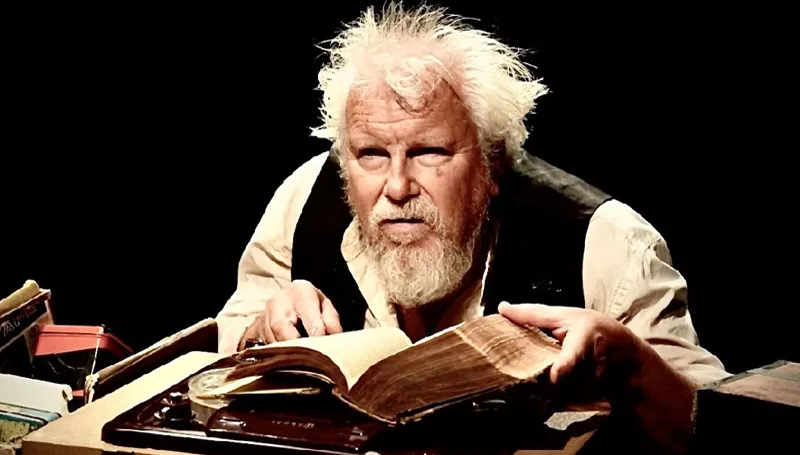
Add to the list David Westhead’s fine Krapp which recently ended an extensive run at the Edinburgh Fringe and continues touring internationally through this year and into next. Directed by American actor Stockard Channing, the celebrated English actor gives a subtle and charming rendering of Beckett’s solitary, and historically hard-drinking, character.
We encounter Krapp – who is an audio diarist – on the occasion of his sixty-ninth birthday as he sits down to make his annual recording. On this occasion, having listened to a tape of his younger self, he contemplates, with rueful humour, the man he was three decades before.
Westhead plays at a table somewhat smaller than we usually see (one remembers Gambon taking what seemed like an age to walk around his piece of furniture, as he slowly traced the indentations on the apron with his finger). Here the diminutiveness of the table makes Krapp seem larger, and the play, somehow, more intimate.
Beckett ensured, by the very title of the play, that we, the audience, would be aware of something that Krapp himself is not: namely, that the man will, at some point in the coming year, die. That, of course, adds a certain poignancy to the piece.
Westhead both resists and plays into that initial sympathy with a performance that shifts between almost violent irascibility (in an early moment of frustration, he sends a tin full of tapes crashing to the floor) and touching fondness (as in his lingering remembrance of the beauty of a young lover’s eyes).
There is a winning, crumpled informality about Westhead’s playing. However, I confess, I should have liked him to have been a little less relaxed, and a little more emphatic, in speaking what I consider to be one of the finest lines in twentieth-century theatre: “Just been listening to that stupid bastard I took myself for thirty years ago, hard to believe I was ever as bad as that.”
That said, this is a touching and memorable Krapp. The actor is always engaging in making available to us the character’s painful regrets, self-deprecating insights, smouldering passions, resistant intellect and, ultimately, his defiant “fire”.
All profits from this production go to the work of the Wembley to Soweto Foundation, a charity co-founded by Westhead in 2010, which gives opportunities through photography to deprived young people around the world: wembleytosoweto.com