“Love & Loss”, Opera Ballet Vlaaderen
Dana Rufolo in Antwerp
★★★★☆
June 27, 2026
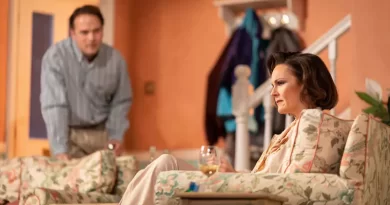
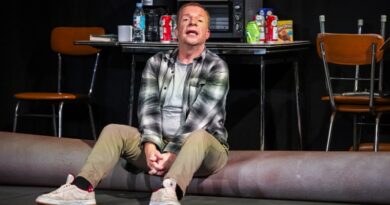
Opera Ballet Vlaanderen (OBV) again displayed its signature talent for plummeting the depths of the theatrical in their dance performance Love & Loss, composed of three distinct choreographies patterned to evoke the loss (through death) of a beloved romantic companion.
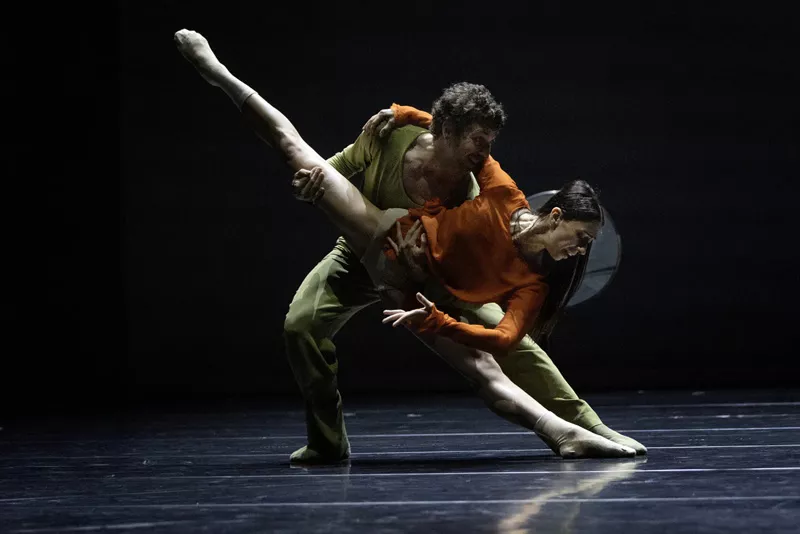
Quintett.
Photo credit: Phile Deprez.
The fusion between the theme of life’s transitoriness and the necessarily momentary nature of dance heightens the poignancy of the choreographies of Anne Teresa de Keersmaeker, William Forsythe, and David Raymond & Tiffany Tregarthen. The ache of love is palpable, especially in Forsythe’s choreography. Honouring loss by celebrating with beautiful dances is the bravest acceptance of human destiny that an artist is capable of, and these artists have committed themselves passionately and resolutely to their tasks.
De Keersmaeker’s Mitten wir im Leben sind is a dance piece accompanying Bach’s second Cello Suite which the composer wrote when his wife Maria Barbara died. Forsythe’s Quintett is a highly personal “love letter” addressed to his terminally ill wife. Raymond & Tregarthen range into the arena of the abstract and eerie with their Only Light Years Away.
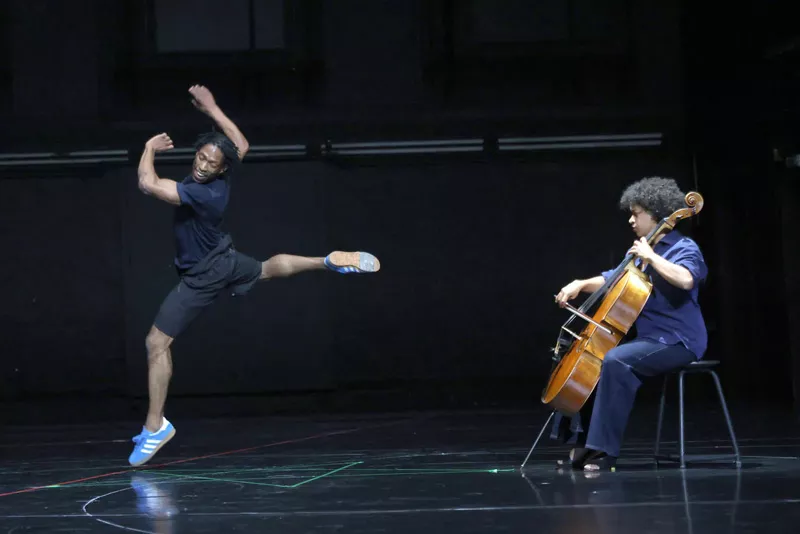
Mitten wir im Leben.
Photo credit: Phile Deprez.
In Mitten wir im Leben sind, the cellist Maria Franz sat in the centre of the stage and played the six Bach pieces as if she were in a world of her own. She was the music, and the solo dancer Philipe Lens (who was joined by Lateef Williams in the second suite) was the music made visible. The bond between instrument and dancer is a layering of the acoustic and the kinetic. Lens danced with the metronomic precision. Every movement seemed spontaneous and yet precise. He leapt vertically, moved rapidly and then arrested in movement, creating a pattern of pentagrams, circles and spirals around the cellist, never straying far. De Keersmaeker’s complex choreography is, the programme tells us, an “organization of movement in time and space on a horizontal and vertical axis”.
Presently, Antwerp’s Royal Museum of Fine Art features an Antony Gormley exhibit with the statue Field (1984-85) – a fibreglass man with extended, outstretched arms. This statue captures the spatial dimension of De Keersmaeker’s horizontal axis, and like Gormley she conceives this as the social axis. The spiritual axis, for her, is vertical. Combined and translated into a dance that is flowing and stuttering, classic and athletic, Mitten wir im Leben sind makes it seem as if Bach’s music has become alive.
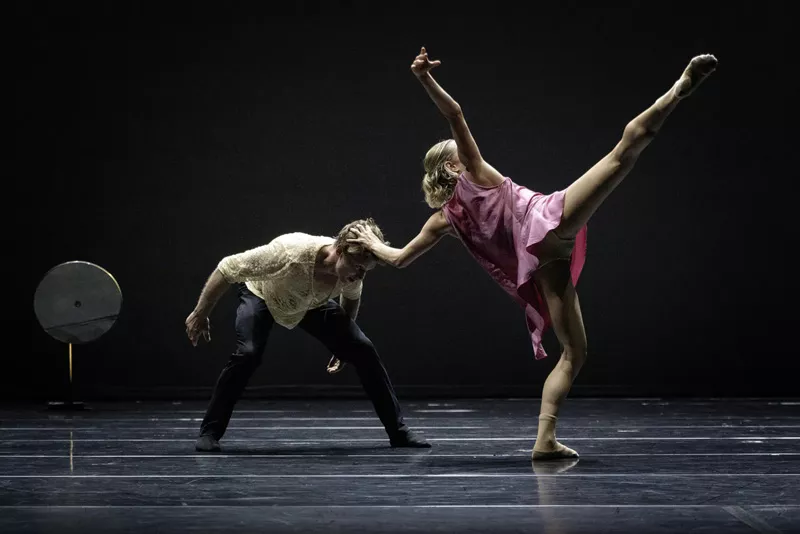
Quintett.
Photo credit: Phile Deprez.
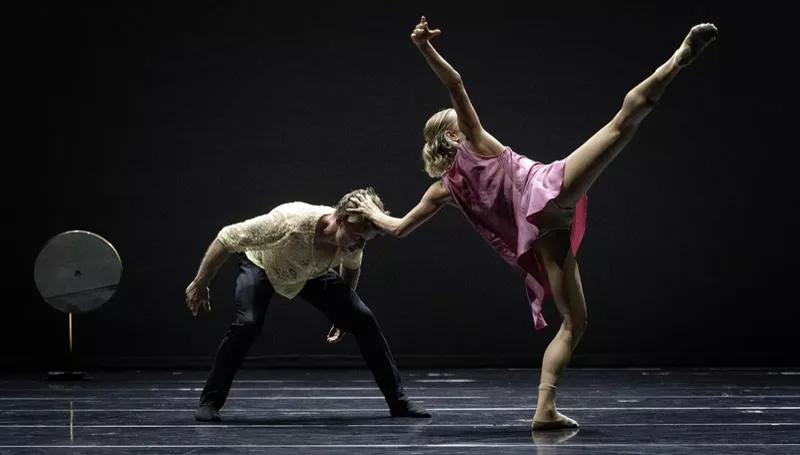
Forsythe is at the top of his form with Quintett which is fiery with emotional intensity and sensual physicality. The dancers seek to cling, even merge, with one another but they cannot and so do the next best thing which is to swirl into each other’s paths. They move in the way that teachers encourage us to imagine electrons circling the nucleus in an atom. They dance to a recorded and looped line sung by a street person in 1971, a bit of found sound that has no originator, no owner although Gavin Bryars made the recording (and the street person is represented on stage by means of a large statue of a wine bottle about to be decanted). The line is, apparently, “Jesus’ blood never failed me yet,” although what I heard, curiously, was “hold me” endlessly repeated. The three men and two women dancers developed increasingly intricate relationships with their partners as the line looped on progressively louder. The dance was dominated by the female bodies, both women being exceptionally graceful and fluid, even double-jointed, while the men remained strong and vigorous and rather more athletic than classical.
None of the dancers seemed aware of the other; the women were taken over by one or another male partner and they threw themselves into flights of dance with no resistance except occasionally a female dancer knocking away the hand of her partner. They performed duos of increasing length and complexity with the fifth dancer – one of the males – simply vanishing offstage and then reappearing. The relentless movement of time, the impossibility of freezing a moment, the hopelessness of keeping one’s self locked to another self or body – these are the themes which the colourful, emotionally moving dance made palpable.
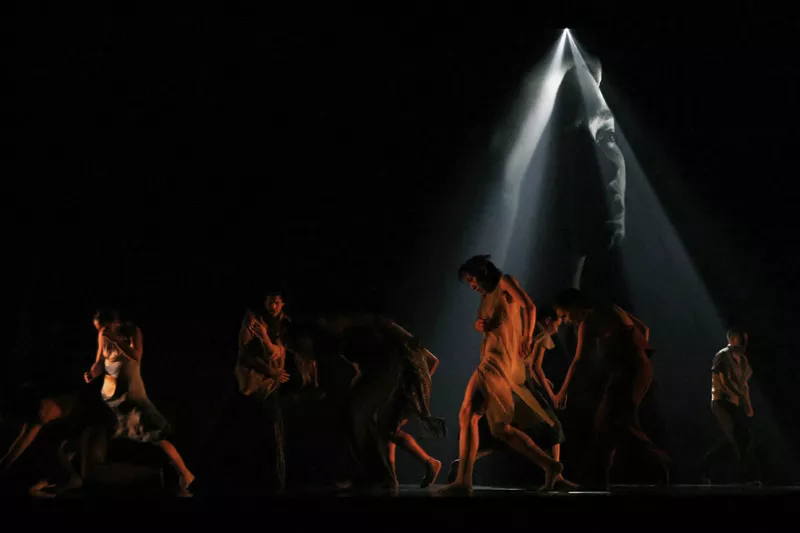
Only Light Years Away.
Photo credit: Phile Deprez.
Only Light Years Away is developed by younger choreographers who think nothing of introjecting projections and digital media into their compositions. The piece began with foghorn-like sounds snapping out of the hazy darkness on stage at twice the volume necessary to make an impression. The entire piece is shrouded in semi darkness. Black and white projections of the face of a woman, presumably dead, rotate in space – sometimes, she hides her face in her hands, and in the final part her face is covered, as if it were a candle flame being sniffed out. Spooky and weird with low, grumbling musical chords, it seemed a child’s view of death as something eerie and unnatural. The loved one is caught in a mesh of dreams by the one still alive, suspended between heaven and earth by the power of longing.
A round structure resembling the outline of a curved hill is onstage, and our first glimpse of dancers is seeing parts of their bodies coming over the mound. They group and one large dancer performs a solo; she probably represents the dead unnamed woman. Then they group together and dance as if members of a tribe. The music of the piece was an assembly of many tracks, chief among them Mot Skogen 2 by Bendik Giske. As the title suggests, the Canadian choreographers Tregarthen & Raymond tried to have the dancers embody physics principles in their movements – they fall and recover, twist and straighten, but they never attempt to fuse. There was little emotion but rather a sense of the otherworldly.