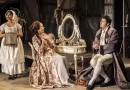
“Sunny Afternoon” at Alexandra Palace
Neil Dowden in North London
★★★★☆
19 January 2026
For those wondering “where have all the gone times gone” they are at Alexandra Palace until the end of the month. They can be found there in the Olivier Award-winning jukebox musical Sunny Afternoon, which tells the story of the early years of the Kinks in the swinging sixties featuring some of their finest songs. After its 2014 debut at Hampstead Theatre, then transfer to the West End, followed by a tour of the UK and Ireland, it’s now back on the road, stopping off at Ally Pally – highly fitting for a show about a rock band whose roots are in nearby Muswell Hill.

Photo credit: Manuel Harlan.
The Kinks have some back catalogue of course, and front man Ray Davies’s songwriting certainly stands the test of time. Joe Penhall’s book interweaves songs like the raunchy “All Day and All of the Night”, the lyrical “Waterloo Sunset”, and the social satire of “Dedicated Follower of Fashion” into an entertaining account of the highs and lows of both the band’s professional and personal lives, focusing on the complex figure of Ray Davies himself.
Sometimes the narrative seems a bit stilted and songs are shoehorned to fit into a biography that they don’t really reflect – but that is a weakness of the jukebox musical genre itself. And while the humour may be hit and miss, this high-energy, feel-good show in which multiple members of the cast sing, play instruments, and dance is irresistibly engaging.
We are shown the band in fledgling form called the Ravens before they become the Kinks, with Ray the singer/rhythm guitarist, younger brother Dave on lead guitar, Pete Quaife on bass, and Mick Amory the drummer. The song “Denmark Street” (written much later in the early seventies – many of the songs are not contemporary to the events enacted) captures the spirit of London’s “Tin Pan Alley” where so much of the popular music business was based then. Although the band signed to prominent British label Pye Records, we see a series of grey-suited, dodgy managers and music publishers who rip them off.
After a couple of flops, the breakthrough comes when Dave Davies slashes the speaker of an amp with a razor blade to create a distorted power chord sound on his guitar, with the raw rock’n’roll of the Kinks’ third single “You Really Got Me” going to no. 1 in the charts – the first of many hits. The north London working-class boys are in the big time, but success brings its own pressures – especially on Ray who is the creative spark.

Photo credit: Manuel Harlan.
Introspective and moody, he is haunted by the premature death of his older sister who gave him his first guitar hours before she had a heart attack while dancing in the local ballroom. And later his marriage fails after his wife Rasa (who sings backing vocals on some of the Kinks’ recordings) tires of his self-absorption and leaves with their two young daughters.
There is plenty of strife within the band too. We witness the Davies’ notorious sibling rivalry (with Dave resenting older brother Ray’s artistic control), an onstage fight when Amory knocks the provoking Dave unconscious with a hi-hat stand, and the stressed-out Quaife wanting to quit. After early success as part of the “British Invasion” in the States, the Kinks are banned from performing there for four years due to their bad behaviour and a dispute with the musicians’ union – only to return triumphantly at the end of the decade.
Edward Hall’s dynamic production is a riot of colour and movement, propelling the story and making the most of the set-pieces when the band perform their songs – “Sunny Afternoon” becomes a blissful celebration of England’s World Cup win in 1966, a harmonious a cappella version of “Days” is a nostalgic look back on past relationships, and the audience sing along with the sexually suggestive “Lola”. Miriam Buether’s spectacular set features three walls with built-in speakers and a recording studio booth at the back, while her radiant costumes evoke Carnaby Street fashions. And choreographer Adam Cooper has the ensemble free-wheeling around the stage to suggest the new-found release from social and sexual restraints.
The 20-plus cast create an infectious vibe. Danny Horn conveys well Ray Davies’s melancholic romanticism, as someone who finds it easier to express emotions in his music. Oliver Hoare is the unpredictable live wire Dave Davies, occasionally wearing a dress and even once swinging back on forth from a chandelier. Harry Curley plays the anxious Pete Quaife who feels sidelined, while Zakarie Stokes’s Mick Avory (who expertly performs an extended drum solo) just wants to get on with gigging. Phil Corbitt and Sorrel Jordan (on press night) are the supportive parents Mr and Mrs Davies, but Lisa Wright’s Rasa eventually puts her own family first after Ray’s lack of domestic support.
Apparently the real Mick Avory tried out the drums on stage on the day of press night. And apart from his band Kast Off Kinks (who are touring once more this year) – with the Davies brothers having surely left it too late now to reunite after 30 years – Sunny Afternoon is probably the closest you will get to seeing the Kinks play live again.