“A Masked Ball”, Festival Theatre, Edinburgh
Mark Brown at the Edinburgh International Festival
★★★★☆
7 September 2026
The 2026 Edinburgh International Festival (EIF) opened its operatic account with the brilliant and spectacular The Galloping Cure. The piece – which is inspired by Kafka’s short story A Country Doctor – is an unforgettable and righteously angry take on the catastrophic opioid epidemic that has taken hundreds of thousands of lives in the United States and far beyond.
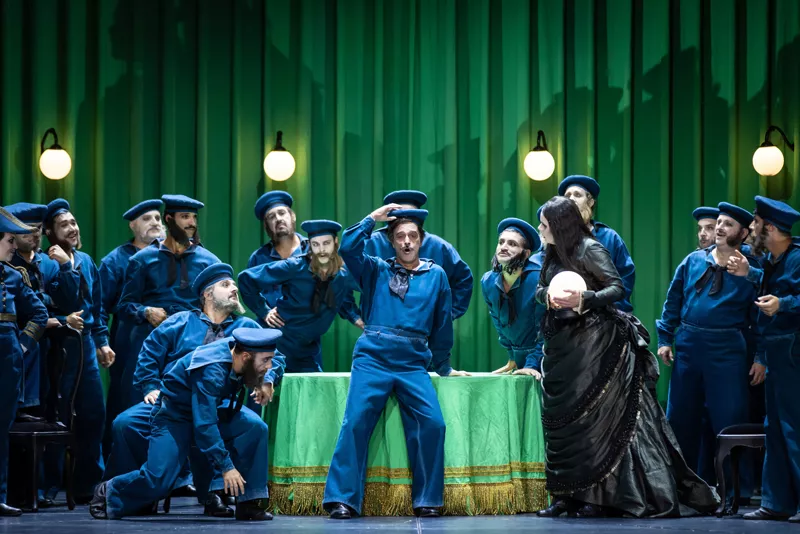
Created by Missy Mazzoli (composer), Royce Vavrek (librettist) and Tom Morris (director), the work is a credit to its co-producers Scottish Opera, Opera Ventures and the EIF. Reviewing for The Times, Richard Morrison said that The Galloping Cure is: “… one of the greatest operas of the century”. I agree.
Having got off to an almost unimaginably fantastic start, the EIF’s opera offering closed with a production billed by the Festival as Verdi’s A Masked Ball. The wording is not insignificant.
Reset from Sweden to the United States (to satisfy Italian censors) this 1859 work does not enjoy the fame of other Verdi operas, such as Rigoletto, Il trovatore, La traviata or, even, Falstaff. Hence the decision by EIF programmers to make it explicit that Un ballo in maschera (A Masked Ball) is, indeed, the work of the Italian maestro.
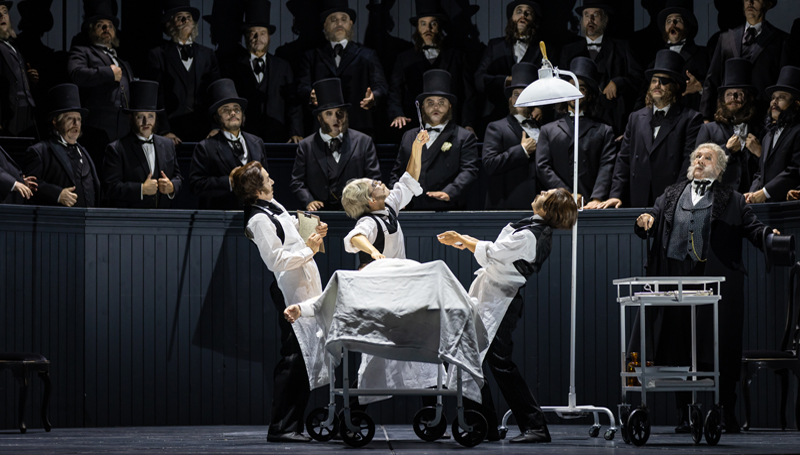
Staged (largely in monochrome) by Zurich Opera House, the piece tells the story of the aristocratic American governor Riccardo who is – in the midst of his somewhat demagogic re-election campaign – the subject of an insurgent assassination plot. This political intrigue is fuelled by the plotters’ rage about Riccardo’s allegedly murderous rise to power.
With its plotline encompassing guns and a divisive, populist American leader, the opera is resonant with our own times. That fact is underlined in the subplot in which influential people incite an angry mob in a xenophobic campaign to kick a fortune-teller out of the state.
These socio-political aspects of the story are intertwined with an anguished, tragic narrative of forbidden love and jealousy involving Riccardo, his best friend (and campaign manager) Renato and (Renato’s wife) Amelia. In director Adele Thomas’s production – which is designed strikingly by Hannah Clark and lit brilliantly by Franck Evin – the multi-faceted story is told on a marvellously utilised revolve that takes us to diverse locations, including a bourgeois drawing room, a bleak corner of the city at night, and, as per the opera’s title, a splendid ballroom.
In a drama presented in blacks, whites and greys (contrasted with occasional splashes of colour provided by the likes of flowers and ball gowns), Sardinian tenor Piero Pretti (who played Riccardo on August 29), Italian soprano Erika Grimaldi (Amelia) and Romanian baritone George Petean (Renato) give wonderfully sung, superbly characterised performances as the three key protagonists.
Polish mezzo-soprano Agnieszka Rehlis – who was advertised as playing the fortune-teller Ulrica on August 29 – had to be replaced at late notice by her colleague Okka von der Damerau. Ms Damerau gave a wonderfully vivid performance which was appreciated volubly by the Edinburgh audience.
The superb revolve assists director Thomas in keeping the tense and suspenseful narrative clicking along nicely. In addition to the excellent leads, there are fine, cloak-and-dagger performances from the singers playing the plotters, as well as from the operatic and (in the ballroom scene) balletic chorus.
In the midst of such general excellence, only a dreadful pedant would raise the issue of the slight incongruity in the scene in which the plotters meet with Renato in his drawing room. So, here goes.
Renato proposes that the men draw lots, and then empties a vase of flowers onto the floor in order to use it as the receptacle from which the men make their choices. This serves a dramatic visual purpose.
However, am I the only patron who noticed that there were perfectly good top hats in the scene from which lots could have been drawn without any need to soak and foul the carpet? This gift to nit-pickers notwithstanding, the production is as handsome and well-paced as it is dramatic.
Verdi’s score is, by turns, rousing, celebratory and poignant, and is played with nuance and, when necessary, admirable gusto by the Orchestra of the Zurich Opera House under the baton of Gianandrea Noseda. Considered alongside the astonishing The Galloping Cure, and concert performances of Mozart’s Don Giovanni and Strauss’s Elektra, this presentation of a somewhat lesser known Verdi speaks to a successful EIF opera programme in 2026.