“The Story” at the Olivier, National Theatre
David Wootton on the South Bank
★★★☆☆
7 September 2026
Written and set in 2003, Tracey Scott Wilson’s The Story concerns the world of print journalism, and examines its involvement in the coverage of the murder of a white male schoolteacher in a Black neighbourhood of an unnamed American city. In so doing, it centres on the approaches of journalists working for “Vanguard”, a newspaper’s opinion section that is devoted to the preoccupations of the city’s Black inhabitants.

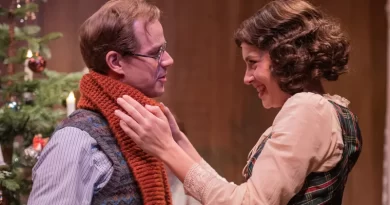
Ashley Thomas and Linseigh Green.
Photo credit: Feruza Afewerki.
Thus, while Wilson’s fast-paced thriller rehearses many of the familiar tropes of journalistic dramas, its underlying theme seems to be the specific demands made on Black working-class women. Through the personalities and trajectories of the two central characters, it dramatizes the lengths to which they may have to go to succeed in the profession of journalism, and the toll that the profession takes on them.
The ambitious young journalist Yvonne Wilson (played by Letitia Wright) is only reluctantly allocated to “Vanguard”, and would much rather work in the newsroom alongside her white boyfriend Jeff (Wilf Scolding), who is the great-grandson of the newspaper’s founder. As a result, she begins a difficult relationship with her editor Pat Johnson (Lorraine Toussaint), who has had to fight to gain her position and standing, and who has had to protect her son in print from racial discrimination. Yvonne is also wary of her more established colleague Neil Patterson (Ashley Thomas), who, all at once, admires her, is attracted to her, and sees her as a rival.
Frustratingly for Yvonne, Pat gives her the most anodyne assignments and then edits the results to limit Yvonne’s own “editorializing” and provide a positive spin on the Black community. In response, she begins her own investigation into the murder of the white teacher, and gains a scoop by identifying and interviewing the murderer. She is Latisha (Aliyah Odoffin), a Black teenager with a complex identity, who plays down her intellectual abilities so that she can fit into a gang called the AOBs.
Both Jeff and Neil question Yvonne’s account of the murder, and Pat instructs Neil to cover the story as well, initially to take a different angle and then to work collaboratively with Yvonne. However, when Latisha contacts Yvonne, she goes off to meet her alone, and that meeting sets off a series of significant but shifting consequences. Having been attacked and hospitalized, she is then lauded as the author of “Confessions of a Girl Gang Member”, an article penned partly by Pat. Then, having failed to produce Latisha, she is both arrested for the obstruction of justice and accused by Neil of being a fraud …
There is no doubt that Wilson has some great strengths as a writer for both stage and screen, and it is good to have the opportunity to see her best-known play in London. The overarching structure and many of the narrative devices keep audience members engaged and on the edge of their seats. For instance, two scenes often run in parallel, while a character, usually Yvonne, mediates between them. As a result, the viewpoints of various characters are frequently tested, and the audience is constantly called to question what it is hearing and seeing, while enjoying some fizzing dialogue along the way.
The pace and energy of the writing are matched by Clint Dyer’s production, from the perpetual barrage of projections and moving images through to the almost literal fireworks at the end. At the outset, the set, created by Anna Fleischle, appears almost too conventional for the stage of the Olivier Theatre, its wide but shallow rectangular space suggesting one end of a school hall, an allusion to the profession of the murder victim and the educational experience of both Yvonne and Latisha. However, this is soon animated, as blank windows spring into life as TV screens, and furniture and props move swiftly and with ease so propelling a sequence of short scenes. (The lighting designed by Paul Anderson and the sound designed by Benjamin Grant also make significant contributions to the staging.)
Unfortunately, in the successes of the play and production lie their problems. They are machines as much as boxes of tricks, and there is a relentlessness about them both that allows too little variety of mood or tempo, and too little emotional depth. To be fair to Wilson, in particular, this may be intrinsic to her perceived intention, that individuals are at the mercy of a harsh society, and must project various, even contradictory, facets of their personalities to survive. Also, that this reflects the fickleness and superficiality of a media culture that is more in search of the next headline than the truth. But, on reflection, Yvonne’s story is not entirely believable, and Pat’s plight is insufficiently explored. Even worse, some of the characters are little better than ciphers, notably such white ones as the victim’s widow Jessica Dunn (Antonia Bernath) and Detective Williamson (Jay Simpson).
Nevertheless, all the actors work hard to portray a population in thrall to a murder story, and those in the central roles prove compelling. Wright’s Yvonne is driven by nervous energy, and, rarely still, seems at times hemmed in by her circumstances. Lorraine Toussaint’s Pat provides a perfect foil in being a larger-than-life character who has created a carapace of competence. The costumes (designed by Natalie Pryce) are important here in contrasting the young professional (Yvonne in a discreet business suit) with the veteran editor (Pat in a flamboyant waistcoat and tie). The two women also take every opportunity to articulate a range of feelings, as when Toussaint shows Pat’s softer side when sitting with Yvonne in hospital, and Wright uses humour as a defence in some of her exchanges with Neil and Jeff (Thomas and Scolding both giving great support). If the audience is ultimately left wondering who Yvonne really is, then that is because Wright does her best to make the character and the question matter.