“A Doll’s House”, Almeida Theatre
Jeremy Malies in north London
★★☆☆☆
10 April 2026
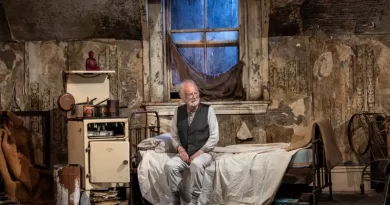
The bare brick rear wall of the Almeida needs no additions as part of the luxury apartment that Torvald (Tom Mothersdale) and Nora (Romola Garai) have rented just before Christmas knowing they will be multimillionaires come January. By then the sale of Torvald’s hedge fund business will have gone through. He will continue to work with the most lucrative clients who have been siphoned off.

Tom Mothersdale as Torvald.
Photo credit: Marc Brenner.
Design by Hyemi Shin for Anya Reiss’s radical adaptation has the front of the stage littered with bags from every major West End shop you care to name. Consumerism and credit card spending is a theme here. There is the obligatory towering retro Italian-style refrigerator and a Christmas tree that would grace Oxford Street. But there is also a hint of concern for the family; accountants must still verify figures before the sale is finalized.
Matters go awry quickly with the Christmas tree and the very title of the play here. When Kristine (Thalissa Teixeira) turns the lights on, Shin has the tree tastefully decorated with small white LEDs. “It’s very white down here!” says Dr Rank as he comes in for a Christmas Eve drink. Does director Joe Hill-Gibbins not understand that the dressing of the tree with baubles in mainstream versions of the play mirrors the objectification of Nora? She too, as a trophy wife, is bedecked with trinkets. An element that works is Nora donning a tacky Ann Summers-style plastic nurse’s uniform that Torvald has chosen for her as they go over the road for a fancy dress party.
I get it that Nora is in a state of emotional turmoil and her behaviour will tend towards the convulsive, but I don’t understand how Garai – an actor who has won a Laurence Olivier Award for The Years – can be so short on gesture and full of exaggerations that take us out of the narrative. With a few nervous tics as she asks her wealthy former undergraduate contemporaries (they can’t remember her as a student) for a job, Teixeira acts Garai off the stage. Garai does have one fine put-down moment with Kristine, saying, “You don’t have to clean. You could … type!”
Garai is not helped by Reiss’s clunky dialogue. Nora tells Torvald, “I calibrate myself to be the wife that you want!” Calibrate! I don’t mix in hedge fund circles, but I really question whether anybody speaks like that, and especially in the middle of a row. I also counted Nora using the word “cunt” five times in as many minutes. I wasn’t offended – just puzzled and eventually bored.

Olivier Huband and Romola Garai.
Photo credit: Marc Brenner.
Certain things work well: Kristine knows all about her more affluent acquaintances through following them on Instagram, and a fateful letter from the original plot becomes a WhatsApp message that sits in limbo for a crucial hour. But these are superficial elements as is the idea of a trophy wife which has been around since ancient Delphi.
It’s A Doll’s House not The Doll’s House. Ibsen chose the indefinite article. In the original, Torvald is simply a recently promoted bank manager. He is comfortable but not a mega rich hedge fund guru. Ibsen is alerting us to dozens if not hundreds of put-upon wives in suburbia surrounded by a gloom of smog, antimacassars, and aspidistras. He is standing up for them, wanting them to show backbone and have agency. So this should be political, gender-driven theatre. The historical backdrop is unimportant; Reiss could set it in the future if she wished but she misunderstands or even wilfully ignores Ibsen’s activism.
The supporting cast do well. Olivier Huband, as the wealthy and terminally ill university friend Dr Rank, manages to keep us in doubt as to whether he has in any way been intimate with Nora. There is certainly more chemistry between him and Garai than between Mothersdale and Garai. Huband evokes the elitism of this metropolis that seems based purely on money and is able to get an Uber on the North Circular within two minutes which is impressive. Does Reiss spend much time in London and actually know anybody in finance?
James Corrigan plays Nils Krogstad, Torvald’s rumpled, socially awkward colleague who has used his computer wizardry to shift money about such that he was able to lend a cool £800,000 to Nora to fund Torvald’s stay at a luxury rehabilitation centre for substance misusers. We learn that Torvald had a heart attack brought on by cocaine use. Again, I contend that this warps the play out of its true guise and changes dynamics since, as written, Torvald is simply tubercular.
Somehow, I believed that Krogstad and Kristine (they have been lovers) might have a future. The point may be that as an initially sinister presence, Krogstad pervades the whole environment, but I found it odd and clumsy that Hill-Gibbins has him invade the stalls when everybody else enters the flat from the back of the stage using a video intercom panel.
I can’t reveal the pay-off but it’s akin to the second noncommittal ending that Ibsen’s backers and guardians of contemporary morality forced him to write soon after the première in 1879. But this version is more a critique of retail spending excesses, and I was struck by Nora’s line, “We’ll pay it back in January. That’s how credit works!”
And talk about a contrived resolution that is not earned. Reiss injects a war in Syria into the plot, with Torvald learning of it from CNN on his gargantuan plasma screen. After cheering footage of bombs being dropped, he says that since the client whose funds have been stolen had taken a bullish position on oil, the missing money will never be noticed. Not in any bank or economy that I’ve ever observed!
This is an odd concept production full of directorial grandstanding in which the economically elite status of the main characters is at odds with the thrust of the original play. It struck me as a marked contrast with Rachel O’Riordan’s production of Tanika Gupta’s adaptation at the Lyric Hammersmith. Here, a decision to set the action during the British Raj with Nora as a native of Calcutta sustained the entire plot logically.
But this version is illogical and self-absorbed. And Nora is in no way left considering what might be a bleak future ahead of her, this being something that is surely crucial. And it would be more palatable if the acting were better. Lucas Hnath wrote a sequel to A Doll’s House which was put on at the Donmar Warehouse. Reiss might revisit and extend her version here in the same vein. Now there is a scary thought.