“Man to Man” at Royal Court Theatre Downstairs
Neil Dowden in West London
★★★☆☆
15 September 2026
The Royal Court Theatre is celebrating the 70th anniversary of the English Stage Company taking it over, an event that was a landmark in post-war British theatre. Just as the revival of Sarah Kane’s 4.48 Psychosis at the Royal Court last year reunited the entire original cast and creative team 25 years after its premiere there, another memorable show from the theatre’s storied past Man to Man by Manfred Karge (first staged as Jacke wie Hose in Germany in 1982) is now returning led by the same people.
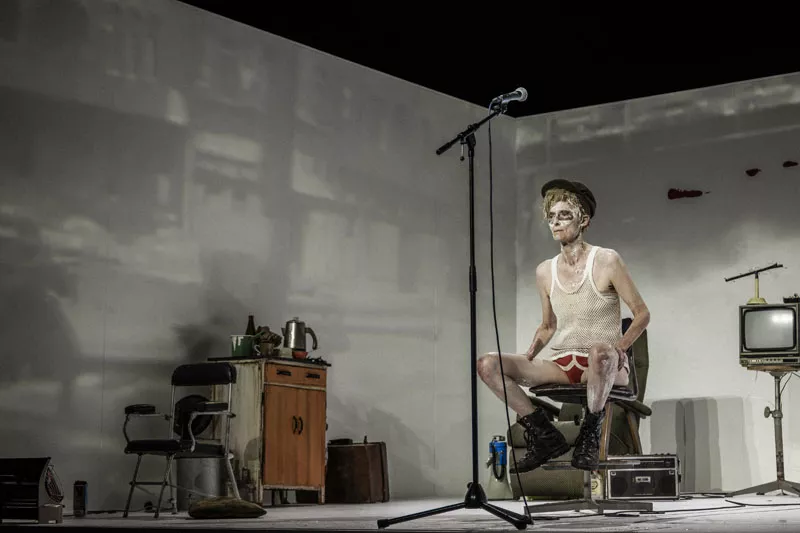
Photo credit: Ruediger Glatz.
In Anthony Vivis’s translation, revised by director Stephen Unwin, with designer Bunny Christie and lighting designer Ben Ormerod, the gender-swapping monologue once again stars Tilda Swinton. It premiered at the Traverse Theatre during the Edinburgh Festival in 1987 before transferring to the Royal Court the following year. Swinton’s virtuosic performance made her name as she rapidly became a screen icon (including reprising the role in the 1992 film version directed by John Maybury). This time the production will transfer to the Traverse before going on to the Berliner Ensemble and Lucille Lortel Theatre in New York.
Not surprisingly Man to Man shows a strong Brechtian influence as Karge’s spiritual home is the Berliner Ensemble founded by Brecht after the war and which Karge first joined as an actor in 1961 under the co-founder and Brecht’s widow Helene Weigel. Indeed Brecht’s short story “The Job” is also loosely inspired by the same true case of a desperate woman assuming the guise of her late husband to retain a job in depression-hit inter-war Germany, while Brecht used a similar gender impersonation in his play The Good Person of Szechwan.
The play consists of 28 short scenes in which the split identity of the protagonist Ella/Max Gericke mirrors the divisions within German society. It stretches from the Weimar Republic, the rise of Hitler and the Nazi state, and World War II, to post-war, communist East Germany. Karge updated it for a previous revival to include a scene about the fall of the Berlin Wall, and added another scene for this production referring to the alarming current resurgence of the far right in Germany. But the political background is rather thinly sketched. And the text with its mixture of verse and prose, songs and varied cultural references tends to be fragmented. There are no stage directions so it’s up to the director to decide how to present it and every production will be different.
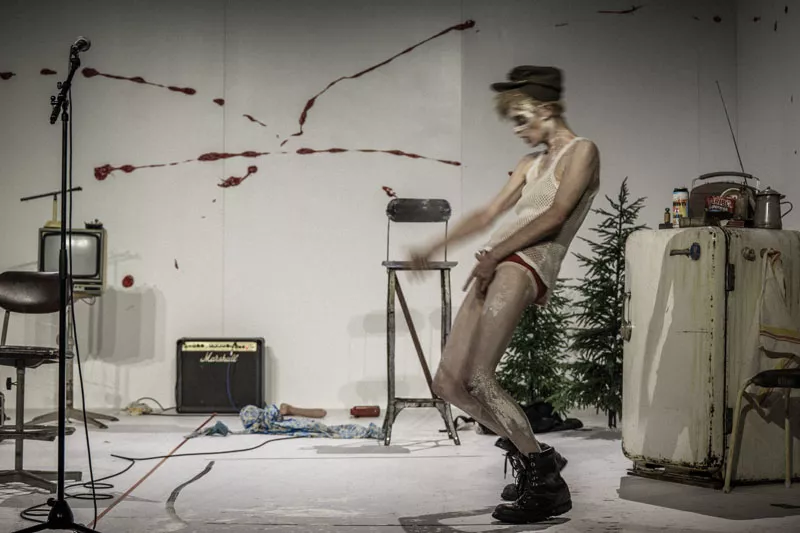
Photo credit: Ruediger Glatz.
At its centre is the widow Ella who takes on her husband Max’s job of crane operator as well as his name after his sudden death by disguising herself and behaving like a man, playing cards and drinking beer. Her initial motive is economic, but there is a growing sense that she is also exploring her own identity. Above all, like Mother Courage, she is a survivor through a tough childhood, bereavement, dictatorship, violence, and grinding poverty. Presenting as a man becomes more dangerous than being a woman when war breaks out, but she finds a dubious way to avoid being called up, and reverts to female when necessary. Any principles must always give way to pragmatism if required. “You do what you can.”
At a time when being the “wrong” identity could swiftly lead to your death, there is a chilling moment when the plight of Jews in Nazi Germany is made clear. When she initially refuses to eat a pickled leg of pork she is confronted by her drunken workmates with “Not kosher. Bet you’re circumcised” and forces herself to swallow it under the threat of “Eat or die”. The notorious maxim “Arbeit macht frei” is used with sardonic humour. In “changing” gender, Ella has to come to terms with giving up her desire to have children. But the emphasis is very much on the hardships suffered by working-class people who are the most dispensable.
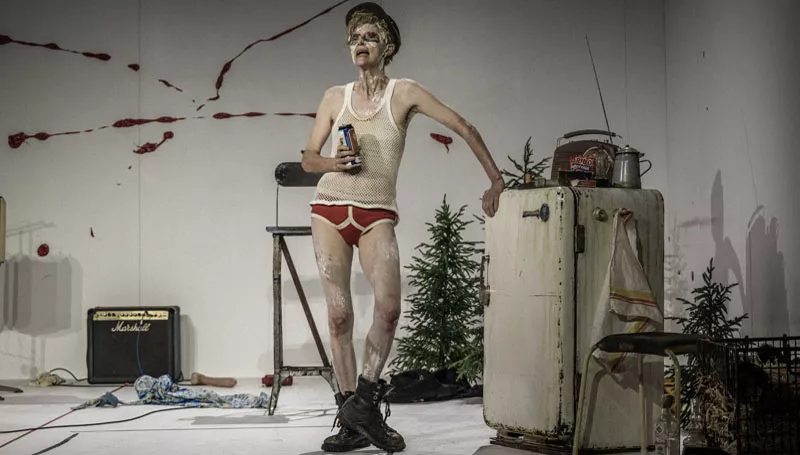
Unwin’s expressionist production – just under 90 minutes straight through – is compelling in its own way without really touching our emotions. Christie’s stylized set design features items of decaying Soviet-era furniture such as an armchair, fridge, and TV all self-consciously separated on stage almost like museum artefacts. Ormerod’s flickering lighting is augmented by Elena Peña’s disturbing sound of marching feet and Matt Powell’s hazy video design of newsreel images.
Swinton makes a triumphant return to the stage after almost 40 years (like Gary Oldman coming back after four decades for Krapp’s Last Tape, which returned to its original home at the Royal Court earlier this year), easily capturing our attention throughout. With spiky hair, face and upper body smeared with white paint, and knees bloodied, wearing just clunky black boots, fishnet vest, and red Y-fronts most of the time (despite claiming to be “Man enough to wear the fucking trousers”), she cuts an arrestingly androgynous figure as she moves with blokeish swagger. She makes an extraordinarily physical impact, swigging cans of beer (and throwing it over herself), spraying blood-red paint over the back wall, and sometimes speaking into a microphone or loud hailer in a gruff Cockney accent. It’s like seeing a great performance artist at work. Let’s hope Swinton doesn’t leave it anything like so long next time.