“Trainspotting The Musical” at Theatre Royal Haymarket
Franco Milazzo in the West End
★☆☆☆☆
24 July 2026
Choose the West End. Choose a Thursday. Choose gilt and plush and cherubs on high looking down at a syringe.
Choose to buy a ticket because it clearly comes with Irvine Welsh’s backing. Choose to see his name on the poster, the hoarding, the tote, the programme, the press release, the front of house display. Choose an author who wrote the brutally beautiful novel, then wrote the book of this musical, then co-wrote every original number, and choose wondering whether this whole misbegotten idea originated with Welsh or his financial adviser.
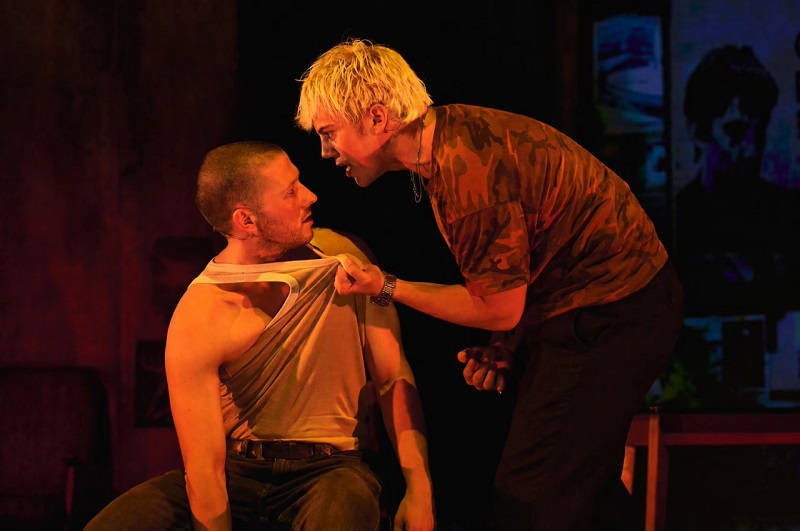
Photo credit: Matt Crockett.
Choose the images you carry in with you, the greatest hits as well as Spud’s greatest shit. Choose the baby on the ceiling. Choose looking up to the empty ceiling of a show with no crawling baby and no intention of frightening you at all.
Choose the deep nostalgia: the poster, the accents, the hallucinogenic toilet dive. Choose an audience that arrives already in love and is handed permission to be in love again. Choose recognizing the behaviour, because it is the behaviour Trainspotting has always been about in all its forms: the return to the source, the diminishing return, the willingness to pay anything for a hit that will never again be as good as the first one.
Choose to have the whole thing on a clunky, chunky metal stage. Choose lighting and transitions so frugal you navigate parts of the show by memory alone. Choose video. Choose more video. Choose projection doing the work of imagination, lending a cinematic sweep to writing that has done nothing whatsoever to earn one.
Choose no jobs. Choose plenty of gear. Choose being told both at 40-minute intervals in case you fell asleep after the last one.
Choose the musical genre roulette. Choose a bit of urban. Choose a bit of blues. Choose a four-to-the-floor boogie for the ones who came for the nineties. Choose a score that can’t decide what it sounds like because this musical can’t decide what it is, and choose the reason: choose to question why Welsh has polluted the iconic 1993 original novel many loved and read with the inferior 2012 prequel Skagboys that many didn’t, and choose the dealer’s arithmetic that follows: dilute the good stuff and you don’t get more of it; you get more of something else.
Choose the updates that are not upgrades. Choose Diane, no longer the schoolgirl who takes Renton home for a wee shag, but a serious girlfriend with a plan and a job and a junkie boyfriend as her ball and chain. Choose the parents – Renton’s, Spud’s – promoted from bit players to featured roles, bringing with them a queasy seam of sentimental wailing that runs against a story that withheld exactly that on every page.
Choose a story in which everyone walks around skint. Choose the giro, the shoplifting, the tenner tapped off a mate, the mother’s purse. Then choose the interval, and choose a tub of ice cream costing more than the paperback that started all this.
Choose a programme costing more than the paperback and the film. Choose a top-price stall ticket that costs more than the novel, the prequel, the soundtrack, the DVD, and a ticket to the touring play combined. Choose to compare it all with the price of a week’s habit in nineties Leith, and choose being honest about which of the two would deliver the stronger hit.
Choose a line-dancing number in a heroin fever dream. Choose it again in Act Two, because somebody in the building believed in it and nobody in the building said anything.
Choose reading the credits to find out who came up with that idea. Choose seeing the name of Caroline Jay Ranger, a director who has already brought Fawlty Towers, Early Doors and Only Fools and Horses to a live audience, and choose wondering who looked at that CV of Sunday-night comfort telly and thought: “Death, dealing, and desperation in druggy, thuggy Leith? Aye, she’ll do.”
Choose Iggy, Bowie, Blondie on loan. Choose Lou Reed on repeat. Choose looking at the songs taken from the film soundtrack standing beside Welsh and Stephen McGuinness’s new numbers like cool parents standing with their bug-eyed kids in a family photo, and choose noticing which ones you’d choose to hang out with.
Choose four women written for the men to slalom their lives around. Choose accents defended to the death and diction that grinds the words down into bitty syllables. Choose guessing when surtitles will appear for those coming to this raw.
Choose a company of genuinely good performers and musicians rowing hard in a boat with a hole in it, and choose saying so in print, clearly, because they’ve earned that much.
Choose the novel. Choose the film. Choose the genius immersive play that blows away this self-serving spin-off that any self-respecting Scot would likely label “pure shite”.
Choose the bitter knowledge that this musical could have swaggered on with Renton’s certainty, daring you not to look. It could have worked you like Sick Boy, all patter and cheekbones and the sense that it knew something you didn’t.
What it is, instead, is Tommy. Decent. Well-meaning. Full of promise on the way in. No real idea what it has got itself into, and is dead from the inside out long before anybody thinks to intervene.
Choose the walk to Piccadilly. Choose the night bus. Choose a thousand words by eleven, and choose the honest sentence over the cruel one, even though the cruel one arrived first and had better shoes.