“The Oresteia” at Bridge Theatre
Neil Dowden on the South Bank
★★★☆☆
17 July 2026
The Oresteia “written and directed by Simon Stone after Aeschylus & others” is the latest example of the Australian auteur’s dragging classical and classic drama – kicking and screaming if necessary – into the 21st century. As previously with the likes of Medea, Phaedra, Yerma, and The Lady from the Sea, Stone has used a highly familiar work as a starting point for his own novel imaginative journey. Ancient Greek and Roman dramatists themselves were of course recycling existing myths and legends, so in a sense Stone is offering just another iteration of the “origin story”. Although comparisons are inevitable, what matters most is if the new plays work on their own terms. The result here is uneven and at times self-indulgent, but it also features compelling, inventive theatre.
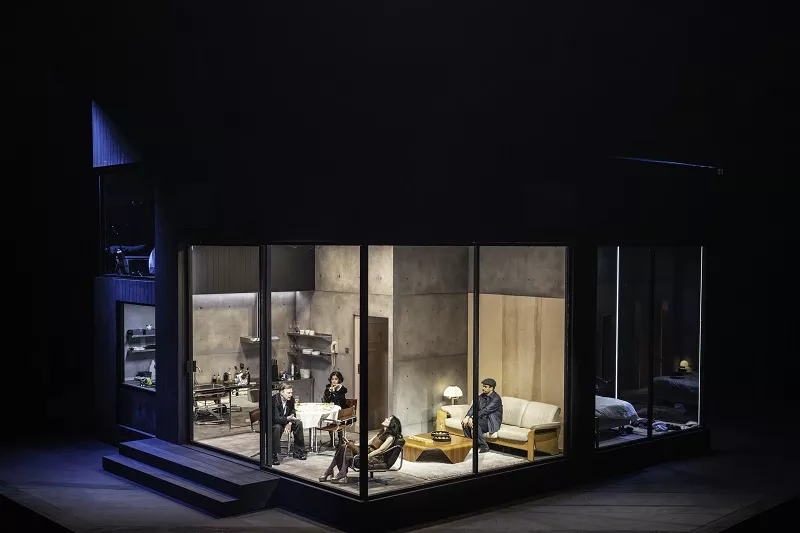
Photo credit: Johan Persson.
Stone has reconfigured Aeschylus’ The Oresteia trilogy into three acts with two intervals in a three-and-a-half-hour epic that starts quietly and slowly but ends in hyperactive turmoil. The action of the first two plays Agamemnon and The Libation Bearers is loosely given a modern counterpart, though the lesser-known third The Eumenides is more or less ignored. The show doesn’t follow the chronological structure of the original with (slightly confusing) jumps forward and backward in time, so rather than an ominous building of suspense for the violence to come there is more of a fragmented crime thriller in which we eventually find out what exactly happened. The family tragedy is not inexorable destiny in the hands of mercurial gods, but stems from flawed humans making bad decisions.
Here the House of Atreus has been changed to Middleton, while Argos is now Kent, in a play that takes place over a decade between 2016 and 2026. Although events like Brexit and Covid are mentioned they don’t have a significant bearing on the story. But the references to wars in the Ukraine and Middle East do, because – like the Trojan War in the original – however distant military conflict is the trigger behind the civil war that destroys the Middletons. The patriarch Christopher Middleton (with his elder brother Melville) runs a tech firm that has supplied equipment used by rogue states to commit war crimes. His activist daughter Isabel has protested about this, but dies in tragic circumstances that precipitate an inter-generational cycle of revenge within the family.
We don’t discover Isabel’s fate until the end of the show, but although he bears some culpability Christopher doesn’t kill her (in contrast with Agamemnon sacrificing Iphigenia to the gods to enable the Greeks’ becalmed fleet to sail onto Troy). So his wife Montie’s lethal vengeance on him here seems excessive (compared to Clytemnestra’s), while their son Augie is spurred on by Christopher’s ghost (à la Hamlet) rather than his sister Alice (unlike with Electra in the original) to murder Montie (and her lover Jerome). Portraying Augie as a victim of PTSD after returning from fighting in Afghanistan makes perfect sense of his fragile, delusional state, though an additional homicide he commits later seems gratuitous.
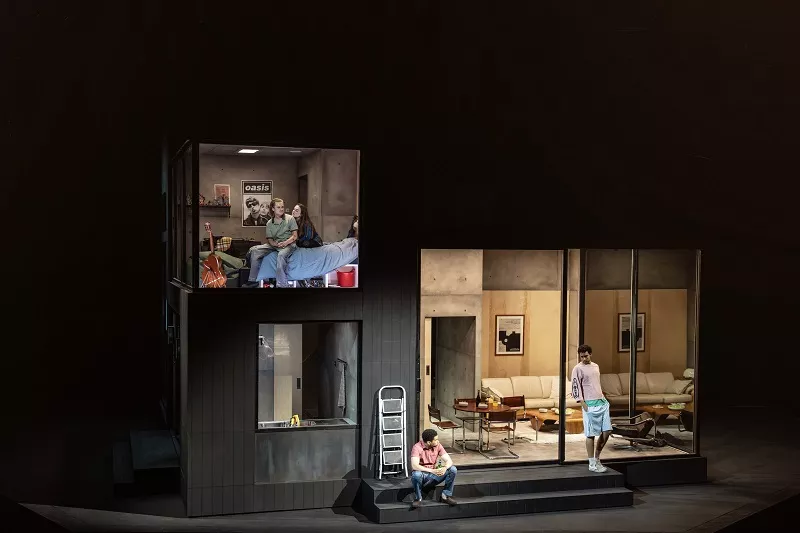
Photo credit: Johan Persson.
The first act mainly takes place before anything tragic has happened but the writing is already on the wall of the House of Middleton. We see the wealthy family in their showy home riven by divisions (and inner dissatisfaction), although it is supposed to be a day of togetherness celebrating the 21st birthday of twins Isabel and Alice. The hard-drinking Christopher rows with Melville over their business (he has stolen shareholders’ money to plug his mounting debts), while the cynical Montie and frustrated Alice mock his patriarchal heavy-handedness, and Augie is subdued – then we hear Isabel is missing. The tone is generally low-key, even humorous – more bathos than pathos – with Stone’s trademark naturalistic, overlapping speech irritatingly verbose. But when we briefly fast-forward ten years the mood dramatically shifts as we see a bloodied Augie telling a detective that he has killed his mother.
His confession (as he “re-members” the “dis-membering”) takes us into the second act which becomes much more intense as emotions become primal. The murders themselves are brutally conveyed as the family disintegrates in mind and body. By the third act, however, it all becomes too much like a slasher movie with knife-wielding figures chasing each other around the stage – while sometimes black humour undercuts the tension unnecessarily. Unlike in Aeschylus there is no final restoration of justice with chaos not order ruling in a godless world. The end brings relief – but more from exhaustion than catharsis.
As with his productions of Phaedra and Yerma, Stone stages most of the action within a rotating glass box (surely parodied in a theatrical reference in Martin Crimp’s equally freewheeling The Misanthrope currently at the National Theatre). It works brilliantly here, with occasional quick scenery changes happening unobserved as the set rotates. Lizzie Clachan’s two-tier design shows a house – like the family – divided into segments, including bedrooms, living room, kitchen (where weapons are found), and bathroom (with the bathtub early on filled with iced champagne bottles but later a corpse). The intrafamilial bloodshed besmears the whole house, as the building physically degenerates like the people who inhabit it. Nick Schlieper’s forensic lighting pinpoints the trapped characters, with Peter Rice’s discordant sound and Katrina Rose’s rumbling score adding to the claustrophobic ambience.
The gruff-voiced, guilt-ridden David Morrissey strongly conveys Christopher’s weak character. American actor Mary-Louise Parker (a two-time Tony winner) plays the role of vengeful Montie with calculated relish, her humanity crushed by grief. Tom Glynn-Carney’s sexually confused, increasingly deranged Augie cannot cope with the implosion of domestic stability around him. Rosie Sheehy raises many sad laughs as the struggling Alice whose life is going nowhere.
Lloyd Hutchinson doubles as the nasty Melville and the pursuant detective Lester (a Fury?). John Macmillan (a Stone stalwart) is an amusingly inept single father Jerome, but isn’t credible as assistant assassin, while Archie Madekwe plays his likeably laid-back son Lorenzo who unrequitedly loves Augie. Rakhee Thakrar is Christopher’s do-gooder aid-worker girlfriend Chandra with a traumatic background (like Cassandra), and Alyth Ross plays both Lorenzo’s controlling fiancée Letitia and the hapless housekeeper Jenny who – as so often in wartime – becomes a victim of collateral damage.