“The Guilty” at Donmar Warehouse
Jeremy Malies in the West End
★★★★☆
5 July 2026
What is it about Danish films that their screenplays prompt British dramatists to write plays that will outlast the original? David Eldridge’s Festen is seen by some as a more important creative work than the source material which is a film for the Dogme 95 school. Here, Chloë Moss has adapted the screenplay for the 2018 movie Den Skyldige to incredible effect in a piece that has premiered featuring Russell Tovey.
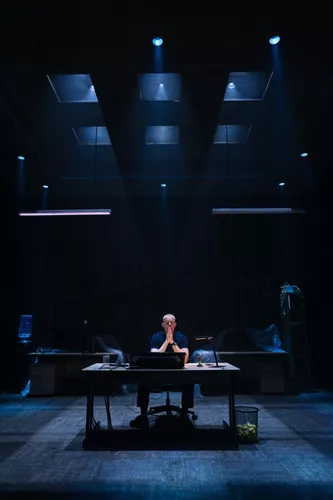
Photo credit: Helen Murray.
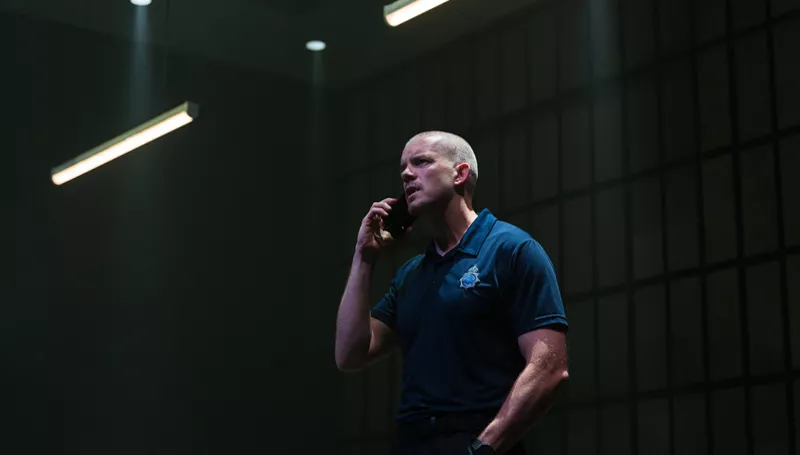
Tovey’s character, Joe, is the sardonic call handler and police asset dispatcher working (it’s somewhat unbelievable) alone in a London control room. There are clouds hanging over him. His mobile conversations with colleagues tell us that he has limited access to his six-year-old daughter after a toxic relationship breakdown and tomorrow will see him appear before a police disciplinary hearing. The second fact explains his seeming demotion from active duty.
For a piece that progresses to discuss everything from child abuse to psychosis, Moss’s monologues and dialogues are full of humour that sustains us even when matters take unremittingly dark turns. Early on, as Joe evaluates the calls, he speaks to a pushy city type. The caller is trying to disguise the fact that his laptop has been stolen by a sex worker who has been invited into his car. Another genteel type explains that her neighbours are partying noisily and asks what the police are going to do about it. Joe is quick to put her in her place. He is dismissive but somewhat gentler with an early call from a teenaged boy who is coming down from ketamine.
Director Felix Barrett, artistic director of Punchdrunk and associated with explorable environments, still displays many of his trademark approaches. Notably, he styles Moss’s text as fractured cinematic loops. Joe moves away from assessment of calls for a while to implore his estranged wife to be by his side at the hearing. This is touching in that he still values her presence and support. He may believe that they have a future together. Moss’s text sets up many parallels. The call to the control centre concerns, in part, another six-year-old girl and another breakup.
As Joe kills time by preparing an antacid drink and trying to lob scrunched-up paperwork into the litter basket, a call comes in that both interests and disturbs him. With only a few mumbled words and guttural noises, the caller, Emily, manages to tell Joe that she is being abducted. She has, cleverly, pleaded with her abductor for permission to call her daughter but in fact dialled 999.
It might have been my individual perspective (that is part of the Barrett appeal and way of working, of course) but I sensed Tovey’s own quick-wittedness, capacity for empathy, and roundedness as a human being kick in such that character and actor became one at this point. The edge-of-the-seat moments come as Joe tells Emily that he is going to ask her yes/no questions and give her list-type statements so that she can describe the vehicle she is in and where it is heading without arousing the suspicions of the driver.
Rather like the Alan Bennett Talking Heads series which creates whole worlds for us (I also thought of the Tom Hardy film Locke), the play peoples Joe’s life. Working on a canvas that is minute compared with his immersive projects for Punchdrunk (the one I know best is The Drowned Man which recreated an entire movie studio in a former Post Office sorting office at Paddington), Barrett sucks us in such that we are engrossed. On second press night, people tottered out as if shattered by the intensity of their engagement.
Barrett’s mesmeric hold on us is in part based on a set by Alex Eales and props by Robin Morgan. The first impression might be that the design is minimalist; Joe has headphones, lip mic, a desk, and two monitors. Oddly (it is deliberate and designed to catch attention) several monitors and desks are mothballed under plastic dust sheets. Is this a dig at police cuts? But there are subtle layers of detail. The props include a scarecrow doll that is so out of place and character that it must be part of game-playing between Joe and his daughter. You would guess that she has a similar one.
There is a massive twist to the reality behind the call that Joe has received from Emily and also a revelation about presentation style. Donmar staff circulated in the public areas afterwards proffering cards including the exclamation “Shh!” and pleading for no plot spoilers from theatre-goers let alone critics. Rarely have I felt so hamstrung as a reviewer, and any more detailed consideration of the form is out of the question. No doubt critics were implored not to reveal the identity of the murderer on the first night of The Mousetrap back in 1952.
Lighting by Anna Watson has huge rhomboids of white light illuminate Tovey from grille apertures while red LEDs pulse across the upper tier of seats to reinforce the impact of phone calls as they come in. Sound for the extraordinary range of effects including forced entry into two properties, various vehicles driving at pace, and a violent encounter is by Gareth Fry. Such is his attention to detail that I noted two distinct noises for screeching car tyres according to two different road surfaces.
The Donmar’s recent record with film adaptations is patchy but this is in a different league to The Fear of 13. It is impressive as a snapshot about London policing and mental health assessment in the National Health Service. There is also, I believe, a plea for more equitable treatment of fathers and mothers in terms of child custody after a divorce.
Tovey conveys his character’s relief and joy at being granted just one minute on a mobile with his daughter using a phone that is new to him after his previous number has been blocked. Of course an emergency call comes in as the pair begin to talk but Barrett’s control of the dynamics means that this does not appear predictable or unearned. Tovey shows his technical range when moving from the blokeism at the core of his dealings with male colleagues to a balanced masculinity if we are to use a vogueish expression. Empathy is at the core of this script.
Are matters at all tricksy? The big reveal has to stay under wraps for as long as this play has legs at the box office. I certainly could not get my head round the lack of realism in the set design but with unrivalled resources available to the Donmar and extraordinary talent within the technical creatives, this is a conscious decision that suggests Joe’s own perception of reality is a little warped. But it’s a staggering fusion of virtuoso acting, naturalistic dialogue-monologues, and Barrett’s command of the microcosm he creates.