“Cock”, Luxembourg City
Dana Rufolo in Luxembourg
★★★★☆
30 June, 2026
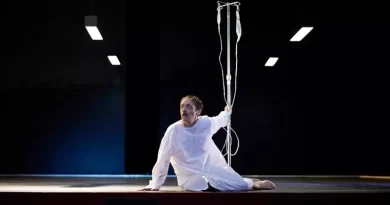
Mike Bartlett has been a shining star in London’s playwright firmament since Cock opened at the Royal Court Theatre Upstairs in 2009. In 2022, Cock had an important revival on the West End with a somewhat updated script. A production of the author’s Cock in Luxembourg – a country that prides itself on fighting for LGBT representation in public life – is not surprising given that the play celebrates the love relationship between two men.
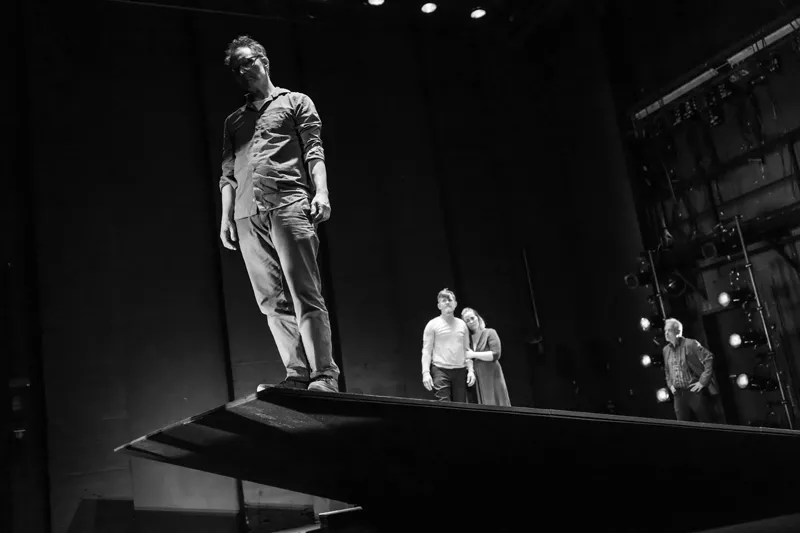
Photo credit: Bohumil Kostohryz.
What does surprise is that this production at the Théâtre des Capucins – which is a revival of a 2024 production – focuses on a metaphysical quest to turn partnering for life into an acceptance of the personality of the other from which all else – including gender – depends. Although there are puerile scenes in Cock as I saw it, the careful dismantling of gender-based expectations of cozy generational family lines and cooking and caretaking roles is contemporary and familiar to every couple.
Cock is not a psychological drama. It is, frankly, not deep enough for that. But then, what is it? It is what it is about at the surface or simple narrative level. The two men, John and M, are challenged as a couple when John has an existential crisis and leaves. Within two weeks, he stumbles into the path of a young, lonely and divorced woman, labelled W, and he has an affair with her as the culmination of his first and probably only act of double disloyalty in the seven years of his live-in partnership with M.
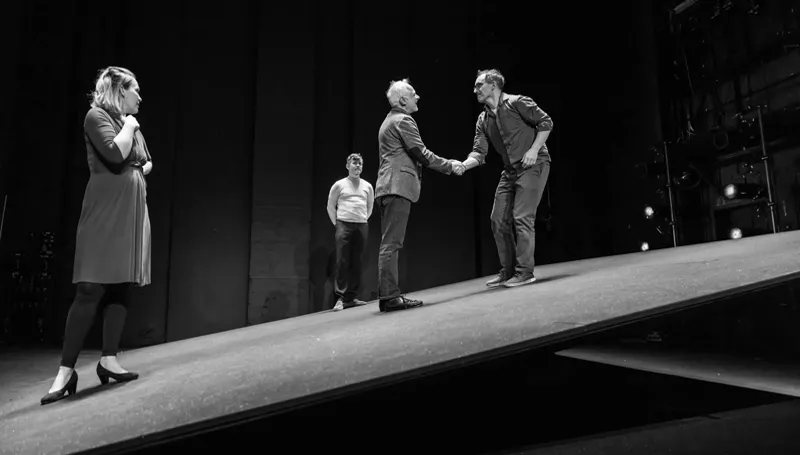
As the director Anne Simon says, “You think about the characters one way. Then another element comes in. The balance shifts and they’re trying to put it all back into balance.” In characteristically Simon style, she found the perfect physical stage solution to manifest that, above all, Cock is a play about staying balanced. Respecting Bartlett’s demand that the play be performed with only four actors and absolutely no props, she puts her characters on an enormous square balancing board supported with central springs set upon the fairly deep and square proscenium stage. It is a play about the nature of the contemporary will to survive. Bartlett doesn’t give a hoot for traditional psychological explanations. These characters are the social fictions – the creations that fit our shared concepts of reality – of our era, and yet they are playing for real.
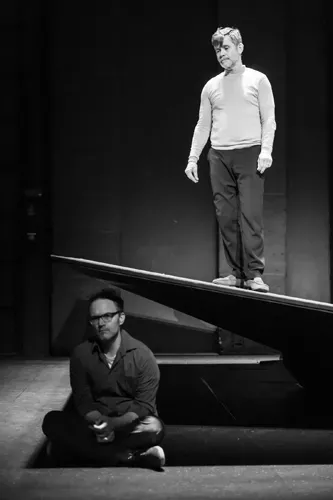
Photo credit: Bohumil Kostohryz.
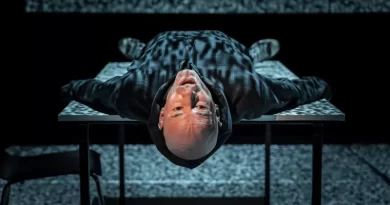
The strength of this Luxembourgish production is the actors’ deftly developed characters. John is interpreted by Philipp Alfons Heitmann as a person with intrinsic complexity and a certain attracting passivity bordering on laziness the way one might call a cat lazy. M played by Tom Leick-Burns interprets a character who is supportive, generous, easy to forgive but edgy with pluck and strategic emotional intelligence. He keeps his will to bite under control. F (David Calvitto) is a latecomer in the play, the father (of M) who is called in as one of the dinner guests during which W is sniffed at scornfully and cornered – sometimes, on the square seesaw stage set, literally – and rejected by M, F is present to remind John that he belongs already to a generational family, albeit one that is rooted in the past and not the imagined future featuring children around the Christmas tree that union with W offers him.
If anything, it is the woman W – no doubt standing for woman, just as M no doubt stands for man – who is the least real, or perhaps the most real: off the streets and accidentally wandering onto the stage “real”. She doesn’t truly fit into the below-her-age (33) sexual identity crisis that has John denying and then swearing that he loves a particular other person, about whom gender is only one of many characteristics. Played as a gentle and slightly smudged ethereal creature by Elisabet Johannesdottir, her solitary representation of half the world’s population was poignant in what was not said about her. Nonetheless her desperation seeps through. When she settles for playing doctor with John in a sort-of grown-up way even though John’s naivety about female anatomy borders on the near impossible, her enthusiasm for the contours of her lover’s strange body parts seems somewhat feigned, because we know that more than anything she does not want to be alone. That is her disadvantage – not his. And so, she soldiers offstage, right through the audience, because she cannot win the man battle.
There are shades of Eve Ensler’s mystically vulgar but once much-loved The Vagina Monologues in some of the less savoury parts of Cock, and in its more noble parts I see excursions into the profound philosophical, tragic and tongue-in-cheek end-of-his-life play The Goat or Who is Sylvia? by Edward Albee. This Luxembourgish production of a play where the men win the day honours the local gay rights movement represented by its affiliation with Rosa Lëtzebuerg, but also reveals subterranean social forces that are erupting. It offers us a glimpse into what our attempts to wrestle with the newly emerging shapes of our present and subjunctive future will entail.