“The Master Builder” at Arcola Theatre
Tom Bolton in East London
★★★★★
23 October 2026
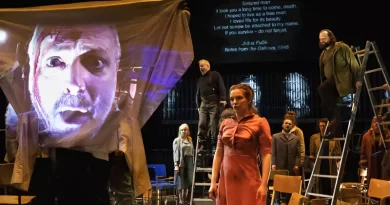
For this revival of Henrik Ibsen’s The Master Builder, the Arcola stage is transformed into an architect’s office, complete with plywood desks and display models. Robert Innes Hopkins’ set places the production firmly in the 21st-century design world of demanding clients, big egos, and office politics. When Halvard Solness enters, the picture is complete. He is a charismatic, successful, demanding, senior architect in every way: a fully recognizable type. It is no surprise that, within minutes, he is exercising his power over his subordinates and pursuing a surreptitious affair with his office manager Kaja Fosil. When his wife Aline walks in she watches his excruciating attempts to behave normally with Kaja with both disgust and weary familiarity.

Greg Hicks as Solness.
Photo credit: Alex Brenner.
However, The Master Builder is a much more complex play than it first appears. One of Ibsen’s late plays, it combines realism and symbolism in a disconcerting manner, prefiguring his final work, When We Dead Awaken.
Solness is soon playing a different kind of game with a different, younger woman – Hilde Wangel – who walks into his office in her climbing gear to claim a promise she says he made her ten years ago, when she was 13. Solness kissed her and promised her a kingdom, then she watched him ascend the steeple of his new church for the only time in his life, overcoming crippling vertigo to hang a wreath on the weathervane. He doesn’t remember, but she’s very certain, and has come for her kingdom. She seems like a figure from a fairy tale, calling in an awful bargain. It will clearly not end well.
The challenges of the play, and there are many, include finding a way to prevent this alarming encounter between a child and a grown man, and his enthusiasm for younger women, dominating our response to Solness. It is also tricky to balance the play’s contrasting tones. The Arcola’s artistic director Mehmet Ergen overcomes these hurdles in an exemplary manner. Other productions lean further into the fairy-tale aspects of the work but, by allowing them to intrude into an entirely credible modern setting, Ergen allows an eeriness to grow which draws us along with the characters.
He is helped by a series of riveting performances. Greg Hicks is a masterful actor with a highly impressive CV (including starring in Ergen’s 2008 production of Ibsen’s An Enemy of the People at the Arcola), and he oozes quality as Holness. He slips from egotistical dominance into a cringing fear in a moment in the presence of Hilde, showing us all of the self-doubt that has poisoned not only him, but all those around him. His exceptional performance is a privilege to watch close-up in such a small space.

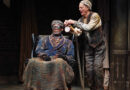
Robin Hooper as Knut.
Photo credit: Alex Brenner.
Hicks is matched by Louisa Binder’s Hilde, who exudes confidence until the bitter end, effortlessly dominating those around her with her personality, and physically. Her reaction when Solness tells her to sit, walking slowly along a bench to tower over him before lowering herself slowly down, is perfectly timed.
Sally George, as Aline, presents a hard shell which hides impossible guilt about the death of her twin babies. Peter Guinness is excellent, slightly creepy as her more-than-friend Doctor Herdal. Jade Williams makes the used and abused Kaja abject, while Ryan Wichert as her boyfriend Ragnar is on the verge of an explosion throughout. His father Knut (Robin Hooper) is desperate, powerless, and dying, yet still winding Solness up the wrong way as his assistant.
Ergen’s classy production is made by its clarity and focus on the text, using David Edgar’s 2011 adaptation with its direct, casually earthy English. He makes sense of the overlapping histories and emotions which complicate each character’s relationships. Solness’s ambition is matched by his belief that he does not deserve success, and must be unhappy to pay for it. Aline’s unresolved grief is terrible, while Ragnar is young but already embittered, and Kaja has sacrificed her happiness for nothing. Knut will die a broken man. Only Hilde will get what she wants, because her needs are cold and terrifying.
Ergen makes the supernatural aspects of the play seem inevitable, because none of the earthbound humans can solve the tangle they are in for themselves. Solness makes his final, fatal climb because he cannot exist in normality any longer. In a fine account of the play, it seems like the only possible choice.