Dana Rufolo in Romania at the Cluj Theatre Festival
The theme of the fifteenth edition of the International Meetings in Cluj that ran from 16 to 18 October was “Contrasts”; and the most striking contrast I identified was between plays sunken in visions of dystopic pessimism and those of hopeful optimism. Dramas like Mein Kampf by George Tabori (1987) which imagines how Hitler’s early adult experiences seed his future as a force of pure evil, and the loneliness-and-death absurdist melodrama Shadow on Paper by Dragoș Pop, leave one roiling in the desert of Armageddon.

Mein Kampf.
Photo credit: Nicu Cherciu.
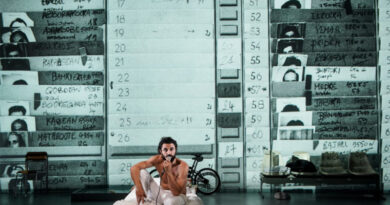
Mein Kampf, directed by Alexandru Dabija, reveals the blatant anti-Semitism of the young Hitler who Matei Rotaru plays as preening, finicky, neurotic, and attractively helpless. The play is set in a homeless shelter in Vienna where Hitler beds down with friendly if coarse homeless others who are mostly Jewish, including the innocent Schlomo Herzl (Ionuț Caras) who is writing a book that he entitles Mein Kampf – he donates that title to Hitler for Hitler’s future book.
But that is not the full extent of the dark vision of a future-in-the-making in Mein Kampf; Death, in this production played by Ramona Dumitrean with the traditional scythe at her side, is a stark, steely figure dressed in black divested of even a shred of redemption or spiritual hope; she emphatically reminds each and every one of us that we will not escape her domain – and she encourages young Hitler to follow her by promising plenty of gold and jewels where he is going.

A Different Kind of White-Moor.
Photo credit: Nicu Cherciu.
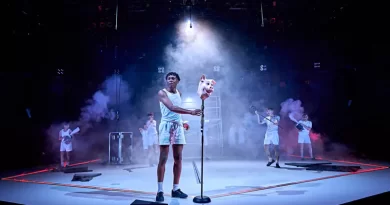
On the other hand, while none would ever think to claim that Eugene O’Neill’s Long Day’s Journey into Night rivals Singin’ in the Rain as an optimistic embrasure of the hostile elements, by cleverly doubling Edmund as both son and narrator-playwright, Mihaela Panainte infuses this morose drama with sprinkles of hope. Similarly, Ionuț Caras’s A Different Kind of White-Moor is a tongue-in-cheek take-off on a Romanian fairy tale that envisages a modern society where joint community efforts outweigh the irritating frustrations inflicted by governments and market forces.
Still, on the whole, the festival featured more depressing dramas than uplifting ones, following a trend already observed in the 2025 festival. What with the ongoing wars, cancel-culture movements, and the failure of formerly admired democracies to provide leadership, the future seems bleak. And theatre is not an escapist art form – certainly not in Romania where it succeeded in subtly criticizing the era of authoritarian regime while on the surface demurely presenting classic dramatists like Shakespeare or Ion Luca Caragiale. These dramas of desperation magnify the attraction to the past, because there is no clear way forward.

Symphony of Freedom.
Photo credit: Nicu Cherciu.
The solo performance Symphony of Freedom by Sânziana Tarța was very popular with the international audience of theatre critics and personalities. It epitomizes the difficulty of resisting the past, traditional and emotional, when there is no clear alternative to set up as a goal. Tarța is a young woman who believes she needs to demand her right to be free. She does not want to be bound by social obligations, and yet in her danced presentation, she shows how her grandmother is a burden. The grandma is represented as a white primitive doll who rides on Tarța’s back. Tarța rips the taped lines on the floor of the performance space in the National Museum of the History of Transylvania to enlarge her freedom of movement, but she does not succeed in escaping the traditional space these lines of tape symbolically enclose. The burden of the past, the grandmother doll, is carried by Tarta until the performance ends. Escape to freedom is a thought that never becomes a fully lived reality.

Sonia Raises Her Hand.
Photo credit: Nicu Cherciu.
Similarly nebulous is the play Sonia Raises Her Hand which is an adaptation of the novel Sonia ridică mâna by Romanian author Lavinia Braniște, directed by Răzvan Mureșan. Sonia is buffeted by events in her life that are typical: by men who are not soulmates and by her work as a writer. She never knows what to do, and she sees her life swallowed up by her own indecision. Although the actors played their roles with gusto and conviction and the directing was creative, they confessed in a post-performance discussion that the play lacks dramatic tension.
Diana-Ioana Licu could not escape feeling that as Sonia she was describing her life to a psychoanalyst rather than actually experiencing frustrations and surprises. This undoubtedly has to do with the difficulty of converting a novel into drama, which makes it difficult to conclude that Sonia as a book character is as vacillating as she appears to be on stage. However, certainly the play portrays a woman who feels she had no future to work towards, no goals to achieve. She is a plaything of destiny.
It is shameful that Look Back in Anger was embraced as an “angry young man” drama, and its latent anti-feminism has been dismissed even by purported feminists like myself because of an over-identification with Jimmy’s claim that he represents how the downtrodden of the British class system, people like him, are unfairly treated.
Tudor Lucanu directs John Osborne’s 1956 play without changing a word of the original (if the surtitles are to be trusted to be identical to the Romanian dialogue that the actors actually spoke). And yet, the times they are a-changin’, and what was “virile and exciting, sexy, witty, funny, profound” (New York Daily News) in 1978 is abusive behaviour in 2026.
As this production made clear, Jimmy’s rants at Alison, his disrespect for her family and her values, and her heroic attempts to placate him speak loudly of misogyny and not of a plea for social justice. Jimmy’s proclamation to his buddy Cliff, much the kinder of the two men, that he is staying with Alison because he wants to witness some kind of awakening into consciousness from her pales into self-congratulatory rhetoric.
But Lucanu doesn’t turn Alison into a Nora slamming the door. The women in this interpretation (stoic Ioana-Maria Repciuc as Alison and stern Cecilia Lucanu-Donat as Helena) are hypnotized by their fascination with Jimmy’s anti-establishment rhetoric which Tudor Jula proclaims with smug assuredness.
Commentary comes by introducing a parallel story told via songs accompanying a band with the actors as musicians and which is situated a stairway above the one-room dwelling where Jimmy, Alison, Cliff and eventually Helena live; their flat is a diminished interior space awkwardly fitting inside the large proscenium stage of the Cluj National Theatre. The final song of the evening asks how many more women will be victims of femicide. Again, in this production, the reins around the status quo chafe, but they are not removed. Habit reins in the characters who buck but are not sufficiently confident enough to gallop to freedom.

Long Day’s Journey into Night.
Photo credit: Nicu Cherciu.
Long Day’s Journey into Night is the hinge connecting pessimism with optimism. The sensitive directorial touch of Mihaela Panainte gives Edmund the role that Tennessee Williams gave his alter ego in the play The Glass Menagerie: Edmund jumps out of the action from time to time, announcing transitions when the play has been cut by telling us this is his story and that he has learned how to survive the pain by writing about it. Given that the play is autobiographical and that Edmund represents Eugene O’Neill himself, this positive perspective on the sad drama gleams like the pole star in a dark sky. And when the action is in full swing, the unconventional set – a cramped living room area surrounded by walls onto which a picture of the coastal area of Long Island Sound is painted – upholds the mood of the play as Mary’s inexorable slide into drugged dependency is embodied with terrifying authenticity by Angelica Nicoară. Never have Tyrone’s words, “this is not a prison”, sounded more inaccurate.
The dependency of the characters on each other screams out at us. Every family member shares an identical story of guilt and remorse. None of them can separate, and yet they cannot be happy together because their interdependency is against the laws of nature that Eugene O’Neill embraces. A powerful production that was painful to watch, this Long Day’s Journey into Night reveals the future to be a Fata Morgana. Just like the moaning of the fog horn that sounds sporadically throughout the play, there are only brief reminders that something lies beyond the house shrouded in fog – and whatever that something might be remains unknowable.
Simply because it is contemporary, A Different Kind of White-Moor, written by Ionuț Caras, is an oasis of optimism. It suggests that problems can be solved. While making fun of Cluj as the 5-star city (it has been called the Silicon Valley of Romania) and complaining that its real estate market is exorbitant, there is also a sense of pride. After all, it is quite something to rival Paris in the square meter value of property. Scenes of people gathering to protest high rents or social inequality, the referencing of the less wealthy regions of Romania – in particular the south where the corrupt Red Baron lives, a cameo of a marriage between two lesbians, current colloquialisms (in Romanian) and the plethora of characters who have a developed sense of social purpose all indicate that the future is a collective invention, and that furthermore it is created by those of us who are alive now.
The past has been internalized as the fairy tale The Story of Harap Alb written by Ion Creangă in 1877 which is a fundamental piece of Romanian literature studied by every secondary-school student. The original story is about Harap Alb, a prince who sets out on a quest, overcomes evil and weds a princess; they become king and queen. In this adaptation, the original story sets the structure onto which Caras imposes his buffooning interpretation. By reclaiming tradition, rather than being bound and imprisoned by history, this play sets itself up as the one that most successfully contrasts with the other dramas in the festival which are rooted in the chaos of the recent past that leave their characters emotionally exhausted.
Thematically, A Different Kind of White-Moor suggests that the schisms Caras sees in Romanian society presently can be resolved. He has observed that especially on social media, whether for political or geographical reasons, different groups in Romania literally hate each other. Attempting to build a future together would annul this rupture. As a well-respected repertory actor who only recently took up playwriting, Caras as director of his own A Different Kind of White-Moor invited amateurs from the general public and members of the technical crew of the Cluj National Theatre to act in the play, a decision that reinforces the theme of the play which is that good prevails and harmony reigns. Idealist as it might be, ending civil unrest is a goal, and goals always presume a future.