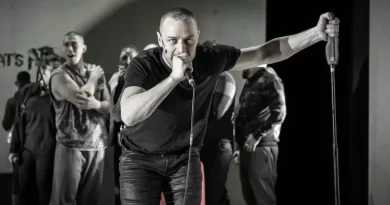
“Kramer/Fauci” at St Ann’s Warehouse, New York
Glenda Frank in Brooklyn
★★★★★
22 October 2026
Giants of our time! Larry Kramer, fierce co-founder of ACT UP (AIDS Coalition to Unleash Power) and mild-mannered Anthony Fauci, Director of the National Institute of Allergy and Infectious Diseases (NIAID), were alternately foes and friends as together they reconfigured the global health landscape.

Photo credit: Maria Baranova.
Daniel Fish, Tony-nominated director of a radical staging of Oklahoma!, has conceived and directed Kramer/Fauci at St. Ann’s Warehouse Theatre. It’s a poignant gem of a production about their relationship during the early years of the AIDS “epidemic” (Fauci) or “plague” (Kramer). The nouns themselves – words they both insisted on – indicate a lot, as much as the love/hate seesaw that kept them both off-balance and bound to each other. The dialogue is taken from a November 1993 C-SPAN conversation between Kramer and Fauci moderated by Steve Scully. The viewers’ calls provide the context of the time.
The play with its four performers is set on the venue’s largely bare playing space, placing the events within a much wider but unseen world. The seated moderator (Greig Sargeant) asks questions and guides the conversation. Jennifer Seastone, sometimes in an absurd blow-up chicken costume, sometimes on rollerblades, takes on the many voices of callers, who provide a range of attitudes toward the crisis.
Will Brill and Thomas Jay Ryan play Fauci and Kramer respectively, one in a suit with a moustache, one in casual black turtleneck. Anthony Fauci’s diction is that of a loquacious, seasoned bureaucrat who has adapted himself to interact with opinionate government power brokers. Larry Kramer is direct, demanding, compelling and charismatic. A street fighter. His outrage against all the deaths and snail-paced funding is the solid core that drives the drama.
It’s hard to explain how compelling this play is, and how entertaining. It is more than a clash of personalities, more than a play of ideas. There is a universality to all wars on disease, and there are the heroes who shout and pound their fists because the world has gone deaf. The broadcast itself is a weapon against the refusal to hear. Kramer’s biblical perspective – “the plague” – brings its own magnitude. If you lived through the period, Kramer/Fauci resonates and the memories bring more shadows and light to the script.
The absurdities and surrealist touches are more than tacked on levity. They are icons of our time, evoking the common culture with a hint of a symbolic commentary, although the meaning is often not clear. The distractions bring light touches, balancing the weight of the real heart of the matter.
The emotional reactions of the men temper the tennis-match format. We continually switch allegiances because both men are right and convincing, and because they approach the problem through very different but parallel avenues. Both had to shed assumptions and easy categorization, and neither has totally let go of his older perspective. They have had to teach themselves to hear each other and the forces that move or hinder them. We journey with them, through our own assumptions and prejudices.
The performances and direction are powerful and very clear. Brill’s Fauci never steps out of his suit, not in his pacing, intonation, or gesture. Ryan’s Kramer, in a more nuanced role, brings us a milder version of the activist than we see in Kramer’s play The Normal Heart (1985), but a firebrand doesn’t change its spots.