“The Children” at Lyric Hammersmith
David Wootton in West London
★★★★☆
13 September 2026
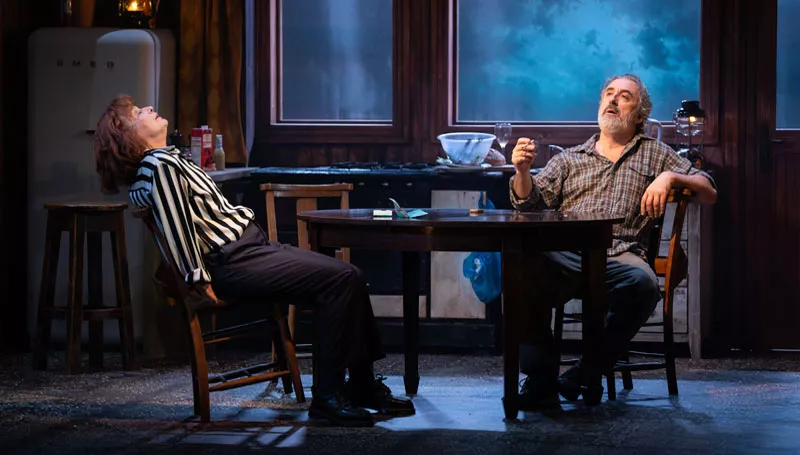
From the outset, Rachel O’Riordan’s staging of Lucy Kirkwood’s The Children, in its tenth anniversary production at the Lyric Hammersmith, establishes a striking psychogeography. The interior of a charming, slightly ramshackle cottage is subsumed within the tunnel of a nuclear power plant, almost like Jonah or Geppetto being swallowed by a whale. Pulsing light and sound briefly emphasize the circular structure, then die away to foreground the cottage late one afternoon. (The designer is Gary McCann, the lighting designer is Anna Watson, and the sound designer is Holly Khan.)
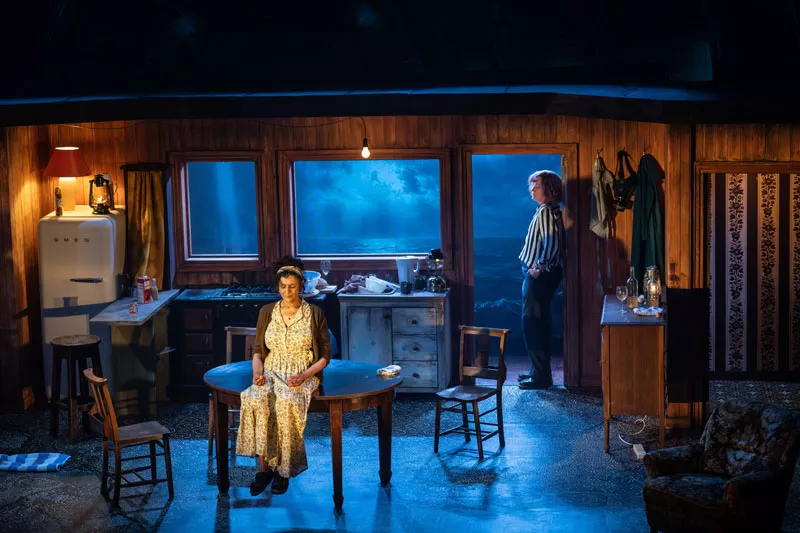
MeeraSyal and KerryFox.
Photo credit: Helen Maybanks.
Unlike the original, more naturalistic presentation of the play at the Royal Court in 2016, this visual contrast sets up expectations in the audience, and perhaps gives away too much too soon. Nevertheless, under O’Riordan’s assured direction, this revival confirms the play as significant and stimulating in its exploration of the weight of responsibility in the wake of environmental disaster.
One of the strengths of Kirkwood’s writing is her ability to weave together the personal and the political, and only gradually reveal the profound implications of the apparently mundane. As the play begins, Hazel (played by Meera Syal) is concerned to staunch the nosebleed of Rose (Kerry Fox). It seems that the arrival of Rose to the cottage so surprised Hazel that she struck her before recognizing her as an old friend and colleague not seen for many years. Indeed, her excuse, in one of many lines of mordant wit, is that “we’d heard you’d died”. The ease with which the characters can bleed will later become a measure of the state of their health. However, blood also suggests generational ties, and the mutual dependence and duty of parents and children, as signalled by the title of the play.
As the women catch up on the passing years, Hazel explains that the disaster at the local coastal nuclear power station led to the move from her house, now inside the exclusion zone, to the cottage belonging to a cousin of her husband, Robin, which is just outside it. Her description of the event itself is couched in strongly domestic terms, as an interruption to her making banana bread for her children’s tea: eggs shook, plates fell, and even the tidal wave rose “like boiled milk”.
Wearing a long floral dress and comfortable cardigan, Syal’s Hazel looks as well as speaks like a domestic goddess, and even something of an earth mother, all yogurt and yoga. Before the disaster, she and Robin had started a small organic farm, and, though it has been ruined by the radiation, he still goes each day to tend the cows and dispose of the milk, or so she believes. Despite all that has happened, they remain loyal to the land, and Hazel’s consideration of retiring to a pastoral idyll in the Punjab is just a passing fancy (in a nice tweak to Kirkwood’s text that allows Syal to allude to her own heritage).
Hazel and Rose have contrasting, even conflicting, personalities and, in the performances of Syal and Fox, they present a sparkling and spiky double act. Rose has returned from a long period of working in the United States, and – smartly dressed in a long jacketed trouser suit – seems the more worldly and hedonistic of the two. Unmarried and childless, she also initially seems free from accountability. When she is invited to share in Hazel and Robin’s evening meal, the contents of which are restricted by circumstance, she says drily that she finds “salad deeply depressing”. She is happier with a cigarette, smoked in the open doorway, and, once Robin returns, with a glass or three of his potent homemade parsnip wine, which, Hazel says, tends to make him “belligerent”.
Declan Conlon’s Robin brings with him a broader humour and a boyish energy. On entering, he cycles around the table on a tricycle, which had once belonged to one of his children, and which he has just retrieved from the house. His presence soon helps make clear that there has been more than friendship to the relationship between these three people, and that there remains a sexual frisson between him and Rose. Their shared experience culminates most positively in their revival of a dance that Hazel has choreographed to a song by James Brown, and there is both relish and resilience in the shapes that these sixty-somethings throw. However, it soon disintegrates, first into recrimination and then into vulnerability, before sparking an important decision as day dawns.
These three are not just old friends but former colleagues, who worked together at the power station as engineers. As such, they are not just victims of the disaster, but are implicated by it. Rose’s return makes them all confront this fact, and so review their past and decide on their future. Though Kirkwood wrote The Children in response to a particular event – the major accident at the Fukushima Daiichi Nuclear Power Plant in 2011 – her play continues to strike home in critical times and ask us all to reconsider our obligations and our actions.