“Quartet in Autumn” at Arcola Theatre
David Wootton in East London
★★★★☆
23 May 2026
First appearing in 1977, Quartet in Autumn was the comeback novel of Barbara Pym. She had had some success as a writer of social comedies during the 1950s, but fell out of fashion in the following decade and, as a result, published nothing for 15 years. More serious than her earlier work, though still very funny, it is firmly rooted in London in the late seventies, and is a deceptively delicate, yet surprisingly deep, reflection on the theme of ageing.

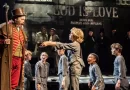
Paul Rider as Norman.
Photo credit: Manuel Harlan.
Though a theatrical version of Quartet in Autumn has been considered before – by Amanda Whittington for York Theatre Royal in 2015 – the production at the Arcola Theatre is the first to present an adaptation on the public stage. The Booker Prize-winning novelist Samantha Harvey has achieved a fine distillation of Pym’s novel, and the highly experienced director Dominic Dromgoole demonstrates its essential dramatic qualities.
A clarity of vision is immediately established by the designer Ellie Wintour, who is responsible for both the set and the costumes. Embedded in the red carpet that covers the stage is a cross-like structure that at once unites and divides four desks, while two tall filing cabinets, also red, dominate one wall. Representing the office that is shared by the four protagonists, this set emphasizes the ambivalent importance that the working day has had for their lives, as they near retirement. (The place is vivified by the subtle naturalistic soundscape of Ella Wahlström and the considered lighting design of Skylar Turnbull Hurd.)
The play opens appropriately with the sound of a string quartet, as its almost musical structure will weave together four voices in a balance of soliloquy and conversation. The novel’s other characters are described, subsumed, and occasionally ventriloquized by these figures, and its events are effectively telescoped.
Each actor first enters from a different corner, and speaks in turn, either addressing God or God’s absence. As Edwin, the most conventionally religious character, Anthony Calf sets the tone by mentioning the impending festival of Mother’s Day, and the others then respond, so establishing their backgrounds and personalities before taking their seats at their desks.
Unlike the others, who have remained single and childless, Edwin is a widower with a family. He devotes much of his spare time to High Anglicanism – its churches, its services, and its clergy. As embodied by Calf, he is tall, bespectacled, and earnest, and perhaps a tad sterner than the Edwin of the novel. He differs strongly from Paul Rider’s Norman, both physically and temperamentally. Characterized by his demotic flat cap, Norman combines a pessimistic outlook with a provocative sense of humour, and is unafraid to speak bluntly or voice his prejudices.
The two women are equally distinct. Though Kate Duchêne’s genteel Letty is anxious at having missed out on love, she makes the best of things. Dressed in twinset and pearls, she takes care of her appearance, and enjoys her food and drink, as well as reading novels. By contrast, Pooky Quesnel’s Marcia is slight, severe, and fiercely independent. Wearing a Welsh wool coat in geometric tapestry, she may be more presentable than the Marcia described by Pym, but she exposes her eccentricities in other ways.
As they work, they talk and reveal insights – both affecting and often amusing – into their private lives. For instance, Letty explains that her close friend Marjorie has reneged on their plan to spend their retirement together, and has instead become engaged to a vicar, who is at least ten years her junior. Later, she says that the house in which she lodges has been bought by a Nigerian evangelical clergyman, and, though she tries not to be prejudiced against him, his noisy prayer meetings necessitate a move (a move that is aided by Edwin).
However, it is Marcia who is the focus of the others’ concerns, and all the more so because she is secretive and self-sufficient. They know that she has had serious surgery, which Norman tactlessly, but accurately, guesses to have been a mastectomy (an operation that Pym herself had undergone). Yet, she rejects their sympathy and any support from a social worker, and instead develops a crush on her surgeon, Mr Strong.
The first act ends with a retirement party for the two women, at which they are described as “the kind of people who work quietly and secretly, doing good by stealth”, and, more ambiguously, as so missed “that nobody has been found to replace them”. The event marks the dissolution of the quartet of colleagues and the instigation of an uncertain future.
The dissolution and uncertainty are then cleverly realized in the second act by the dismantling of the desks, which then not only represent the surviving office, manned by Edwin and Norman, but also provide the furnishings for several other spaces, in which the characters attempt to sustain their equivocal relationship. Ironically, perhaps, it is the death of the malnourished Marcia and the contents of her will that allow all four to be seen at their best and strengthen their connection. The cast members bring their individual, idiosyncratic characters impressively to life, and they work beautifully together to communicate the complexity of four isolated people in need of each other.