“A Month in the Country” at Donmar Warehouse
Neil Dowden in the West End
★★★★☆
7 September 2026
Lyndsey Turner has already successfully directed Brian Friel’s adaptation of Ivan Turgenev’s novel Fathers and Sons as well as Friel’s plays Philadelphia, Here I Come!, Faith Healer, and Aristocrats at Donmar Warehouse. So, not surprisingly, her production of A Month in the Country by Friel after Turgenev shows a similar sensitivity to the subtle shifts in mood that characterized both writers’ work.
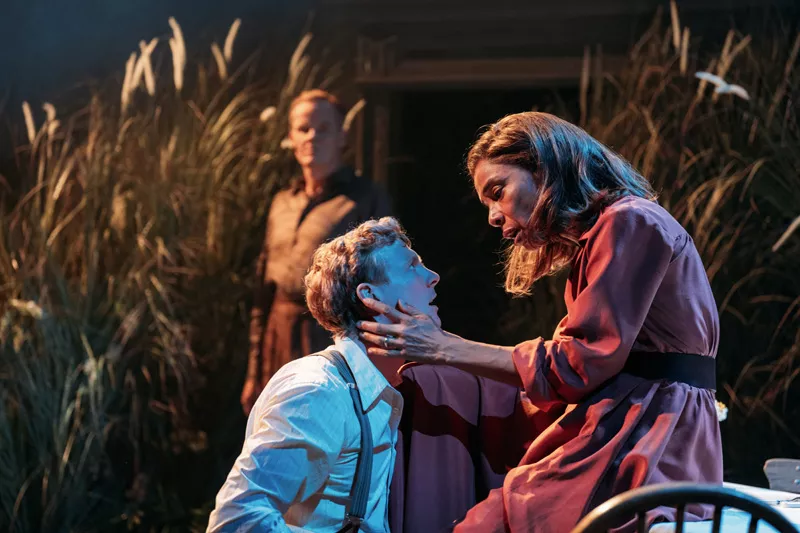
Patrick Gibson, Sophie Okonedo and Alistair Petrie.
Photo credit: Helen Murray.
The original play had a complicated genesis: it was written between 1848 and 1850, under the title of The Student, then heavily edited before being published as Two Women in 1855, then finally staged for the first time as A Month in the Country in 1872. This was only about a decade before Anton Chekhov’s first plays, and although Turgenev’s sole theatrical masterpiece benefited from Chekhov’s huge, longstanding popularity in Russia and in the West as the two playwrights have much in common, he set the blueprint. Like the work of his younger compatriot, A Month in the Country presents a household of landed gentry beset by unrequited love and unfulfilled hopes with a mixture of pathos and humour. Friel also wrote free versions of Three Sisters and Uncle Vanya, with both Russian masters heavily influencing his own plays.
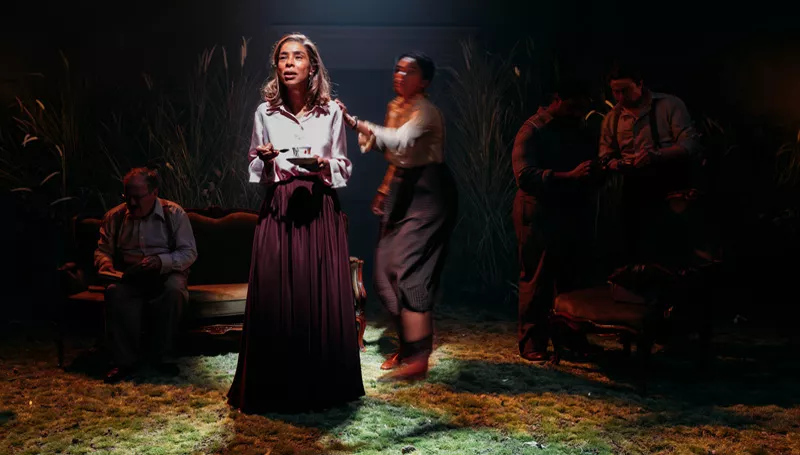
Turner’s revival opens with the audience confronted by a ring of glass-encased thick foliage around the stage through which we see the face of a woman peering out as if trapped – an apt image setting the tone for a play about people struggling to escape their restricted lives. Then – in Leslie Travers’ splendid design – the green fringe is lifted up to the flies to reveal an elegant country house drawing room with a floor of grass, as if natural forces cannot be suppressed by social convention. This burgeoning tension between passion and propriety is then played out during a sultry summer (beautifully lit by Tim Lutkin) on the Islayevs’ country estate.
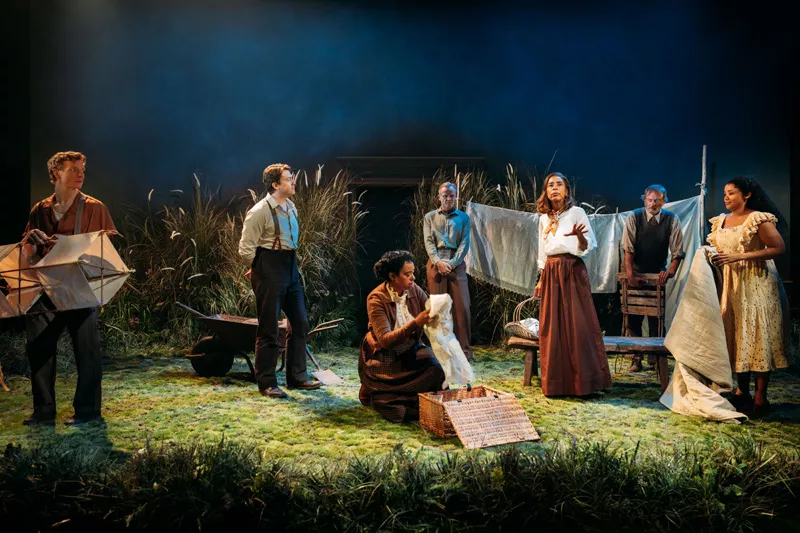
Photo credit: Helen Murray.
The lady of the house Natalya Petrovna (whose fraught face we have already glimpsed) presides over her family, guests, and servants with gracious assurance, but her enviably comfortable lifestyle does not fulfil her. Her kind but emotionally illiterate husband Arkady is more interested in carrying out engineering projects on the estate, while close family friend Michel worships her but she has no romantic feelings for him. All changes after she falls for Aleksey, the young, handsome tutor of her son, but unfortunately her 17-year-old ward Vera is also in love with him, with all the conflicting and competing emotions disrupting the former prosaic placidity of the household.
Friel accentuates the comedy in Turgenev’s play especially with the portrayal of minor characters including the elderly and clumsy but wealthy neighbouring landowner Bolshintsov who wants to marry Vera and the eccentric, language-mangling German tutor Herr Schaaf. There is a sense of absurdity in the way people becomes entangled in hopeless situations of their own devising, but the writing ensures compassion for their plight. Friel also emphasizes the divisions of social hierarchy amongst the characters, with staff complaining about their employers who expect them to be at hand whenever needed. This is especially represented in the clownish doctor Shpigelsky whose habit of cracking terrible jokes masks a real loathing at being at the beck and call of the gentry in order to make a paltry living – and who proposes a pragmatic marriage to Lizaveta, companion to Arkady’s card-playing mother Anna.
Sophie Okonedo gives a finely tuned performance as Natalya, showing how badly jealousy makes the character behave without losing our sympathy for her as a woman being slowly suffocated by boredom. Alistair Petrie plays her long-suffering confidant Michel with just the right balance of masochistic love and awareness that he is wasting his time. Rachelle Diedericks gives the naively trusting Vera a touching vulnerability, while Patrick Gibson conveys the awkwardness of the humble-born, Irish-accented Aleksey caught between two women’s affections neither of whom he wants to offend.
Thomas Arnold is the benevolent but clueless Arkady, while Susan Brown’s Anna reveals a surprising amount of personal concession in her past marriage. Daniel Rigby makes a lively and lightly subversive Doctor Shpigelsky, with Amanda Wilkin as the snuff-snorting Lizaveta. Michael Hodgson is the befuddled Bolshintsov, and Mark Hadfield delivers Herr Schaaf’s unintentional double entendres with perfect Teutonic seriousness.