“King Lear” at Crucible Theatre, Sheffield
John Murphy in North-East England
★★★★☆
6 September 2026
There’s a rich tradition of Shakespeare at the Crucible Theatre, one filled with star names and innovative productions, and it’s a history that the current artistic director, Elizabeth Newman, is keen to build on.
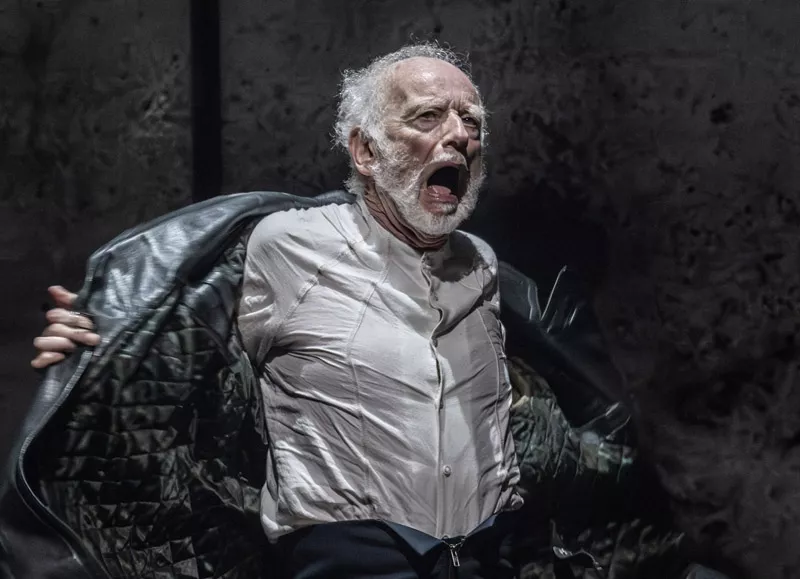
Ian McDiarmid as King Lear.
Photo credit: Johan Persson.
For the first time, Sheffield Theatres has assembled its own Shakespeare repertory company whose cast will perform a double bill of the Bard this autumn. In October, Mathew Horne will head the cast in Jamie Glover’s production of Twelfth Night, but first we have 82-year-old Scottish actor Ian McDiarmid taking on the title role in Titas Halder’s stark version of King Lear.
The story is, of course, extremely bleak. Lear, a man given to vanity and narcissism, attempts to divide his kingdom between his three daughters in return for their pledges of love and devotion. Only the youngest daughter, Cordelia, refuses to partake in the empty flattery and is banished from the kingdom, leaving Lear to descend into madness. The parallels to a certain world leader are clear although never explicitly stated. Despite brief flashes of levity in the relationship between Lear and the Fool, the production remains unrelentingly grim.
McDiarmid has actually played the character on the Crucible’s stage before, in Edward Bond’s reimagined Lear in 2005, and he’s absolutely magnificent in a role that feels almost custom-made for him. From the opening scenes of a cruel father taunting his children, to the frailness and vulnerability of the closing scene, McDiarmid simply owns the stage. As a veteran Shakespearean actor, he delivers the verse beautifully, with that famous voice savouring every syllable.
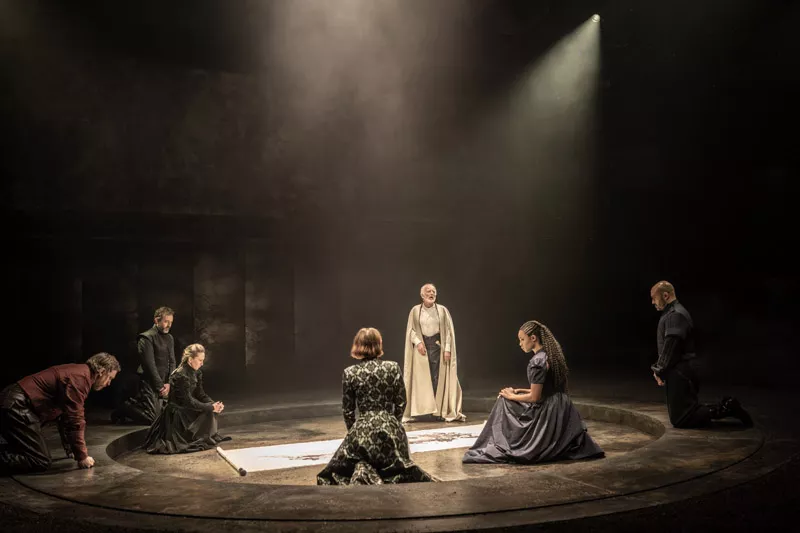
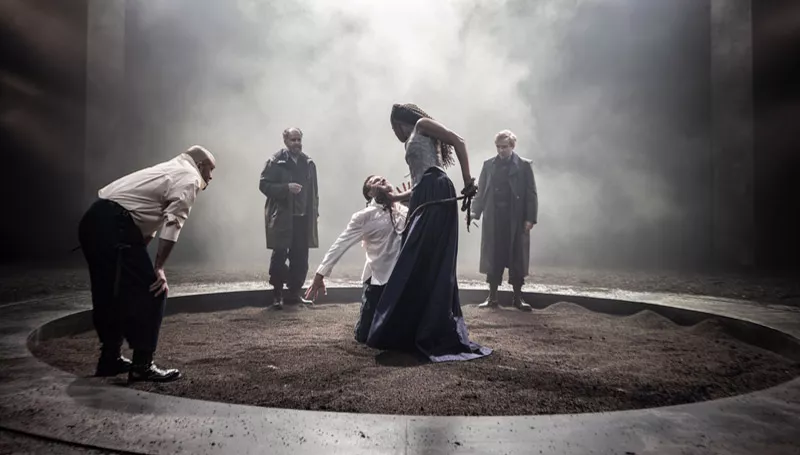
Photo credit: Johan Persson.
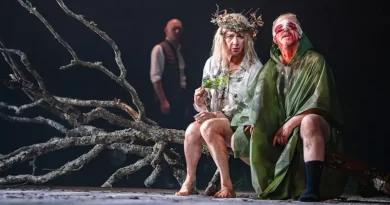
The supporting cast are almost as good. Bebe Sanders brings a composed and dignified air to her Cordelia. Mark Holgate is full of charismatic menace as the Earl of Kent (portrayed here, appropriately enough, as a bluff Yorkshireman). And David Birrell does an excellent job of portraying the Duke of Gloucester’s increasing panic after being blinded. But it’s Max Revell who steals the show as a brilliantly lithe and athletic Fool – clad in tracksuit and trainers, some of his movement is almost balletic. It’s impossible to take your eyes off him when he’s on stage, and it’s intriguing to wonder what he’ll bring to Twelfth Night’s Curio next month.
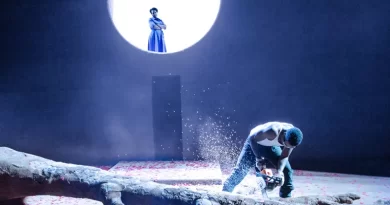
The action takes place within Richard Kent’s minimal set design – simply a large black pit in the middle of the stage covered with sand and gravel, giving an almost post-apocalyptic feeling. It also makes effective use of the Crucible’s famous thrust stage, lending every scene an eerie and portentous feel. That’s accentuated by Ryan Day’s harsh lighting, while Sarah Angliss’s sound design is beautifully subtle, especially when the action moves to the open heath where Lear loses his mind.
At times, the show may seem a bit workmanlike – in the past, Sheffield productions of Shakespeare have been most effective when something different has been brought to the party (as in Ramps on the Moon’s extraordinary version of Much Ado About Nothing). Yet Halder keeps the action moving quickly, and the three-hour running time flies by. This is a darkly compelling interpretation of one of Shakespeare’s most celebrated tragedies, anchored by a memorable lead performance from McDiarmid.