“Tru” at Menier Chocolate Factory
Jeremy Malies in South London
★★★★☆
28 September 2026
As Truman Capote, Jesse Tyler Ferguson (Here We Are and Jesus Christ Superstar) tells us that an advantage of fame is being able to get a cheque cashed in a small town. Every word uttered comes from published writings by or interviews with Capote. In Tru – first staged on Broadway in 1989 – playwright Jay Presson Allen excelled in creating a script that coalesces while conjuring up a time and place.
It is the night before Christmas Eve, 1975. Capote enters his apartment near the United Nations building in Manhattan and plunges us straight into the mainspring of the plot. He is being shunned by most of his usual circle due to his tell-all article in the November issue of Esquire. Never loyal even to those who had been generous and indulgent, he has written unflattering, thinly disguised descriptions of the women who surrounded him. The piece details their sexual and financial indiscretions. Capote had intended to do a whole book along similar lines entitled Answered Prayers but never came close to completing it.
Prominent among those he betrayed – he called the women his “swans” – were magazine editor Barbara Paley and Lady Keith of Castleacre, a former wife of Howard Hawks. Ava Gardner is mentioned repeatedly, and he discusses the possibility of meeting her on Christmas Day.
In a gothic floor-length diaphanous gown [pictured] Charlotte D’Amboise casts an ethereal mood over the room as his almost mute swan-like companion who he is imagining. (Her costume together with Truman’s fur coat and felt jacket are by Jaimal Odedra.) The swan allows Capote to dress her in a string of pearls and steer her around the room though – given Capote’s sexual orientation – there is not a tremor of physical charge between the pair. They are barely tactile.

Charlotte D’Amboise as The Swan.
Photo credit: Johan Persson.
The structure of the script has Capote make phone calls, leave answerphone messages, talk at length to the telephonist to whom he has dictated a telegram, and speak into a cassette recorder. He tells a florist that he categorizes his friends into “A” and “B” grade and this is reflected in the value of the flowers they receive at Christmas. The list of people he knew is truly dizzying and I chuckled when he told us that he knew (independently) both Robert Kennedy and Sirhan Sirhan. He does address us, but it is never overdone. These devices are of course the stock in trade of a dramatist telling a life story through monologue.
Director Rob Ashford introduces these potentially clunky techniques in a manner that is fluid and unmannered. The script is outstanding as Capote widens the focus to discuss alcoholism among writers, noting that of his close contemporaries Tennessee Williams is a bad case, but Arthur Miller has escaped the curse. Allen avoided any low-brow clichéd material in her choice of stories.
The memories go back to the age of eight and being traumatized when bitten by a water moccasin snake. Capote diehards might question a few omissions; I should certainly have liked Allen to have at least mentioned childhood friend Harper Lee. But even with the limited techniques available in this form, we get a flavour of the Southern Gothic that surrounded a young Capote.
Here, Ferguson is acting rather than slavishly imitating. He opts not to have Capote (the trait is well documented) go up an octave whenever he laughs, a habit that might have become grating. The ravishing D’Amboise utters no more than 20 words as the pair move around to Sinatra, Louis Armstrong, a Broadway cast recording of Alice in Wonderland, and a Bach cello suite.
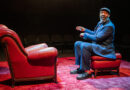
Audience members are put on dining-room chairs, sofas, and even a few chaises longues at the centre of the performing area. A no-show meant that I was promoted to a wonderful armchair in a front row of the in-the-round configuration. Ashford works with designer Paul Farnsworth on an immersive set (it’s essentially an installation) that the audience is invited to inspect at length before the action. The attention to detail is staggering but never merely forensic.
Truman takes delight in showing us views across the East River and D’Amboise finally opens the curtains to their full extent. No matter that the glow is coming in from Southwark – lighting designer Jamie Platt creates a shimmering effect across the furnishings and drapery that could indeed be reflections from the tidal estuary in Manhattan.
Ferguson shows his subject massively the worse for wear, apparently from alcohol, as he enters but he reaches immediately for a pharmacy of drugs. I loved the moment, only a few feet away from me, when he simply scooped up an unidentified pink tablet and said he would take it as a pot luck item.
The creative team under director Rob Ashford are imaginative throughout. On my own tour of the set I inspected Christmas cards from his known friends and there are reproductions of paintings of the writer as a younger man that smack of genuine oils. Fellow audience members discuss letters they have seen elsewhere. There are Persian carpets, tapestries, and ornate ceiling carvings. Bookcases are crammed with exactly the kind of things he might have read; Bernard Shaw and James Agee leapt out at me. I did wonder about the peacock wallpaper, but Capote was a peacock himself. The production comes to London from New York where it was seen in the House of the Redeemer, a Gilded Age mansion on the Upper East Side that might have come across as even more opulent.
Allen’s structure meant that she was not able to air all the legitimate criticisms of her subject that warranted immediate discussion. Additional points of debate and damning instances of disloyalty have emerged since the play premiered. I thought of some of these as the writer clutched a first edition of In Cold Blood and described how (as an official witness) he watched the hanging of Perry Edward Smith at a penitentiary in Kansas in April 1965. Capote eventually wanted this to be the end of the case and process in order to fulfil his writing ambitions even as Smith and Hickock were posting appeals.
It should be said that the third phase of the play, notably Ferguson and D’Amboise’s stylized exit to the strains of Tchaikovsky’s Swan Lake waltz, is a little underpowered. But overall I was seduced. The set, the actor’s spontaneity, and his rapport with the audience when he engaged meant that I was mesmerized.