“Judgment Day” at the Old Red Lion
David Wootton in North London
★★★★☆
27 September 2026
At the station of a small provincial town, three people sit waiting for a train. As it is late, they begin to chat. Like the chorus of a Greek tragedy, their seemingly inconsequential conversation prepares the ground for some devastating events. In turn, these events expose the harsh herd mentality of the inhabitants, as they exercise their prejudices and indulge their taste for persecution.

Photo credit: Alex Storey.
The Austro-Hungarian writer Ödön von Horváth wrote Der Jüngste Tag, or Judgment Day, in 1937, while Nazism was on the rise. His plays and novels provide subtle, satirical analyses of the climate of the time, and articulate some chilling abuses of speech and action. Sadly, his burgeoning career was cut short as, following the German annexation of Austria in 1938, he migrated to Paris, where, at the age of just 36, he was killed during a thunderstorm by a falling branch.
Five decades later, in 1989, the Old Red Lion in Islington provided a rare opportunity for a London audience to see a play by Horváth when Filthy Lucre Productions presented the acclaimed British premiere of Judgment Day, translated by Martin and Renata Esslin and directed by Stephen Daldry. Since then, several of Horváth’s plays have been revived, sometimes using translations by Christopher Hampton, who brought Horváth back to life in his own play Tales from Hollywood (1982). These revivals included one of Judgment Day at the Almeida in 2009.
Now, a new company, Fright Train, returns Judgment Day to the Old Red Lion, this time in Hampton’s version. It is directed by Matilda Ziegler, who played Anna in the British premiere. As well as directing, Matilda plays the gossip Frau Leimgruber, while her younger daughter Faye Ziegler plays Anna, who fatefully attracts the protagonist Thomas Hudetz, performed by Craig Hamilton.
A moment of inattention leads Hudetz, the town’s respected stationmaster, to fail in his duty and so unintentionally cause a disastrous accident. Maintaining his innocence, he initially garners the support of his neighbours, but, when they realise that he has perjured himself, they turn against him.
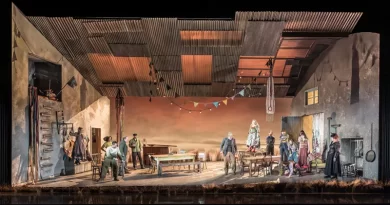
As director, Matilda Ziegler makes clever use of the small black box that constitutes the stage and auditorium of the Old Red Lion, and emphasizes its immediacy, even its sense of claustrophobia. Indeed, the audience is so close to the action that it feels almost stifled by small-town life and complicit in its activities. Lily Booth’s set is spare, and Felix Gibbons’ lighting is intimate, with the result that the events have the clarity of a dream. That dreamlike quality is emphasized by the unnerving music, composed and performed live on an electric violin by Matilda’s elder daughter Evie Hilyer-Ziegler.
The slightly exaggerated performance style and costumes (again designed by Booth) together suggest the art of George Grosz, whose intense, unromantic observation of society could lead not only to caricature but also to a form of magic realism. And, indeed, while the tone of Horváth’s text is generally that of heightened naturalism, it can tip over into the surreal and even the supernatural (reminiscent of the Symbolist plays of Maurice Maeterlinck, another European writer deserving of revival). So, there are moments when both the walking dead and an avenging angel inhabit the stage.
Yet, Ziegler’s strong direction ensures that the uncanny develops organically out of the everyday, and that all elements of the drama feel to be of one piece. One hallmark of the production is its stillness, with often only the speaker moving, while those around him stand motionless. Another is the employment of offstage space, as when Hudetz’s release from prison is celebrated in a party that can be heard but not seen. Both prove all the more striking in such a small space.
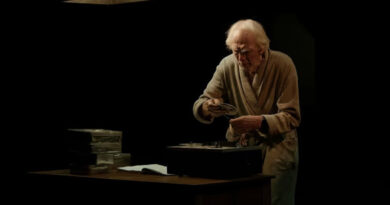
Hamilton’s Hudetz is an intense and serious presence, who, even before the events of the play, has been bearing the weight of an unsatisfactory marriage to an older woman. Outwardly, he appears to epitomize steadfastness, but inwardly he is at breaking point, and – in the fashion of a fairy tale or fable – it is Anna’s kiss that breaks him.
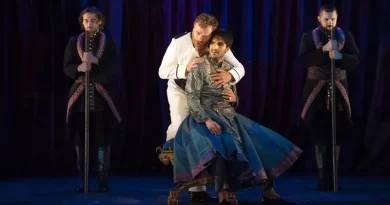
Faye Ziegler’s Anna is a complex character, who seems to have everything that she could want, but she cannot live within the bounds set by the small town and is tempted to transgress, even if that transgression should prove self-destructive. She is the daughter of the landlord of the suggestively named “The Wild Man” (depicted by Bobbie Wilson on an impressive inn sign) and the fiancée of Ferdinand, the local butcher – and she is clearly loved by both. However, she feels the need to seduce Hudetz, and, whether her intention is to free him or console him, her impact is decidedly negative.
Florian Saturley’s leather-jacketed Ferdinand is the very opposite of the uniformed Hudetz. He moves with ease, and even swagger, though his apparent confidence can easily turn to aggression, and is likely to collapse when distressed. Michael Higgs’s landlord is more robust, but even his authority is eroded by his experience.
As played by Agni Scott, Frau Hudetz is as least as much sinned against as sinning, for she has had to suffer the low opinion, and even the ostracization, of the townsfolk long before she speaks out against her husband. And she cannot count fully on the support of her brother Alfons (Alfie Webster), for his attempts at loyalty and honesty are affected by abrasive encounters with customers in his chemist’s shop and across the town.
In a play that is as much about the collective as it is about the individual, the highly talented cast of Fright Train works well as an ensemble, with some members called on to double two or even three roles. However, Matilda Ziegler must be singled out both for her direction and for her memorable cameo as Frau Leimgruber, who, more than anyone, embodies the dangerous spirit of small-town spite and hypocrisy. I look forward to what she and her company do next.