“Hedda” at Orange Tree Theatre
Neil Dowden in South-West London
★★★★☆
31 October 2025
As part of a growing trend of revitalizing/modernizing classics, this year has seen London host a number of free-ranging takes on Ibsen dramas with new plays where writers use the originals as a springboard. They include Gary Owen’s new version of Ghosts (Lyric Hammersmith), Lila Raicek’s My Master Builder (Wyndham’s), and Simon Stone’s The Lady from the Sea (still on at the Bridge Theatre). And following Matthew Dunster’s Hedda (Theatre Royal Bath), a “reimagining” of Hedda Gabler, comes Tanika Gupta’s illuminating Hedda, which is “inspired by” Ibsen’s play.

Joe Bannister and Pearl Chanda.
Image credit: Helen Murray Photography.
Gupta’s spin is that – as with her Raj-set A Doll’s House at Lyric Hammersmith in 2019 – she introduces an Anglo-Indian perspective, so that racial as well as gender inequality is foregrounded. This Hedda is set in London in 1948, three years after the end of the war and one year on from Indian independence, with the British Empire crumbling but colonial and racist attitudes still prevailing. Most of the characters are involved in the film industry, including Hedda herself who has retired early from being a screen star having hidden her dual heritage for the sake of her career and social status, but who finds concealing her Indian background an increasing strain.
She has recently married George Tesman, a mediocre film director who made propaganda films during the war but is now making a film backed by producer John Brack – with whom Hedda has an edgily flirtatious relationship. George desperately needs to make more money to finance Hedda’s expensive lifestyle in the Chelsea mews house they are leasing. But when former film-maker Leonard (who has subsided into alcoholism since his fighter-pilot experiences in the war) returns (apparently a reformed man due to the loving encouragement of ex-actress Alice Smith) with a superb new film script for Brack, George’s project may be shelved. After the men all go off for a boozy party everything unravels.
Gupta has added an extra layer by roughly basing Hedda’s situation on that of film icon Merle Oberon (Cathy in the 1939 movie of Wuthering Heights) who hid her mixed-race, Sri Lankan origins her whole life by pretending she was born in Tasmania. The Hays Code in Hollywood – operating from the early 1930s to the late 1960s – forbade interracial relationships on screen. Like Oberon (who suffered cosmetic poisoning), Hedda uses cream to lighten her skin colour, and tries to stop too much sunlight coming in through the windows, in order to pass as white. The casual – but now shocking – racist comments that other characters make graphically shows her plight. The only people who know the truth are Leonard – who like her is Anglo-Indian and whom she has known since they grew up together in India – and her maid Shona. It is revealed early on that Shona is actually her mother.

Bebe Cave, Joe Bannister, Milo Twomey.
Image credit: Helen Murray Photography.
It’s an interesting, novel slant on Ibsen’s story which otherwise Gupta follows fairly closely – except that there is no suggestion that Hedda is pregnant – until a twist at the explosive end. Although here Hedda still displays her cruelly manipulative destructiveness, the fact that she has had to suppress her true identity for so long – she is literally always playing an off-screen role – makes her more sympathetic as she is forever trapped in a lie. And because Leonard’s film script is (unbeknownst to the others for now) based on her own life story, this gives her extra motivation to destroy his only copy.
The play still deals with power hierarchies in society as in Ibsen’s original, but Hedda views this through the prism of race in particular. Gupta has made her name with plays examining the impacts of British colonialism in India (like The Empress) as well as portraying British-Asian culture (including adapting other classics into this context such as Hobson’s Choice and Great Expectations). Hedda is a fine addition to this work.
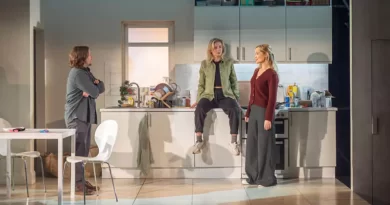
Hettie Macdonald (returning to the theatre after almost 20 years spent focusing on TV work such as Normal People and Howards End) keeps up the tension on the intimate Orange Tree stage, though there are times when the actors need to move more for the audience’s sake in this in-the-round format. Simon Kenny’s simple, effective design features a large cream rug, chaise longue, and stool, with a wood-burner that plays a vital part in the plot. Ben Ormerod’s silver-screen lighting effects suggest the characters’ work backgrounds, while Pouya Ehsaei’s Indian-textured music is subtly evocative.
Pearl Chanda (who appeared in Rebecca Frecknall’s revivals of Cat on a Hot Tin Roof and Three Sisters at the Almeida and The House of Bernarda Alba at the National) makes a compelling Hedda, prowling the stage like a caged tiger. She captures her sardonic humour and dangerous provocativeness, but also her frustrated yearning for freedom. Joe Bannister convincingly conveys George’s boyish naivety and cloying cheerfulness as he tries hard to please his glamorous wife. Jake Mann’s more passionate Leonard is wilfully self-destructive, while Bebe Cave’s demurely clean-cut Alice vainly attempts to hold him to the straight and narrow. Milo Twomey is a suavely sinister Brack, a man of the world who knows how to exert his control. Caroline Harker is George’s intrusively protective Aunt Julia. And Rina Fatania is splendidly feisty as the ever-vigilant Shona who maintains guard over her daughter.