Craiova International Shakespeare Festival
Dana Rufolo in Romania
25 May, 2026
Vermilion cloth cut and stitched to represent streams of blood gushing from Lavinia’s mouth and forearms in Titus Andronicus: Reborn, Edgar challenging Edmund with a cardboard sword and shield in Silviu Purcărete’s King Lear, Brutus and Cassius dancing a jig as the finale of Petty Men, Titania enchanted by Bottom’s modest ass ears set against a blue sky scattered with nimbus clouds in Philip Parr’s A Midsummer Night’s Dream – these are the vivid images that come to my mind after attending the initial four days of the 2026 Craiova International Theatre Festival.
Craiova, Romania becomes a Shakespearean hothouse for ten days, usually in the month of May. The festival began in 1994. Running from 21 to 31 May, the 2026 International Shakespearean Festival is advertised as “the largest in the world”. Not only is this southerly Romanian city, 80 kilometers north of Bulgaria, hosting a prodigious 119 theatre companies and 243 shows and events, but also it features an area with arts and crafts displays on Shakespearian themes designed by and intended for children in a square next to the trim English Park downtown. There is additionally a Shakespeare Village offering outdoor performances and living history recreations of Elizabethan trades such as stitching garments, marketing produce and hammering nails. Publicity advertises that the numerous activities, exhibits and performances taking place outside theatre spaces expand “the event as an urban and community experience” that is intended to appeal to a diverse range of festival goers. In this respect, it resembles the multi-layered atmosphere of the Almada theatre festival.
These remarks (belonging to an enterprising promotion style) distract from the festival’s existential justification. Is Shakespeare “still our contemporary”? This is the theme of a series of papers presented by members of the International Association of Theatre Critics. It was these papers that brought me to Craiova at this time. The festival spectacles indicate that yes, Shakespeare still inspires. Outlandishly offbeat ways of championing Shakespeare such as the Japanese production, by Kaimaku Pennant Race company of Hamlet/Toilet that starts with three men in a public toilet holding a flatulence competition that is also a concert of sounds indicates that, for better or for worse, the four-hundred-year-old plays written by William Shakespeare continue to fuel contemporary imagination.
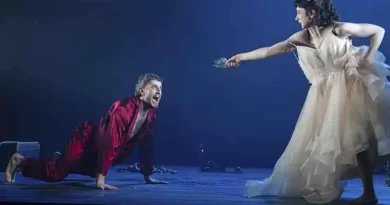
Interestingly, given the world events that are affecting us all presently, the two major theatre productions I saw played the cruelty and violence embedded in their chosen Shakespearean work to the hilt. I mentioned above the striking “costume” of the disabled Lavinia, played by Fūka Haruna, a slight and childish actor with long socks up to the knees and a lilting high voice; the performance focuses on her as a living symbol for the destruction of innocence in the festival-opening Japanese Titus Andronicus: Reborn. It was directed by Ryunosuke Kimura of the company Kakushinhan. Kimura states that his company asks how Shakespeare would “direct his play to achieve optimal impact upon a modern audience”.

Titus Andronicus by the Kakushinhan Company.
Photo credit: Masanori Ikeda.
I can’t say if this is how Shakespeare would have directed, but all the villainous characters are played as absolutely evil. Before she is savaged, Lavinia begs Tamara to save her or to kill her, to which Tamara responds not a whit – not even a facial expression, a gesture or an utterance. Aaron the Moor and “God of Revenge” in his scant and fluttering black outfit that reinforces his nickname “crow” (“raven” on the website) is slightly humane only in the scene when he gently holds his baby – to be abandoned shortly thereafter. The hunting down of Bassianus in the forest is reimagined as a game of golf, and after he is murdered, his body is carelessly clubbed into a hole.
Ovid the author is initially a journalist asking for interviews, and then she states that she is the author of Metamorphoses. We are told, “Civilizations fall. But words precede the moment of cessation.” The hodgepodge of styles in the play keeps our attention. Borrowings from the Noh theatre tradition, ritualistic movements, frozen postures, a monumental storm dramatically conveyed by the rapid shaking of a rectangle of aluminum sheeting held by four men, the demonic nature of the evil characters and the bent-backed weariness of Titus (Tsunao Yamai) as he endures a fate he himself helped unwittingly to create are enchanting.
Nonetheless, Titus Andronicus:Reborn is excessively anxiety-provoking. The half dozen audience members I queried suffered through the experience of watching it. One said it was oppressive, another said he felt like a prisoner obliged by the etiquette of theatre-going to not force his way past spectators’ knees in order to leave. I simply waited out the quiet agony of having to watch the play until its end. The actors were eminently professional, so collective audience displeasure derived from it being unrelentingly horrifying and pessimistic, sometimes even vulgar. In fact, during one of the many diversions from the original script, a character on stage asks why the audience is watching a play of such violence. The answer given is, “Maybe they are close to worlds like this?”
Distressing audience members without offering relief is a serious fault. Why is Titus Andronicus: Reborn painful for audience members to endure? Titus Andronicus staged by Silviu Purcărete in 1992 presented essentially the same narrative, and in that production Titus (played by Ștefan Iordasche) absorbed the pain, the terror, the desire for revenge, the fears, and the cruelty contained in the drama. By reacting as a human being, fully expressive and intensely involved, he made sure that the horrors we witness did not fall leaden at our feet. He internalized and then externalized the emotional shocks that press upon and deform his character with transformative intensity.
It is likely that the stylization in Kimura’s Titus Andronicus:Reborn which cuts short the full emotional horror of the scenes in favor of caricature results in the actors not fully integrating what they are experiencing into their characters. Therefore, undigested, the horrors spill over the stage and are jettisoned into the audience. The result is that the performance posits the emotionally untenable position that life can be lived in a state of utter hopelessness. This certainly raises that ancient question about the function of catharsis in drama and is a subject well worth further research.
The additional major production I saw was King Lear directed by Silviu Purcărete, the brilliant Romanian director with 50 years of directing behind him. He has been associated with the Craiova festival for decades. His production was on the Marin Sorescu National Theatre’s backstage area with audience sitting in bleachers on three sides and screens providing English surtitles. Dragoș Buhagiar provided the minimalist scene design, chiefly one central lightbulb and a large table laden with a fruit display and food upon which the callous characters eat as the drama closes. There is also a banquet scene at the beginning of the play on the same table.

King Lear directed by Silviu Purcărete.
Photo credit: Axel Hörhager.
Again, Purcărete weighed in on the side of savagery in his interpretation. Potential scenes of tenderness in the play are diminished in favor of sadism. In Act One, Cordelia is initially so sure of her father understanding what she means when she states her love for him is no more than is her duty that she avoids eye contact and smiles bemusedly to herself while looking at the table before which she is seated. The instantaneous infuriation of Lear (Claudiu Bleonț) startles the other characters on stage: Goneril and Regan – both dressed in identically cut evening gowns of differing colours, their husbands, and Kent. Lear smears Cordelia’s face with icing from the large cake which he had meant to cut into thirds to represent each daughter’s kingdom. This is an interesting spin on the usual map device. The group’s initial surprise elicits the only moment of general sympathy in the entire play.
From here on out, the drama gallops to heights of transgression, the most visually appalling being not the blinding of Gloucester, already gory, but the intentional tramping on his eyeballs lying on the stage. Even when Lear finds Cordelia dead, his grief is understated. He opens her bodice and then closes it again, rather absentmindedly This stern interpretation is intended to show that Lear is definitely senile, but it leaves no counterbalance to the eldest two sisters’ cackling and chuckling over their limitless ability to belittle their father.

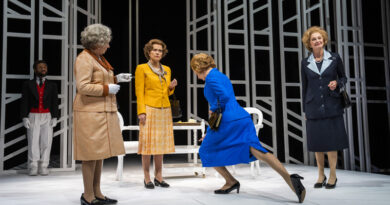
King Lear directed by Silviu Purcărete.
Photo credit: Albert Dobrin.
Whistling winds and a chorus of sounds convincingly place our poor outcasts in the open heath. The modern materials – sheets of plastic provided to protect from the rain, and “poor Tom” Edgar’s cardboard box – seem out of place and confusing, however. Always in a leotard and a prodigious dancer, Edgar (George Albert Costea) comes across as kind and gentle, but why doesn’t his house of cardboard dissolve in the storm? The actor playing Cordelia (Costinela Ungureanu) doubles as King Lear’s fool for which there is a tradition both in the playwright’s day and even now, but unfortunately it was easy to see that both characters were played by the same actor. A sad fool she is, too; very doleful and with a restrained relationship to Lear, utterly the contrary to Birgit Minichmayr’s fond fool in the classic 2008 Burgtheater König Lear directed by Luc Bondy.
Both Purcărete’s King Lear and Kimura’s Titus Andronicus:Reborn suggest that there is no redemption. Acts of vengeance and murder will be repeated compulsively. But hope and light-heartedness came through in less mainstream productions such as Petty Men from Great Britain’s Buzz Studios. It is directed by Julia Levai and was presented in the Sala Brancusi of Craiova’s Ramada Hotel.

Downtown children’s play area.
Photo credit: Axel Hörhager.
Called a reworking of Julius Caesar, Petty Men is a zany piece where two actors – Adam Goodbody as the understudy for Cassius and John Chisham as the understudy for Brutus – rehearse and goof around in a room backstage. They recite their lines in spurts and otherwise make cups of tea, ramble on about Gordon Ramsay, jump rope, bounce a tennis ball, strum the guitar, sing “I’m scared to fall asleep”, drum on the table with bare hands, play word games, and puzzle over what it would feel like to commit murder. The Brutus understudy insists he is not capable of murder and the Cassius understudy counters that everyone is capable of murder given the right circumstances. They “kill the script” by dipping it in a basin of water and then return to rehearsing lines and drinking tea. Occasionally, spooky sounds and announcements come over a screen, and clapping or cheers from the ongoing Julius Caesar frontstage filter through into their small enclosed room. The gist of Shakespeare’s Julius Caesar is delivered. The exception is Portia’s contribution to the play: “We forgot her”.
The understudies are two young men in a Huis Clos or The Two-Character Play – waiting for a chance to break out into the open, to make it. Like thousands of actors who can’t find proper jobs, they are insecure: “We are good actors … good enough”. The rhythm of their rapid exchanges is flowing and light-hearted. Yet, when one of them is called to play Brutus onstage, the other begs him to stay behind and continue to “play”. To no avail. The happiness they enjoy rehearsing together is abandoned for the trumpet call of success. In the final scene, a grown-up Brutus wearing a suit (presumably his costume) dances with Cassius, still in shorts and a tee-shirt.
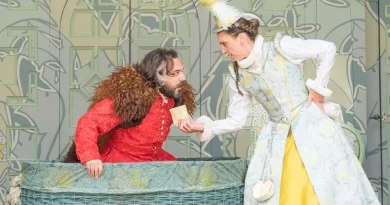
The Shakespeare Village is near the racetrack in Craiova’s enormous Nicolae Romanescu Park which is four kilometers out of town. The president of the festival, Vlad Drăgulescu, will probably see to it that a transportation system is available in the future. The village is a low-key circle of wooden shelters featuring Elizabethan trades and wares. As entertainment, the outdoor A Midsummer Night’s Dream by the UK company Parrabbola was delightful in its robust style of delivery, the troupe intentionally conveying the feel of community theatre, actors’ voices carrying without microphones, music coming from handheld instruments, lines delivered rapidly and rhythmically, and costume changes right there on stage with each actor using their own clothes horse. Spectators sit on bundles of hay.
A surprise was to meet in the village a member of Griffin Historical from the UK, Michael Bradley, transcribing William Shakespeare’s will. He solved one of the mysteries associated with the document by explaining that Shakespeare “provides his wife with the second-best bed because all the best things are going to his son”. This is an entertaining note to end on.