“High Society” at the Barbican Theatre
David Wootton in Central London
★★★★☆
7 June 2026
During recent summers, the Barbican Theatre has established itself as the place to enjoy a classic musical, and especially those written by Cole Porter. So, Anything Goes in 2021 and Kiss Me, Kate in 2024 are followed this year by the highly infectious High Society.

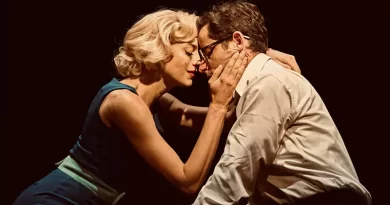
Julian Ovenden and Helen George.
Photo credit: Pamela Raith.
Unlike its predecessors, High Society was written not for the Broadway stage but for the Hollywood screen, and it has a more complex genesis than either of them. It is based on the 1940 film comedy The Philadelphia Story, which was itself based on the 1939 play of the same name by Philip Barry. Barry wrote his play specifically for Katharine Hepburn, and she played the lead Tracy Lord both on stage and screen. On screen, she was accompanied by Cary Grant, as her former husband C. K. Dexter Haven, and James Stewart, as the reporter Mike “Macaulay” Connor. Then, when Cole Porter transformed it into a musical in 1956, the roles were taken by Grace Kelly, Bing Crosby, and Frank Sinatra. Such starry casting can make both films hard acts to follow.
It took 30 years for High Society to reach the stage, and it did so first at the Haymarket Theatre in Leicester, in an adaptation and production by Richard Eyre, which stuck with the songs from the film. However, the version that has really established itself as the basis for many a production is that with a book by Arthur Kopit, which premiered in San Francisco in 1997 and transferred to Broadway in 1998. This used six of the nine songs from the film and then supplemented them with others from the Cole Porter songbook. At the Barbican, director Rachel Kavanaugh employs and adapts Kopit’s version with great confidence, integrating a different selection of Porter’s hits, including “You Do Something to Me”, “Be a Clown”, “I’ve Got You Under My Skin”, and, in the finale, “Let’s Do It”.
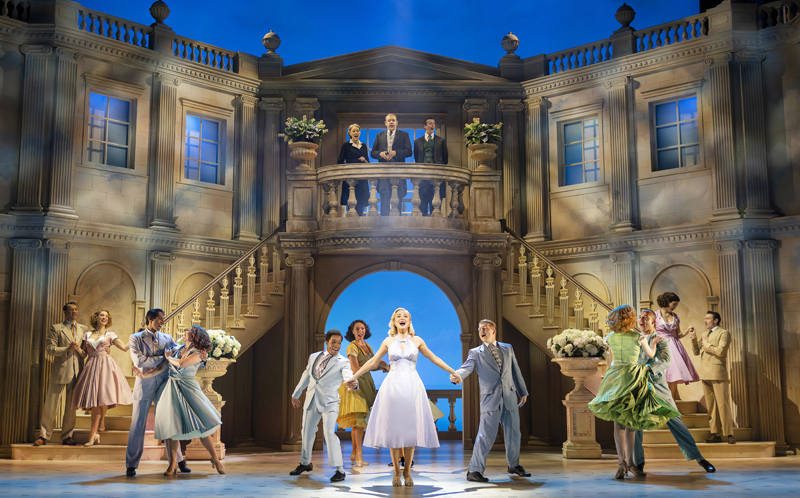
Photo credit: Pamela Raith.
While this may concern some purists in the audience, desirous to see an authentic rendering of the musical, Porter himself set a precedent by often introducing a number from one of his musicals into another. Furthermore, it seems entirely appropriate that a musical comedy about a second attempt at love and marriage should itself be subject to review and revision.
Central to the action of High Society is Tracy Lord (played by Helen George), a Long Island socialite, who, having divorced the wealthy yacht designer Dexter Haven (Julian Ovenden), is now to marry her father’s accountant George Kitteridge (David Seadon-Young). Her choice is disparaged by her younger sister Dinah (Naomi Pacquette), though tolerated by her mother Margaret (Felicity Kendal). George’s inadequacies are thrown into relief by Dexter, who turns up at the Lord mansion after a long absence, during which he has been sailing his yacht True Love (a symbol of his lasting affection for Tracy).
Dexter tells the family that the editor of Spy magazine had intended to expose the infidelities of Tracy’s father, and that he had managed to stop this only by agreeing to get a reporter and photographer invited to the wedding as friends of the Lords’ deceased cousin Junius, so that they could surreptitiously cover it. Enter Mike Connor (Freddie Fox) and Liz Imbrie (Carly Mercedes Dyer), who do not immediately fit comfortably into the sumptuous surroundings of their privileged hosts.
Tracy introduces Uncle Willie (Nigel Lindsay) as her father Seth to cover up his inexplicable absence, and then, when Seth arrives unexpectedly (played by Malcolm Sinclair), he himself is introduced as Uncle Willie. Increasing amounts of comedy are gained from mistaken identity and misapplied affection, as the hosts and guests embark on a pre-nuptial party that is powered by jazz, gin, and copious amounts of champagne.
Tom Rogers’ impressively flexible, even fluid, set – strikingly lit by Howard Hudson – represents various neo-classical buildings on the Lord estate. Working within it, company members establish an irresistible atmosphere from the outset. Dressed initially in a palette of pastel shades, with the men wearing generously cut suits and the women full skirts, deliciously designed à la 1950s by Jon Morrell, they perform Anthony Van Laast’s characteristically inventive choreographed sequences with verve. Morrell then reflects alterations in mood through a great number and variety of costume changes.
Van Laast has the clever knack of being able to accommodate the varying terpsichorean talents of cast members, and so can supply suitable steps for, say, Ovenden who as skilled as he is can it seems act better than he can sing and sing better than he can dance. This knack is demonstrated especially well during the comic number “Be a Clown”, when Ovenden, Seadon-Young, and Lindsay perform a wide range of entertaining moves, few of which are strictly dance steps. However, elsewhere, Van Laast tests the most dexterous dancers to the limits with spectacular high kicks, pirouettes, and splits.
As the lovers at the heart of the action, George and Ovenden play Tracy and Dexter as experienced, world-weary, and susceptible to sparring, like a musical Beatrice and Benedick. If slightly lacking in warmth or depth, they are extremely professional and do much to carry the show. Even more engaging, however, are Fox and Dyer as Mike and Liz. The immensely talented Fox extends his range with assurance in his first significant role in a musical, and he left this audience member wondering why Tracy didn’t finally plump for him rather than Dexter, so appealing is he in every way. Equally delightful and multi-dimensional, Dyer provides one of the most touching moments of the performance when, overcoming the somewhat cruel overmiking, she tenderly sings “I’ve Got You Under My Skin”.
These four principals are ably supported by the other members of the cast. If anything, Seadon-Young has to rein in his natural abilities to play the dullard George as his few opportunities to sing and dance suggest that he could do so much more. Similarly, the gifted veterans Kendal and Sinclair are underused as Tracy’s parents. However, Lindsay is given greater opportunities as the alcoholic reprobate Uncle Willie, and rises to them wonderfully, at times almost stealing the show. And Naomi Pacquette, in the role of young Dinah, on the verge of adulthood, is an ideal foil for George’s Tracy.
In George’s hands, Tracy is shown to mature as a person through the 24 hours or so that are represented on stage, from being told by her father that she fails to exhibit “an understanding heart” to telling Mike that he “will never be a first-rate writer until” he has “some regard for human frailty”, a realization that then allows her to let Dexter back into her life. This injects an element of profundity into what is essentially feel-good, escapist entertainment that rests on the strength of Porter’s score, which is expertly driven by musical director Stephen Ridley.