“Stage Kiss” at Hampstead Theatre
David Wootton in North London
★★★★☆
17 May 2026
When Stage Kiss was first produced in Chicago in 2011, it is unlikely that the company included an “intimacy co-ordinator” to manage the intimate moments between the actors. However, since the Harvey Weinstein scandal of 2017 and the subsequent rise of the #MeToo movement, such a role has become the norm in the industries of stage and screen. So, Yarit Dor is credited as the “movement, intimacy and fight director” for Blanche McIntyre’s Hampstead revival of Sarah Ruhl’s romantic comedy, and the play itself seems more relevant and thought-provoking than ever.
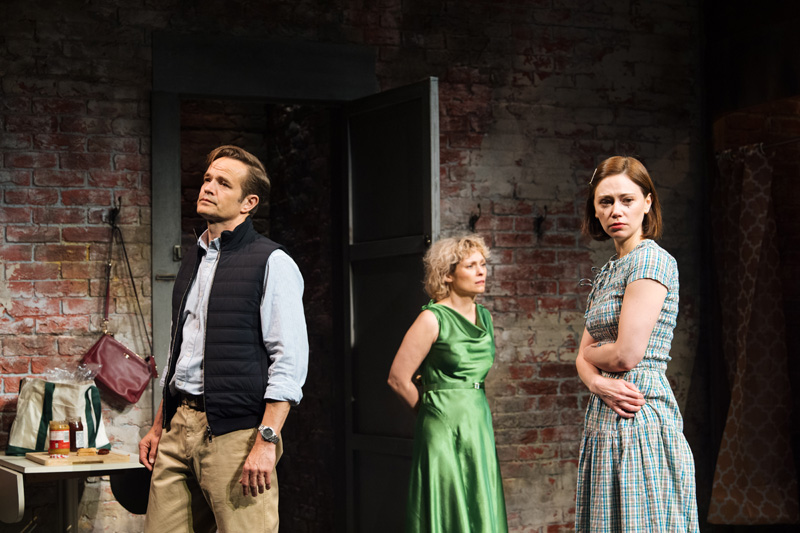
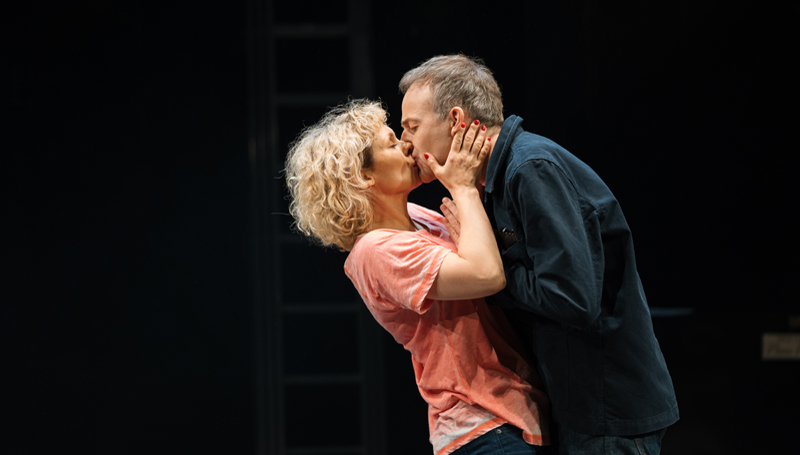
Oliver Dimsdale, MyAnna Buring and Jill Winternitz.
Photo credit: Helen Murray.
Stage Kiss is a highly entertaining and often astonishing exploration of the nature and strength of loving relationships through the action and implications of kissing on stage. The ways that actors kiss in their professional and private lives, and the degree to which their kisses are convincing or authentic, are notions repeatedly tested through a series of scenarios, variations in tone and levels of reality. As a result, one is sometimes reminded of Tom Stoppard’s 1982 play The Real Thing, which was revived at the Old Vic in 2024. However, Ruhl’s play is wilder, and perhaps weirder, in its ambitions.
Act One of Stage Kiss concerns a modern revival of The Last Kiss, a fictional play by “Erbmann, Landor and Marmel”, which is said to have bombed at its Broadway premiere in 1932. Despite this failure, the unnamed Director (played by Rolf Saxon) asserts that “with the proper cast, a new score, and some judicious cuts it will be really very well received in New Haven”. He summarizes the story as a love triangle between a woman in Manhattan with “a rare degenerative disorder”, her “wealthy train mogul” husband, and her “first love”, a sculptor, who travels from Sweden to be with her, but then falls in love with her daughter.
Nevertheless, The Last Kiss contains not only “sad bits” and “funny bits” but also song and dance (the composer for this production being Grant Olding, and the sound designer Gregory Clarke). Indeed, the Director acknowledges that it is “tonally … slippery”, a description that might be equally applied to Ruhl’s own play. However, while Stage Kiss demonstrates a mastery of stagecraft, The Last Kiss is – to put it bluntly – bad. It takes a writer of Ruhl’s sophistication to be able to pen situations and speeches that are intentionally both excruciating and hilarious, and she clearly had great fun doing so.
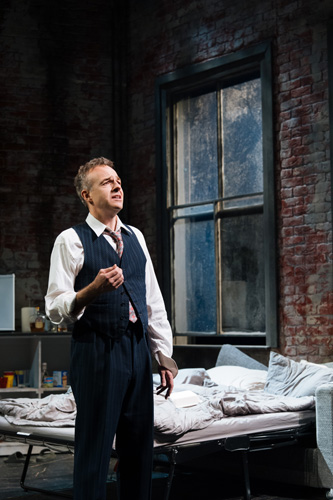
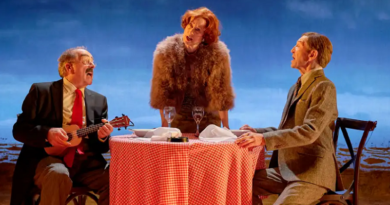
Patrick Kennedy.
Photo credit: Helen Murray.
To a degree, the events of The Last Kiss are mirrored by the lives of its stars, who are never named and who are identified in the script as only “He” and “She” (Patrick Kennedy and Myanna Buring). Having had a relationship that is long in the past, they find to their surprise, first, that they have been cast together and, second, that they are still in love (an understanding initially and tentatively marked by an interwoven pair of internal monologues). And this, despite the fact, that she is now married with a teenage daughter, and he has a steady girlfriend.
From the outset, the kiss is the drama’s central trope. At the audition, She soon introduces a funny fluttering hand gesture to save her from having to repeatedly kiss another actor, Kevin (James Phoon). Then, in the first rehearsal, She and He test a range of kisses. However, the following day, as He is absent, Kevin stands in for him and embraces She awkwardly, “making a little face” through embarrassment and then admitting that he is “not straight”. His statement that it is “a strange job to kiss strangers in front of people and make it look like you know each other” lays the ground for the climax of Act One. After the opening night of The Last Kiss, He and She have an intimate moment in the wings, and She admits that she is scared because “there’s no one watching” and because their contact felt like “a person kissing a person”.
If anything, Act Two is braver than Act One in its construction and writing. On the morning after the last night of the run, He and She are discovered together in the bed of his New York studio apartment, first by his girlfriend, Laurie (Jill Winternitz), and then by her husband, Harrison (Oliver Dimsdale), and daughter, Angela (Toto Bruin). However, as those who perform these roles double as the actors/characters of The Last Kiss, the real and the fictive begin to collapse into each other. This collapse is exacerbated by the arrival of the Director, who not only offers the lovers parts in a play that he has written and intends to direct, but also decides to base the design on He’s apartment. In the next scene, the set is the same but now represents the staging for the Director’s play in its production at Detroit Actor’s Theater. The farcical atmosphere of Act One (comparable to Michael Frayn’s Noises Off) has been overtaken by absurdist metatheatre (more akin to Luigi Pirandello’s Six Characters in Search of An Author). In this metaphorical maze of reflections and refractions, will love win out, and, if so, between whom?
Stage Kiss begins with a near empty stage, and this apparent simplicity provides the audience with no clue as the visual delights to come. Designer Robert Innes Hopkins (aided by lighting designer Oliver Fenwick) presents a veritable box of tricks, in which rehearsal room becomes stage set, and then stage set from behind, before introducing an apartment that doubles as a new stage set, which is then again seen from behind. And his striking costumes also contribute much to the dazzling complexity.
Ruhl’s play provides the highly talented actors with as many challenges as opportunities. They succeed in meeting the constant need to change character and register, and in mimicking – and sending up – coarse acting in performing both The Last Kiss and the Director’s play, entitled I loved you before I killed you, or: Blurry (and, yes, it really is as terrible as it sounds). And they rejoice as much in the physicality of McIntyre’s engaging production as in the agility of Ruhl’s exhilarating dialogue.
Buring is outstanding in the central role of She, and moves with ease across a complex emotional landscape, from being insecure and scatty, on returning to the stage after a long absence, to realizing, at the last, where the true depth of feeling lies. She is well supported by both Kennedy and Dimsdale, who manage to individualize and fill out the parts of lover and husband, which, at times, can seem interchangeable, and which may, in Ruhl’s intricate treatment, be intentionally so.
Of the others, Saxon is especially funny as the ineffectual and unperceptive Director, who repeatedly tells the actors to “follow their instincts” rather than offering his own interpretation, and cannot distinguish good writing from bad. Fortunately, he is not in charge of Hampstead’s production of Stage Kiss, which interprets Ruhl’s excellent writing with aplomb, and which deserves a kiss of appreciation as well as applause.