“Tosca”, Bayerische Staatsoper
Andreas Rey in Munich
14 April 2026
★★★★☆
The Bayerische Staatsoper (Bavarian State Opera) has revived its production of Puccini’s Tosca by the Hungarian director Komrei Mundruczo from two years ago, this time with Italian conductor Marco Armilato on the podium.
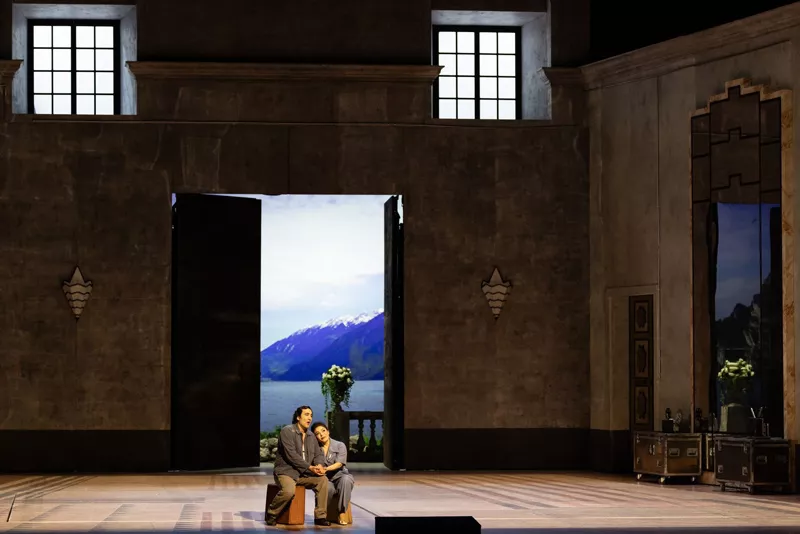
Photo credit: Geoffroy Schied.
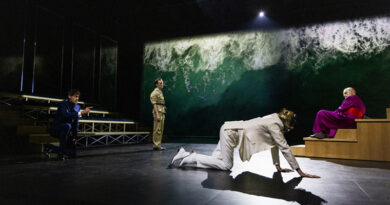
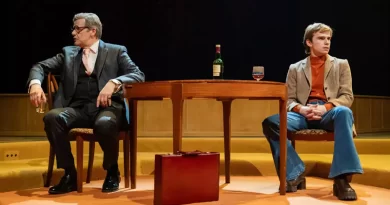
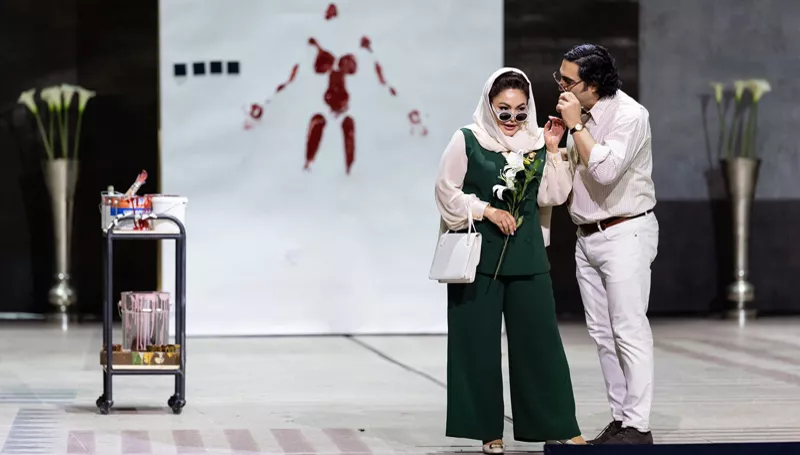
If the scenography and costumes by Monica Pomalre are perfectly executed, situating the drama during the 1930s – first in a modern church, then in Scarpia’s luxurious salon, and finally in his torture cells – it must also be said that the staging tends to exaggerate. Thus, Caravadossi is a painter using Yves Klein’s imprint technique, a Polaroid photographer – which allows for the famous jealousy scene of Tosca regarding the Madonna’s eyes in progress – and a filmmaker of a movie involving a wedding in the church.
The approach even leads to incongruities such as the reading of the Angelus by the priest from the script and Angelotti taking refuge in a trunk. Is all this really necessary? I say this because there is an abundance of good ideas elsewhere. These include subtly highlighting the submission of the altar to the throne with priests in Caravadossi’s prison, the female characters in white dresses stained with blood between the legs following her murder as well as the prefectural police being depicted as a kind of militia. Such pieces of invention are numerous. The actors’ performances are always accurate, each being individually identifiable, thus making the opera extremely effective from a purely dramatic point of view.
The voices are also well chosen and thbis is notably so in the secondary roles. Even though the Angelotti of the Hungarian bass Roman Chabaranok struggles to be heard next to the orchestra, he maintains a clear and fresh voice. And the priest of the New Zealand bass Martin Snell blends into his vice comica with a light bronze timbre.
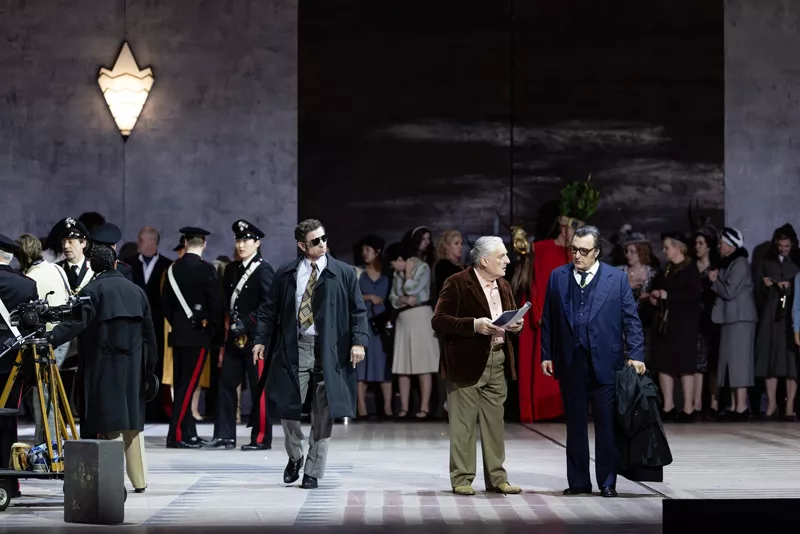
Photo credit: Geoffroy Schied.
But it is the main characters that hold the attention. The Caravadossi of the Uzbek tenor Najmiddin Mavlyanov surprises with the way his timbre develops. He begins during the first aria “L’arte nel suo mistero” with a slightly veiled voice, then takes on amber nuances in front of Tosca in the first act, and finally offers other velvety tones during “E lucevan le stelle…” in the last act. This developmental process is one of the many pleasures for the audience.
The Tosca of the American soprano Ailyn Perez, besides portraying a childlike, almost bigote Flora Tosca in the first act, before revealing her heroism from this character traits in the second act, gives her “Vissi d’arte” an intimate note, delivered as if after a fracture, one of the most touching moments of the evening.
And what can be said about the Scarpia of French baritone Ludovic Tézier! Those who saw him in Vienna in the same role were able to admire him as a sort of nobleman whose elegance was torn apart by the gestures of cheeky children. Here he is even more magnificent as a militia chief, manipulative and unafraid to show his coarseness. He impresses during the “Te Deum” by letting his voice rise like a wave of oil, and he continues to impress during the second act facing Tosca.
The duets needs to be discussed, of course. If those of Tosca/Ailyn Perez with Cavaradossi/Najmiddin Mavlyanov show a couple forced to grow and reveal themselves before dying, those of Scarpia/Ludovic Tezier with Tosca/Ailyn Perez trace the path of violation by the prefect.
The orchestra of the Bayerisches Staatsoper under the baton of Marco Armilato, for its part, preserves Puccini’s silkiness, which began with Manon Lescaut and would continue with Madame Butterfly. The fastidious listener might possibly regret breaks in the intensity of the orchestral flow, a feature that highlights a more narrative than lyrical interpretation, but the orchestral aspect is still a source of great pleasure.
The quality of the performers, both in terms of their acting and their instruments and stage presence, once again made this interpretation a success.