“Macbeth” at the Munich Opera
Andreas Rey in Bavaria
13 April 2026
★★★★☆
The Bavarian State Opera in Munich is reviving its production of Verdi’s Macbeth from three years ago under the direction of Martin Kušej with the young Italian conductor Andrea Battistoni at the podium.
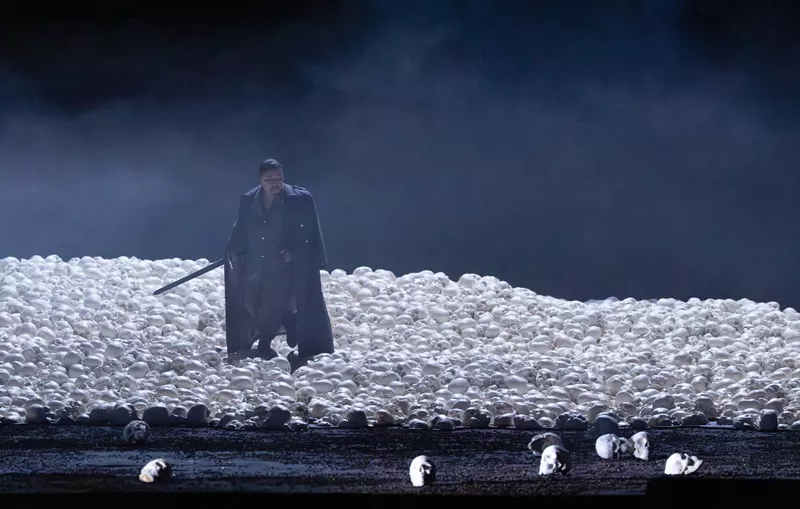
Photo credit: Geoffroy Schied.
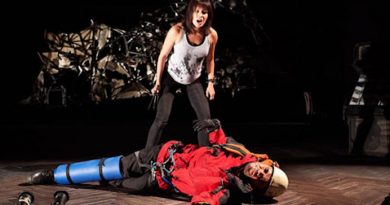
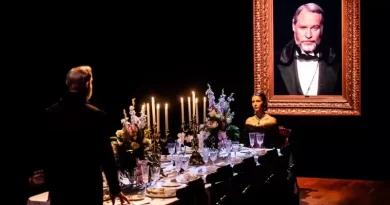
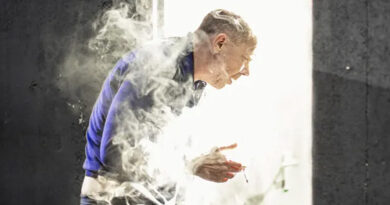
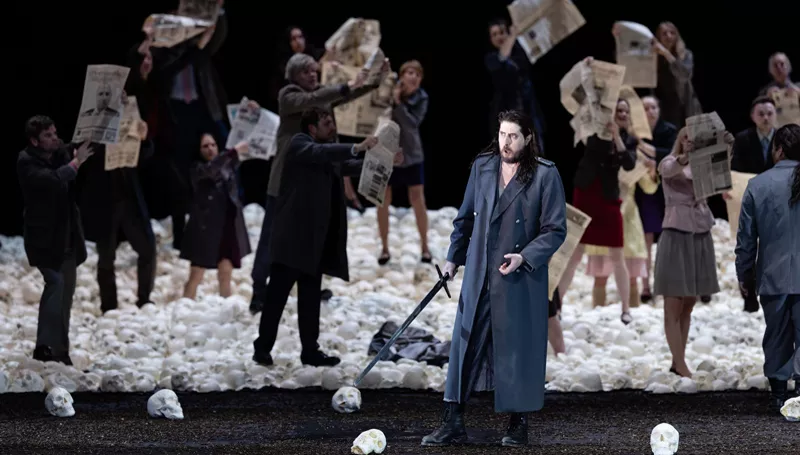
The wager of the Austrian director here is to use the darkest surrealistic aspects of Francesco Maria Piave’s libretto in order to reveal the horror of the curse weighing on the crown of Scotland. This is first seen in the countless skulls strewn across the stage, and later with characters hanging by their feet, like Banco — some even nude while the chorus sings “Pattria oprresa! il doce me.” This exhortation thus follows the libretto to the letter, while allowing some digressions, like the witches as children and a science fiction time setting with very twentieth-century costumes and props such as swords from the Middle Ages. This interpretation reveals what Verdi’s opera will have of Machiavellian in Il Trovatore and psychological in La Traviata and shows without insistence a parallel with Wagner’s operas in its medieval aspect.
Just as with Wagner, this one has few female characters – only one here, two for his contemporary Lohengrin – goes all the way through a curse, like The Flying Dutchman, and is essentially cyclical, like Tannhäuser, with the pair of Banco Junior and Macduff taking up that of Macbeth and Banco Senior. The German-Italian duality having always nourished the lyrical world up until Puccini’s death.
With this framework established, the viewer will continuously find ingenious ideas here, such as the carrying of the Scottish crown with the four hands of the Macbeth couple, the Scottish palace reduced to a simple tent, or the friendship between Banco and Macbeth being marked by gestures of rivalry such as crossing swords.
While being modern, this staging thus makes use of the tradition of this opera, and that is to its credit.
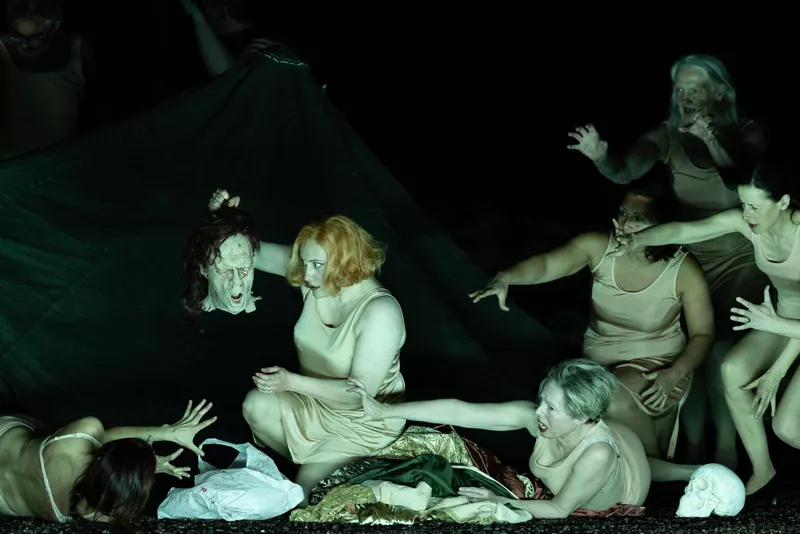
Photo credit: Geoffroy Schied.
The other great quality of the production is the choice of singers for the central male roles. The Banco of the Italian bass Roberto Tagliavini, articulated, dark but clear in timbre, from his “Chi siete voi? Di questo mondo,” like a bass line that will be broken by his death, is particularly effective. Connoisseurs will appreciate his address to his son “Studia il passo, o mio Figlio …,” full of a noble and manly tenderness.
The Macduff of South Korean tenor SeokJong Baek, with his clear timbre, is undoubtedly more impressive than moving. The brightness of his voice almost makes one forget the pain revealed in his arias “Di destarlo per tempo il Re m’impose” and especially “O figli, o figli miei! da quel tiranno”.
In addition to these two admirable performers, the greatest success of this evening is undoubtedly the performance of Mongolian bass Amartuvshin Enkhbat, who, besides perfectly mastering his acting, delivers his solos admirably. How he manages this remains a mystery, but he gives his voice a soft, veiled quality in moments of weakness, such as during the first acts, and a firmer foundation in the most tyrannical moments, even in his aria “Perfidi! All’anglo contro me v’unite!” . Each of his moments, each of his arias shines here with its dark light, and could serve as a lesson for generations to come.
The Lady Macbeth of the Spanish soprano Saioa Hernández is certainly remarkable for technique, firmness, notably in her first aria “Ambizioso spirto” but she approaches the role of the thane’s wife like a classical opera role whereas, according to Verdi’s stated intention, it should be approached outside the usual aesthetic. Verdi wanted a raw voice, a voice that is therefore unworked. Perhaps a Betty Smith, a Janis Joplin, or closer to us, a Shannon Shaw from “Shannon and the Clams” voice, would be better suited for the role.
Nevertheless, the quality of the voices makes the duets, and especially the male duets, very successful, notably those of Banco and Macbeth. But the Macbeth couple, both in their acting and in the harmony of the voices, are also accurate.
The Munich Opera Orchestra under the direction of Andrea Battistoni (still in his thirties – 38) maintains a beautiful string section, even if sometimes the balance with the voices is uneven. He still struggles to manage the cymbals and brass well, a failing that gives them a slight marching band quality. But above all, by following the score’s narrative too closely, he nearly undermines its lyricism.
Although the staging goes further than the orchestra, for once, this Macbeth, thanks to the voices, and particularly its Macbeth, is worth the trip.