“Othello”, Theatre Royal Haymarket
Jeremy Malies in the West End
7 November 2025
★★★★☆
Talk to people in theatre biz about this play and they’re likely to give you a truism, “The better your Iago, the harder it is for your Othello.” However much of a team player he might be – and the track record shows he is indisputably focused on group endeavour – Toby Jones as Iago must set a high benchmark as he buzzes around David Harewood playing Othello.
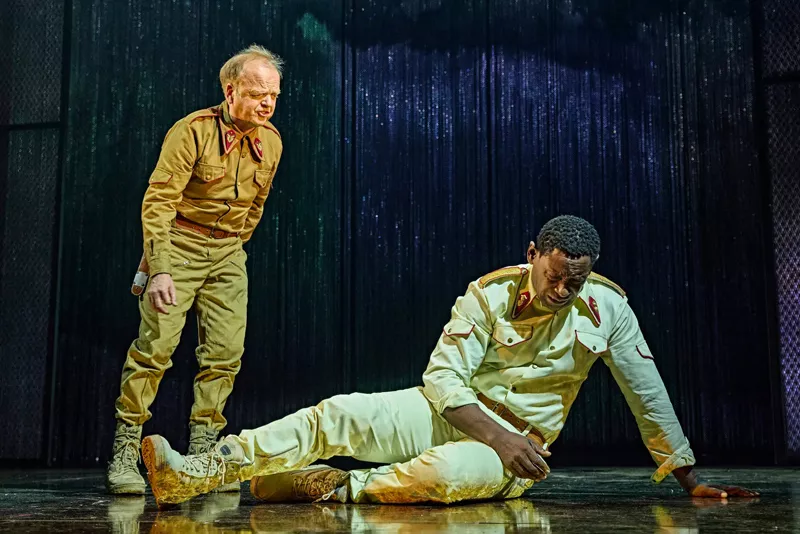
Toby Jones and David Harewood.
Photo credit: Brinkhoff/Moegenburg.
Publicity material says the production, as directed by Tom Morris, is contemporary. But I saw it as timeless, and the clunky line (surely odd even at the time that Shakespeare wrote it) “Keep up your bright swords, for the dew will rust them …” seemed all of a piece against the huge Turneresque seascape that set designer Ti Green opts for as a backcloth.
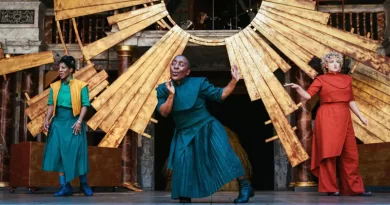
In the first scene Green has Venice dominated by abstract linear shapes to no obvious purpose. But during the sea journey to Cyprus these flip upwards in a brilliant piece of stagecraft and become the ribs of the ship in the storm that is destroying the Turkish fleet nearby. Richard Howell’s lighting reinforces this and there is more of a naval tone than I can ever remember in the play. Frequently, Howell sheds light on the stage as though it has been refracted through sea fret.
Morris creates a convincing military backdrop (even though he minimizes what can be a tedious scene of barrack room singing) and also persuades us that the society we are watching is irredeemably racist. Talk to young people today brought up in multi-ethnic colour-blind cities and they will question the plot here, saying that race is not enough these days to establish Othello as an outsider.
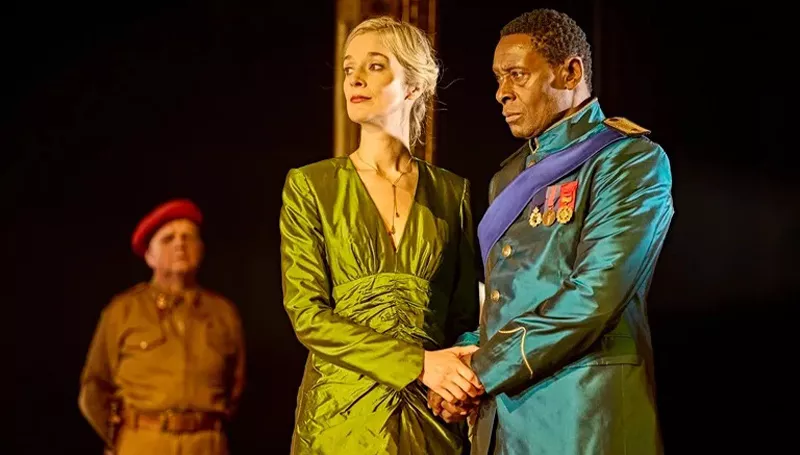
Peter Guinness as Brabantio sums up the tenor of the society with “Who would be a father!” when he hears that Desdemona (Caitlin FitzGerald) has been seen with the Moor. Crucially, Brabantio regards any interaction between the pair as an immediate piece of deception in and of itself. He stresses this to his fait accompli son-in-law with, “Look to her, Moor, if thou hast eyes to see: / She has deceived her father, and may thee.” Enchantment at this soldier’s romantic past is not shared across the family.
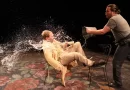
Jones puts his comedic skills on display but does a high-wire act in terms of balancing these with Iago’s poisoning of Othello’s mind. As Iago pretends to have watched Cassio (Luke Treadaway) having pretty much a wet dream about Desdemona, we laugh while also knowing that an innocent woman is being traduced not to mention Cassio being slandered while Othello’s mind is being poisoned in a way that will prompt him to murder and then suicide.
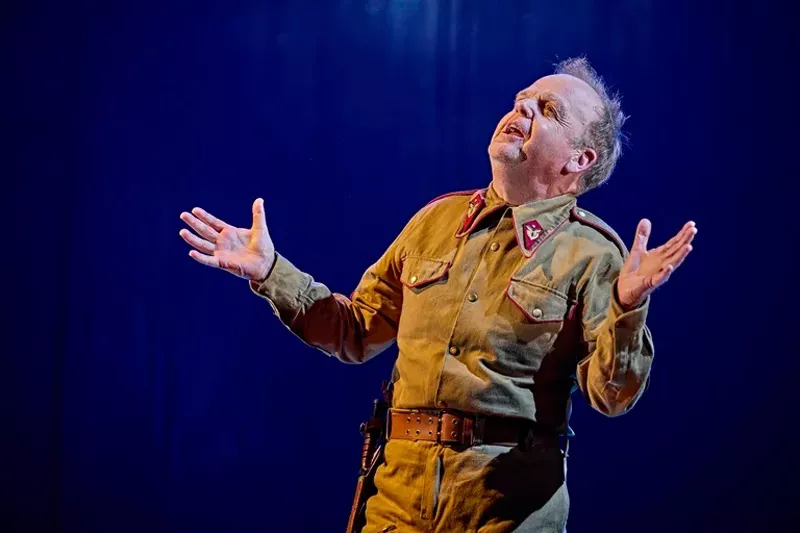
Toby Jones as Iago.
Photo credit: Brinkhoff/Moegenburg.
I was struck by the costume given to Tom Byrne as Roderigo. Sabia Smith and Mariama Bojang dress him in two different pantaloon or harlequin outfits to underline the ludicrous nature of his aspirations towards Desdemona and the fact that he is at core a fop and chancer. This works. The military costumes are fanciful but still splendid to look at. Junior and middle-ranking officers are either in khaki drills or are NATO-esque (though bizarrely equipped with jungle knives) while Harewood is given a tunic that is a cross between a US Naval officer and a Mexican storming the Alamo.
There is languorous, forced and possibly over rehearsed (movement director Yarit Dor) byplay between Othello and Desdemona. It certainly doesn’t seem spontaneous. I saw not a jot of chemistry between them, and it’s remarkable that Harewood’s verse-speaking ability (voice coach Carol Fairlamb) manages to catch the lyricism and magic in the major speeches during which he reflects on her. But catch all this Harewood does. He is generally magnificent, never more so than in the major early speech that includes: “She loved me for the dangers I had pass’d, / And I loved her that she did pity them.” Harewood’s PTSD seems engrained on his face here. Hotspur in Henry IV is supposed to be the first dramatic description of combat fatigue. I would say that it is here also.
Like most members of the creative team, PJ Harvey (busy in theatres having worked on London Tide at the National) shows restraint with single pinging notes at times of introspection and swelling reedy tones when we are at sea. Harvey never swamps the narrative flow. And Morrison shows good sense when reining in the dozens of filthy puns in Iago’s speeches. The point is soon made about his sewer mouth; the double meanings don’t always come across the centuries unless you are a textual scholar and the jokes can grow wearisome.
I question the blocking late on. Isn’t it clear after Desdemona’s strangling that however physically brave Emilia (Vinette Robinson) is, her main fear is that she is now confined with a murderer and has no obvious point of exit? Morris seems unaware of this or not interested and gives Robinson no pointers. Of course Emilia’s speeches on jealousy, fidelity, and the nature of desire are among the best in the play but I didn’t expect her to eclipse FitzGerald whose Willow Song is flat and avowals of faithfulness colourless.
Jones and Harewood are of course a pincer movement. Jones proves adept at projecting self-loathing. He makes his character’s carnal imagery compelling like a lurid rollercoaster ride, daring us to laugh at gags that only his character could find amusing. His Iago loves nobody but his present self and his self-image after the expected (but thwarted) advancement. If he loves Desdemona, it is “Not out of absolute lust … / But partly led to diet my revenge.”
Having convinced us of his character’s magnetism for both the woman he loves and his subordinate officers, Harewood has the sense to simply sit on the pulse of the verse. He is credible both as a career soldier and as an individualist who has defied the prejudices of a society where many (the older generation at least) see him as an interloper.
At times this is an unsteady evening, but nothing is forced or modish. It can be ravishing on the eye and would be a good introduction for curriculum audiences both as their set text and as a general way in to Shakespeare. The play is on the whole well served.