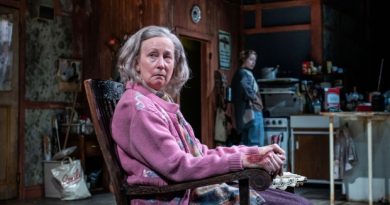
“The Assembled Parties” at Hampstead Theatre
Jane Edwardes in North London
★★★★☆
27 October 2025
A splendid Christmas tree adorns the stage at the start of The Assembled Parties at Hampstead Theatre. In many plays, this would be a warning of family feuds and recriminations to come. The American playwright Richard Greenberg is more subtle than that. Instead of massive eruptions, he puts a family onstage which is capable of unexpected acts of kindness as well, inevitably, as the odd cruelty.

Tracy-Ann Oberman and Sam Marks.
Photo credit: Helen Murray.
At the opening of the play, the Christmas celebrations are taking place in 1980 within a vast rent-controlled apartment on the Upper West Side, New York. Reagan has just been elected; AIDS is about to make its presence felt. Ben and Julie, though Jewish, are hosting a Christmas lunch: goose, roasted potatoes, and rumaki. James Cotterill’s revolving design allows us to explore several of the impressive rooms. Jeff, a guest and friend of their student son Scotty, falls for both the apartment and its inhabitants in a big way.
Early on, Greenberg intriguingly references another playwright. One of the characters recalls the wit, charm, and breezy dialogue of Noël Coward. Those are characteristics of Greenberg too. His characters have a fluency and articulacy that most of us would envy.
The family is dominated by two very different women, who make a fascinating pairing. Jennifer Westfeldt’s Julie was once a movie star who gave up her career to become a homemaker. She is warm, welcoming, and whimsical. Her favourite word is “lovely”, and for her the world and all its inhabitants are lovely. She wants everyone to be happy. Even when she was asked to give up a precious ruby necklace to her sister-in-law, it is said that she did it with grace and a lack of resentment. It’s quite a surprise when she sharply refers to Bing Crosby’s “White Christmas” as “a tiny acoustic rape”.
The second half of the play is set in the same apartment in 2000, now looking somewhat distressed, by which time Julie’s life has lost its rosy glow. Two of the men in her life have died, money is short, her son can’t even look her in the eye when he makes a rare visit, and she herself is dying of cancer. Even then, she concentrates on making an ambitious celebratory feast, laughing at herself as she can’t be sure that there will be more than three people at the table. She is dressed in a glamorous, salmon-pink frock that her mother once made. Westfeldt is grace personified, but her sing-song voice does tend to grate after a while, making it hard to feel as affectionate towards her as the characters do onstage, who strive to live up to her expectations.

Sam Marks and Julia Kass.
Photo credit: Helen Murray.
Julie and her sister-in-law, Faye, should hate one another, but they don’t. Tracy-Ann Oberman is completely convincing as a Jewish mother with an unbridled tongue. Every gesture rings true. Wearing a blonde bouffant wig, Oberman grabs one’s attention as she sweeps into the apartment with Mort, her husband, and Shelley, her unprepossessing daughter. Faye’s mission is to get her brother, Julie’s husband, to go and see their dying mother. Instead of marrying a wealthy man like Julie, Faye slept with a nobody in the neighbourhood and immediately got pregnant. She ends up marrying Mort (David Kennedy), who is not a bad sort but definitely not a catch. To Faye’s great distress, her mother can’t forgive her. Faye’s a cynic who is bewildered by Julie’s optimism, and, for the first half of the play, is dependent on anti-depressants. Later, it is revealed that Mort is fonder of her than she realizes. Her life is turned around by a ruse that is engineered by her husband and of which she is unaware.
Although this play was first seen on Broadway in 2013, it’s taken a long time to get here. Sadly, Greenberg, best known for the Pulitzer Prize-nominated Three Days of Rain and the Tony Award-winning Take Me Out (both staged at the Donmar Warehouse, in 1999 and 2002 respectively), died of cancer earlier this year. The peculiarly named The Assembled Parties is steeped in a gentle humour and there’s a strong sense that Greenberg was preoccupied with mortality when he wrote it.
I am not, however, convinced by Blanche McIntyre’s production, which sometimes hits the comic pedal too heavily. Sam Marks’s Jeff, the onlooker on Julie’s life who becomes increasingly involved, appears to be in a farcical comedy at the beginning of the play, only relaxing into a more truthful performance later. Equally, Julia Kass as Shelley stands out, not in a good way, for her grotesque portrayal of a daughter who feels unloved.
Greenberg’s play isn’t perfect. It is very wordy, the exits and entrances can be contrived, and it occasionally feels as if it is disappearing down a blind alley. And yet, he writes about his characters with a clear-eyed tenderness, asking us to understand and not condemn. It is a bitter-sweet experience to see their lives unfold. In the end, I was surprised to find that I had tears in my eyes.