“Hadestown” at Lyric Theatre
Franco Milazzo in the West End
★★★☆☆
23 March 2026
As the old saying goes, the fact that there’s a highway to hell and only a stairway to heaven says a lot about anticipated traffic numbers. By that logic, Hadestown – a modern retelling of the ancient Greek myth of Orpheus and Eurydice – sits just off the slip road, merrily directing traffic. With a fresh cast now clocking in, it’s time to see how this latest intake fares on the eternal shift.

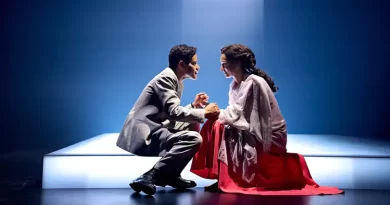
Bethany Antonia and Marley Fenton.
Photo credit: Brinkhoff-Moegenburg.
There are musicals that arrive fully formed, strut about for a season, then politely leave. And then there is this show that has spent the better part of two decades tinkering with its own myth, like Orpheus endlessly rewriting that one song in the hope it might finally land. From its Vermont workshop origins in 2006, through concept album adolescence and winning eight Tonys on Broadway, to its current West End residency, this is less a production history and more like an Icelandic saga. You half expect Hermes to pop up at the interval and narrate the development timeline.
And narrate he does. In the ever-capable hands of maestro Clive Rowe, Hermes is as warm, wry, and rhythmically precise as ever. Rowe doesn’t so much guide you through the story as gently usher you along, hand in hand through scene after scene. His performance is crucial, because the simple narrative itself has a tendency to sag under its sentiment rather than soar with its adventurous spirit. Without his buoyant presence, there’s a sneaking suspicion that the whole enterprise might quietly wander off into the underworld and stay there.
If Rowe is the show’s spine, then Rachel Adedeji’s Persephone is its blazing, boozy heart. Her voice cuts through the hellish gloom like a well-aimed shaft of sunlight, particularly in “Livin’ It Up on Top” and the deliciously sardonic “Our Lady of the Underground”. Adedeji finds both the mischief and melancholy in a character trapped between worlds and in a rather disappointing marriage.
That marriage, of course, belongs to Hades, here played by Alastair Parker. With his deep voice and charismatic figure, he stomps around like a baritone who got lost on his way to Covent Garden. He does what he can with a role that feels curiously underwritten for the literal god of the underworld. Hades begins as a demonic taskmaster and ends as someone swayed by a song, a resolution which may be efficient but is emotionally thin. His big number “Why We Build the Wall” is filled with lyrics that have echoes of Trump on the stump circa 2016: “How does the wall keep us free? / The wall keeps out the enemy / And we build the wall to keep us free / That’s why we build the wall / We build the wall to keep us free.” It’s long, it’s loud, and it hammers its point home with all the subtlety of a lead-wrapped brick.
As for the young lovers, Marley Fenton’s Orpheus and Bethany Antonia’s Eurydice have their moments. Individually, they shine: Fenton’s falsetto floats sweetly through “Wait for Me” and “Epic III”, while Antonia brings a grounded steeliness to Eurydice’s plight. Together, though, they never quite ignite. The material has enough in it to entice, entertain and entrance, but the pair never really bring to life its deepest emotions. If this really is a love worth defying death for, we are rarely made to feel it. So when at the end Orpheus tragically looks back to Eurydice, we look over to the exit.
Visually, it’s all a touch underwhelming. This is a story with immense creative potential that spans the overworld and the underworld, life and death, hope and despair, but Rachel Hauck’s set design feels oddly restrained. Lighting designer Bradley King’s language is too similar for both realms. This combination leaves the audience to often rely on expository cues and imagination to locate the characters. The central revolve, which dutifully goes up, down, and around and around literally and dramatically does much of the heavy lifting. After all these years of development, you might have hoped for something a little more, well, mythic.
There is still plenty of energy in Rachel Chavkin’s snappy direction and David Neumann’s witty choreography. What truly elevates the evening, however, is the music itself. Anaïs Mitchell’s score remains the show’s undeniable triumph, and the on-stage band is its beating heart. The blend of folk, jazz, and blues rhythms gives Hadestown its distinctive pulse, lifting scenes that might otherwise drift. It’s here, in the interplay between voice and instrument, that the show feels most alive, most urgent, most worth the journey.
But therein lies the rub. Hadestown is a musical that, by its very nature, resists looking back. It is about ploughing ever forward: find the girl, write the song, escape from Hades. Yet after nearly 20 years of evolution, one can’t help but feel that, while the score is superb, the surrounding production hasn’t quite kept pace. The road to the underworld is long, and if this show is to travel it for another two decades, it may need more than a beautiful song to see it through.