“Twenty Thousand Streets Under the Sky” at Southwark Playhouse Borough
David Wootton in South London
★★★★☆
19 September 2026
Patrick Hamilton is equally remembered as a novelist and a playwright, though his most famous works in those two fields are very different from each other. The plays Rope (1929) and Gas Light (1938) are taut thrillers, while such novels as Hangover Square (1941) are more psychologically complex, often semi-autobiographical, explorations of lonely Londoners. It is therefore interesting to reflect on how Hamilton himself might have adapted one of his novels for the stage.

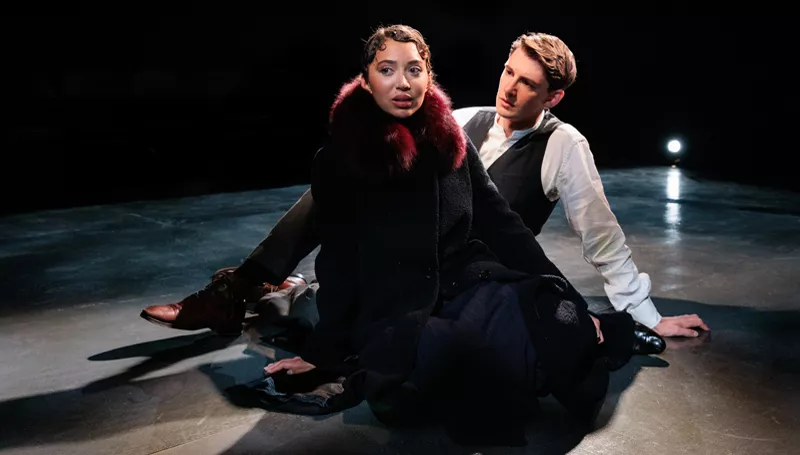
Alex Bhat as George Perry.
Photo credit Mitzi de Margary.
Late in life, Hamilton did adapt his novel Slaves of Solitude (1947) into the radio play Miss Roach (1958), while both before and since his death others have attempted to dramatize his work for stage, cinema, and television. These include the playwright Kevin Elyot who in 2005 adapted Hamilton’s ambitious trilogy of novels Twenty Thousand Streets Under the Sky (1929–34) for the small screen. Now Simon Reade has produced a fresh adaptation of that trilogy for the stage, which is sensitively directed by Matthew Iliffe and movingly performed by the theatre company Troupe at Southwark Playhouse Borough. The result is a surprisingly fine distillation brought vividly to life.
Each of the novels in the trilogy focusses on the perspective of a single young character: Bob, a waiter at The Midnight Bell, a pub off the Euston Road; Jenny Maple, Bob’s girlfriend, who is a prostitute; Ella Dawson, Bob’s colleague, who is a barmaid. However, the structure of the trilogy is unusual, with the first and third novels running in parallel time, and the second novel providing Jenny’s back story. Understandably, Reade unifies them into a single, simplified narrative, while incorporating Jenny’s back story as a flashback.
On entering the larger of the two auditoria of Southwark Playhouse Borough, the stage, set out as a theatre-in-the-round, seems almost achingly empty. One wonders how it could possibly represent the “twenty thousand streets” of Hamilton’s title, and especially those of the square mile or so that encompasses Fitzrovia and Soho, where most of the action takes place. Yet, this is almost effortlessly realized through evocative light and sound, and a few effective furnishings, which together contribute to a beautifully fluid production that is simultaneously naturalistic and dreamlike. Only a street lamp and a pub sign are permanently, and perhaps symbolically, in place. (The sets and costumes are designed by Ellie Wintour, the lighting by Alex Musgrave, and the sound designed and music composed by Elizabeth Purnell – all working together in inspired harmony.)
As the play begins, a plank-like structure drops from above and hovers just above the head of Bob (played by Jordan Scowen). Lights then shine through it to cast a map over him and across the floor, so that he is almost caught in a cartographical net. He expresses his literary ambitions, as if he is talking into being the narrative that the audience is about to see. However, he is soon replaced by Jenny (Yanexi Enriquez), who is keen to tell her story about her relationship with Bob. Clearly, they both have strong, perhaps competing, points of view. And this is emphasized later in the play, when Bob tells her that he is going to be an author, and she responds, “I’ll write a book one of these days.”
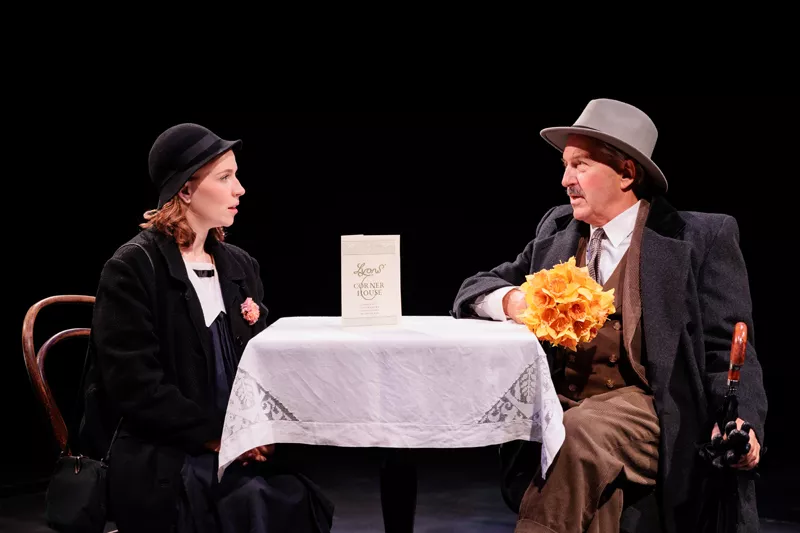
Rosalind Lailey and Michael Maloney.
Photo credit: Mitzi de Margary.
The plank drops down onto a chest to become the bar of The Midnight Bell. Bob and Ella (Rosalind Lailey) prepare to serve, and customers soon arrive. The first is the elderly Ernest Eccles (Michael Maloney), who will become Ella’s admirer. The second is Jenny, who enters with Prunella (Lucy Gray), her friend and fellow sex worker. Reade achieves a clever conflation of characters, and, while necessarily filleting the plot, succeeds in retaining its essential spirit.
Though nothing can quite compensate for Hamilton’s hauntingly detailed descriptions of The Midnight Bell and other settings, many aural and visual touches accomplish much, as in the auditory tapestry that weaves together everyday noise with popular song, and in the frequently changing illumination that so well defines each of a variety of spaces. These range from the disreputable drinking and dancing dens of Soho, through the more respectable tea shops of Covent Garden, to the refreshing heights of Hampstead Heath.
Once the awkward but touching relationships between Bob and Jenny and between Ella and Ernest have been clearly established, the audience is presented with the darker, more disturbing liaison between Jenny and George Perry (Alex Bhat), which led her to leave the service of two elderly ladies and turn to prostitution. A conflation of three characters in the novel, Perry is irresponsible and predatory, and he involves them in a motor accident (a trope in Hamilton’s writing that was based on personal experience), before he takes her home to seduce her. Though far from ideal, the other relationships in the play have, by contrast, a semblance of normality, and are at least fuelled by mutual, if incompatible, vulnerabilities.
All members of the cast of six give affecting performances, and move well in Wintour’s convincing costumes. Scowen’s Bob is an idealistic innocent abroad, who is so infatuated with Jenny that, while he is not blind to her failings, always convinces himself that she will behave better next time. Enriquez’s Jenny only just manages to protect her susceptibility with a shell of brittle self-interest, and conveys this quality so well that it matters little that she is not as Hamilton described her. Bhat’s Perry is a frightening presence, both physically in his stature, towering over Jenny, and emotionally in his selfishness, incessantly coaxing her to conform to his will.
Lailey’s Ella is straightforward and sensible, while sufficiently willing to make compromises to consider a less than satisfactory suitor. Maloney’s Ernest is a romantic manqué, ready with a grand gesture and ostensibly eager to give all for love, yet victim to petty vanities and tortured by the opinions of others.
In some ways, Gray has the hardest task, making the most of three very different supportive roles. In addition to Jenny’s friend Prunella, she plays Jenny’s landlady, who fields Bob’s phone calls, and the waitress in a tea shop, resigned to receiving small tips. She injects a lightness of touch, while suggesting the wider population of London’s twenty thousand streets.