“Golden Boy” at Almeida Theatre
Neil Dowden in North London
★★★★☆
19 September 2026
Clifford Odets was seen as the “golden boy” of American theatre in the 1930s. But after making his name with socio-political dramas arising out of the Great Depression, he worked mainly in Hollywood with limited success, and by the time he returned to Broadway he had been overtaken by the likes of Tennessee Williams and Arthur Miller whom he had influenced. He also later felt a backlash after giving testimony to the House Un-American Activities Committee (like his friend and colleague Elia Kazan), with his work drying up. When he died aged only 57 in 1963 many regarded his career as one of unfulfilled promise. Odets’ plays are rarely staged in the UK these days, but now at the Almeida Theatre Sam Yates has thrillingly revived his biggest commercial success Golden Boy with screen star Josh O’Connor.
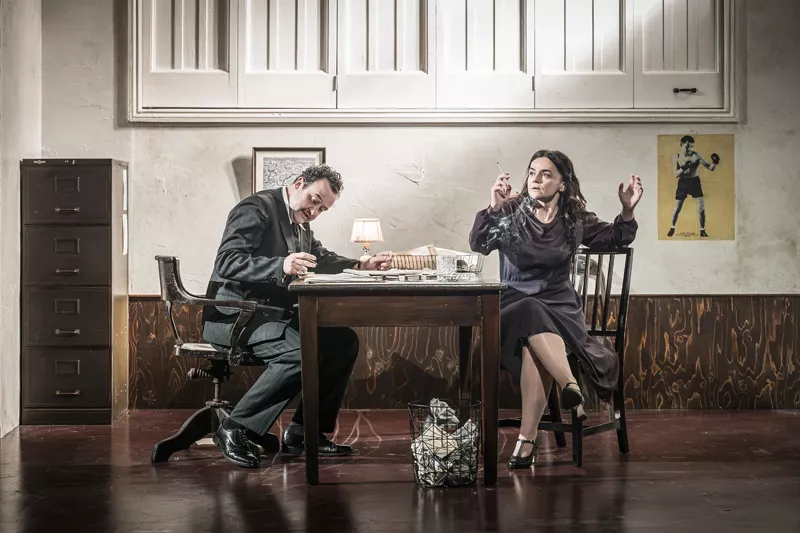
Daniel Mays and Hayley Squires.
Photo credit: Marc Brenner.
Joe Bonaparte is a young Italian American in New York who forsakes his musical talent and chance of working as a professional violinist in favour of the fame and fortune of being a prizefighter. Hustling boxing manager Tom Moody is determined to exploit him to the max, keeping him under control with the help of his mistress Lorna Moon, with whom Joe falls in love though she feels loyalty to Tom. Disillusioned, Joe stops trying to protect his hands for violin-playing and starts to hit out ruthlessly in the ring, with gangster Eddie Fuseli now owning a piece of him while Mr Bonaparte despairs as his son wins fights but loses his soul.
Odets seems to be recycling his own dilemma of choosing between the artistic fulfilment of writing for a politically conscious theatre and the glamorous, material benefits of working in Hollywood. But Golden Boy also dramatizes the attractions and pitfalls of the American Dream, or a consumer capitalist society in general, especially from the perspective of a second-generation immigrant (Odets’ Jewish parents were from Eastern Europe) who sets their eyes on the main prize. There is a strong sense here of Joe betraying (or even killing) his younger, true self for whom the harmony of music is so important, as he rejects the 21st birthday gift of an expensive violin lovingly offered by his father and turns his back on the moral values of his family – to engage in a violent activity that brings him financial rewards including the luxurious Duesenberg car in which he speeds recklessly.
Odets’ gritty, hard-boiled dialogue still packs a punch while lines like “Life shouldn’t be printed on dollar bills” and “You are only lost if you knew where you were going” would have fitted well into screwball comedies or film noir movies. His lyrical street language still brilliantly walks the line between naturalism and expressionism, though the play is a bit schematic and towards the end tips over from heightened intensity into outright melodrama. Golden Boy was made into a film in 1939 starring William Holden and Barbara Stanwyck, and a musical in 1964 with Sammy Davis Jr. when the action was transposed to an African American community in Harlem. This stirring production of the play is the first this side of the Atlantic for 25 years, and is a welcome follow-up to the Almeida’s excellent revival of Odets’ Awake and Sing! in 2007.
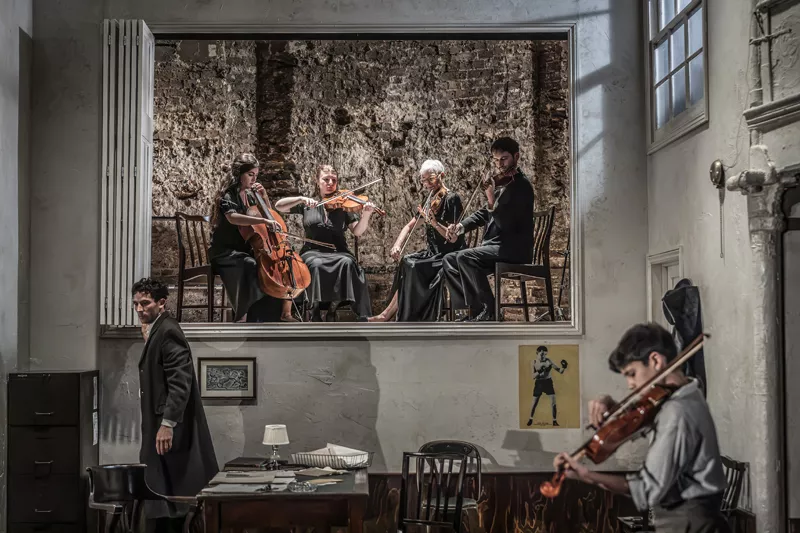
Set by Rosanna Vize.
Photo credit: Marc Brenner.
Yates’s staging is dynamic, conjuring up the thrusting energy of the Big Apple in the 1930s, but bookended by O’Connor sitting alone at the back of the stage deep in reflection and illuminated by just one candle. Rosanna Vize’s effective, split design with a beautiful wooden floor and solid furniture divides the action mainly into the Bonapartes’ home and Moody’s office, signalling the domestic and work settings. In an alcove at the back, whose shutters are opened and closed according to the state of Joe’s conflicted mind, a string quartet plays Isobel Waller-Bridge’s vibrant score, as if it’s happening in his overheated imagination.
In another coup de théâtre, Jack Phelan’s live on-stage video images are displayed from a camera inside a punch bag that unsteadily swings back and forth in fight scenes, which boxing director Kate Waters forcefully suggests with stylized movement. And Dan Balfour’s splendid sound design evokes the raucous boxing crowd as well as the fast, noisy traffic of NYC.
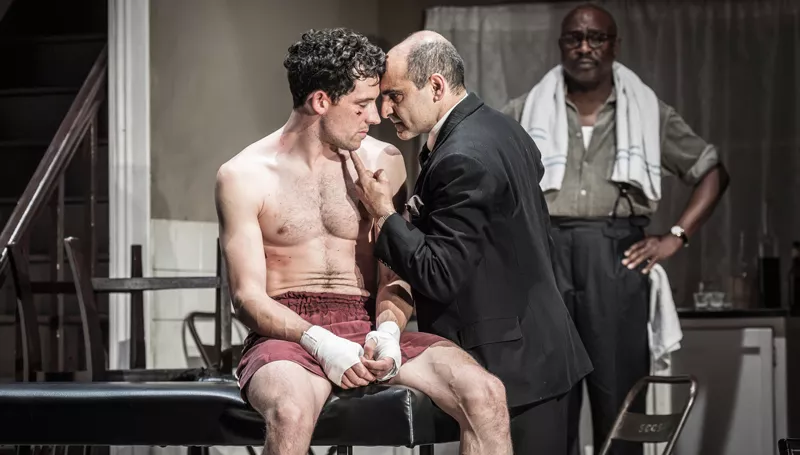
O’Connor (Disclosure Day, The Crown) returns to the stage for the first time in 11 years to give a superbly committed performance as the embattled Joe. Sufficiently muscular to convince and increasingly bloodied as Joe’s bouts take their toll, O’Connor strongly conveys a sensitive awareness as well as the ambitious hardening of his behaviour, as his internal sparring plays out before us.
Daniel Mays is also terrific as the wheeler-dealer Tom who is in danger of losing both his new star client to a rival and his girlfriend until his wife agrees to divorce him. Hayley Squires does well as the only female character Lorna, who is not so much a femme fatale as a sassy broad from Newark who “knows a dozen ways” but has a heart. Oozing contempt, Zubin Varla gives Eddie a reptilian menace, while Stanley Townsend lends Mr Bonaparte a real warmth and moral weight. And (on press night) Oscar Prout touchingly embodies the spirit of the young Joe who silently looks on as his older self heads towards his final round.