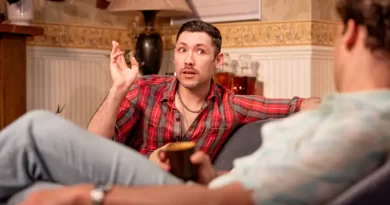
“Who’s Afraid of Virginia Woolf?” at @sohoplace
Neil Dowden in the West End
★★★★★
4 October 2026
Edward Albee’s 1962 play Who’s Afraid of Virginia Woolf? is indisputably one of the core classics of American theatre, following in the footsteps of Long Day’s Journey into Night, A Streetcar Named Desire, and Death of a Salesman. It’s probably most famous for the 1966 Hollywood movie starring Elizabeth Taylor and Richard Burton (in which their own tempestuous marriage seemed to bleed into their screen characters) under the direction of Mike Nichols. But it is regularly revived on stage on both sides of the Atlantic attracting major actors including, in London in the last three decades, Diana Rigg and David Suchet, Kathleen Turner and Bill Irwin, Imelda Staunton and Conleth Hill. Now Marianne Elliott has revived it with thrilling success at @sohoplace featuring brilliant leading performances from its two American stars Gillian Anderson and Billy Crudup.

Gillian Anderson and Billy Crudup.
Photo credit: Johan Persson.
The continuous action is all set in the living room of a house on the campus of a New England college after a faculty party. Without telling her husband George beforehand, Martha has invited the young couple Honey and Nick to their home for yet more drinks, which – accompanied by game-playing that is more akin to psychological warfare – goes on throughout a seemingly interminable dark night of the soul. George teaches history, and Martha is the daughter of the college president, while Nick has recently taken up a post in the biology department accompanied by his wife Honey. Although to start with the middle-aged hosts’ bickering with each other is largely drunken banter, it soon turns nasty as the younger pair are sucked into their bitterly unhappy marital relations – and cracks are revealed in their own marriage.
Martha is the more verbally aggressive, but George acts as a kind of manipulative circus master for the perverted games of “Humiliate the Host”, “Get the Guests”, “Hump the Hostess”, and “Bringing Up Baby”. Martha shows her contempt for George whom she calls a “great big fat flop”, as he has not become head of his department and let her father stop him from publishing his risqué novel – while they also squabble about their relationship with their 21-year-old son. But the underlying reason for their failed marriage becomes apparent only at the end. Meanwhile Martha dances sensually to jazz music with Nick, then George cruelly makes public what Nick has confided in him that he married Honey due to a “phantom pregnancy” – causing her to rush to the bathroom to be sick (again). As Martha seduces Nick into going upstairs with her, George plots his ultimate revenge.
First and foremost, Who’s Afraid of Virginia Woolf? is a black comedy drama about how romantic relationships can go horribly wrong if they are not founded on truthfulness. And indeed the theme of reality versus illusion runs right through it with hints that George’s novel may be autobiographical rather than fiction, and most importantly both couples’ attitudes towards having children. It’s also an indictment of American post-war social conventions with a conformist academic culture and the expectation of a patriarchal family where the man is the breadwinner and the wife the homemaker bringing up their children.

Gillian Anderson and Josh Dylan.
Photo credit: Johan Persson.
It’s more naturalistic than Albee’s first plays in the style of Theatre of the Absurd, but there’s still a Beckettian sense of pointlessly passing the time. There is a strong influence of Strindberg (especially Dance of Death) and O’Neill (especially Long Day’s Journey into Night), but also perhaps Noël Coward’s lighter Private Lives – an emotional co-dependency where you can’t live with someone, but can’t live without them.
Elliott (who has previously had major successes with the American classics Sweet Bird of Youth, The Little Foxes, and Angels in America) gives us a compelling theatrical experience throughout the three hours’ stage time – there is no let-up in either the awkwardly funny barbs or the rising feeling of the characters being trapped in an alcohol-fuelled nightmare. Performed in-the-round, the audience become transfixed voyeurs to an arena where fights are enacted on a super-slow revolving stage (that briefly speeds up near the climax), with the roundabout motion suggesting the protagonists are caught in a vicious cycle that may be repeated infinitum. Miriam Buether’s circular set is a comfortably furnished, book-lined room with a well-stocked drinks table, with the three act titles “Fun and Games”, “Walpurgisnacht”, and “The Exorcism” displayed on an upper ring that is raised to the flies.
The British-based Anderson may be best known for her TV roles in the likes of The X-Files and The Fall, but she has real stage credentials in All About Eve, A Streetcar Named Desire, and A Doll’s House, and here she is superb as the foul-mouthed, out-of-control Martha who drowns her desperate unhappiness in alcohol. As well as dancing provocatively, at one point she crawls right around the perimeter of the stage like a tipsy predator. Her insults towards her husband are wickedly funny, delivered with a growling confrontational directness to get a reaction from him, but despite everything we still feel her strong attachment to him.
Billy Crudup is a Broadway star, but though this is the third West End show he has done in succession (following Harry Clarke and High Noon) this is the first time he has been in a show here that does full justice to his talents. His George is a masterclass in passive aggression, partly concealing his damaged masculine pride under a carapace of sardonic humour, yet still conveying not only a sensitive intelligence but also a tenderness for his wife that transcends their tearing each other apart.
Josh Dylan gives the ambitious, square-jawed, former school football champion Nick a harder edge than usual, seen particularly in the way he bristles with male rivalry towards George whom he evidently does not respect despite his more junior status. And Phoebe Horn is terrific as the blonde, genteel Honey whose polite manners and inhibitions dissolve in a haze of brandy as she descends into childlike naughtiness and tantrums amid painful home truths. At the end of the night it feels like the emotional devastation may just have averted the young couple from turning into their older counterparts, who no doubt have gone through this sort of psychodrama many times before and will do again.