“The Standard of Living” at Theatre Royal Haymarket
Neil Dowden in the West End
★★★★☆
3 October 2026
James Graham’s new play The Standard of Living opens with a man in a grey pinstripe suit coming alone to the front of the stage to address us: “What is a good life?” We very soon learn that it is the hugely influential economist John Maynard Keynes asking this big question. It also becomes apparent that the double-edged title refers not just to economic wellbeing but to quality of life in general. It is clear in Graham’s warm, multi-faceted portrayal of Keynes – whose life was heavily involved in the arts as well as economics – that his motivation is as much aesthetic as political in trying to ensure that people can lead richer lives in every sense.

Rory Kinnear, Thomas Flynn and Natalia Osipova.
Photo credit: Manuel Harlan.
Spanning almost 40 years and two world wars – from 1917 to 1946 – Graham’s play is admirably ambitious and fleet of foot, even if he isn’t quite able to knit together all the strands of Keynes’s life – and his intertwining with the momentous events of that period – into a coherent tapestry. Graham is well-known for boldly taking on vital political issues, but here he portrays a towering figure of the first half of the 20th century – who is still having a big impact now – for whom the importance of gross domestic product is only a means to an end. The play verges on hero-worship at times, but it makes complex ideas accessible, and though episodic is always entertaining.
Keynes is shown both inside and outside the establishment trying to reform orthodox thinking with mixed success. We first see him as a conscientious objector during the Great War, leaving the cloisters of Cambridge University to work in the Treasury. But after attending the Versailles peace conference he publishes his sensational exposé The Economic Consequences of the Peace in 1919 condemning the severity of reparations against Germany, which leads to economic and social breakdown, the rise of Hitler, and another worldwide war. He also argues in vain against Chancellor of the Exchequer Winston Churchill returning Britain to the gold standard in 1925, which sparks the General Strike the following year.
After the Wall Street Crash in 1929 causes the Great Depression, Keynes advocates state intervention in the economy to curb the pernicious excesses of capitalism. His 1936 masterwork The General Theory of Employment, Interest and Money is the fullest expression of Keynesianism – the efficacy of government investment shown in Roosevelt’s New Deal in America. But it is not until after World War II that Keynes comes into his own as at Bretton Woods he helps to establish the International Monetary Fund and World Bank (as well as a long-term, low-interest loan from the US to the UK to rebuild) which sets the international regime for decades to come. Despite later fluctuations in status, Keynes’s legacy is assured.

Photo credit: Manuel Harlan.
Indeed, after a period when his theories have often been out of favour with neoliberals in power, Keynes seems to be making another comeback with our current prime minister Andy Burnham’s speech at the Labour Party conference – on the same day as opening night – providing some echoes. Graham counterpoints Keynes’s optimistic belief in borrowing to invest with the stringent figure of Austrian neoclassical economist Friedrich Hayek who follows a laissez-faire, free-market approach that believes in self-correcting, “natural” laws. In a Stoppardian flight of intellectual fancy, there is an outstanding scene on the rooftop of King’s College Chapel in Cambridge with the two men arguing their cases while watching for incendiary bombs during the Blitz. The argument continues today.
The Standard of Living is by no means just a chronology of seminal historical episodes, as it alternates Keynes’s professional career with his more personal interests, especially involvement with the Bloomsbury Group. We see him mixing with the bohemian artists and writers, including his lovers Duncan Grant and Lytton Strachey as well as sisters Virginia Woolf and Vanessa Bell. Statistician that he is, Keynes keeps a record of all his numerous sexual encounters in a coded notebook.
Having, it seems, been exclusively homosexual as a young man, it takes everyone by surprise when he falls in love and marries Lydia Lopokova, the Russian ballerina star who joined Sergei Diaghilev’s Ballets Russes and danced ‘Firebird’ in Stravinsky and Fokine’s revolutionary ballet. As well as helping to lay the foundations of what would become the Royal Ballet, she supports Keynes in founding the Cambridge Arts Theatre in 1936 and becoming the first chairman of the Arts Council in 1946. She also cares for him when his weak heart leads to his death aged only 62.
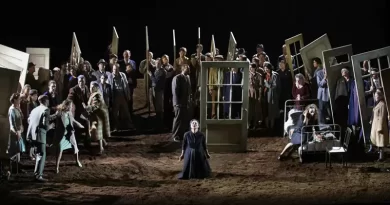
Trying to cram so much in, the play spreads itself a bit thinly, but Nicholas Hytner’s production is commendably fluid and engaging. Bob Crowley’s ingeniously flexible set design features moving panels that separate one scene from another without breaking momentum, often displaying Bloomsbury artworks as well as archive footage of the times (projection designer Luke Halls), while Jenny Beavan’s costumes contrast the subdued, formal suits of Whitehall with the colourful, flamboyant dress of Charleston. Movement director James Cousins ensures this is no static show of talking heads, and ballet consultant Edward Watson beautifully evokes some of Lopokova’s most celebrated performances.
Rory Kinnear gives a quietly commanding performance as the modest, rather donnish Keynes, who flits between different worlds without quite belonging wholly to any of them, like an outsider with privileges. He makes the most of moments of self-deprecating humour, but there is no doubt about his character’s commitment to social progress. Natalia Osipova – principal ballerina with the Royal Ballet – makes an outstanding dramatic stage debut as Lopokova, bringing compact comic energy to her fellow countrywoman’s unconventionally direct comments on Keynes’s snobbish friends, as well as dancing wonderfully as you would expect.
Thomas Flynn is also excellent as Keynes’s first great love, the charmingly uninhibited Grant, with Pip Carter giving the jealous Strachey a wry crustiness. Naomi Frederick suggests Woolf’s super-sensitive intelligence and Claire Price Bell’s independent spirit. Laurie Kynaston makes the respectful but uncompromising Hayek an amusing foil to the older Keynes, as at one point they dance together with the former calling out “Tighten your belt!” and the latter “Buy a new belt!”