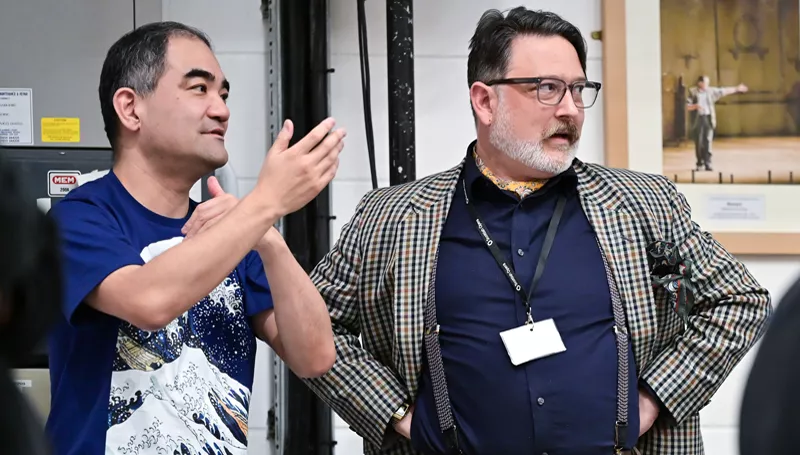
Opera composer Dai Fujikura interviewed by Mark Brown
The drama of Hokusai and his daughter Ōi: opera composer Dai Fujikura interviewed by Mark Brown
Interview at the offices of Scottish Opera, Glasgow, 7 January, 2026
As I was preparing to write this article I found myself in a branch of a well known supermarket chain. As I perused the fruit and veg, I noticed that the back of the t-shirt of a young member of the packing staff was emblazoned with a reproduction of what is, unarguably, the most famous work of Japanese visual art. Indeed, it is one of the best known images created by an artist anywhere in the world.
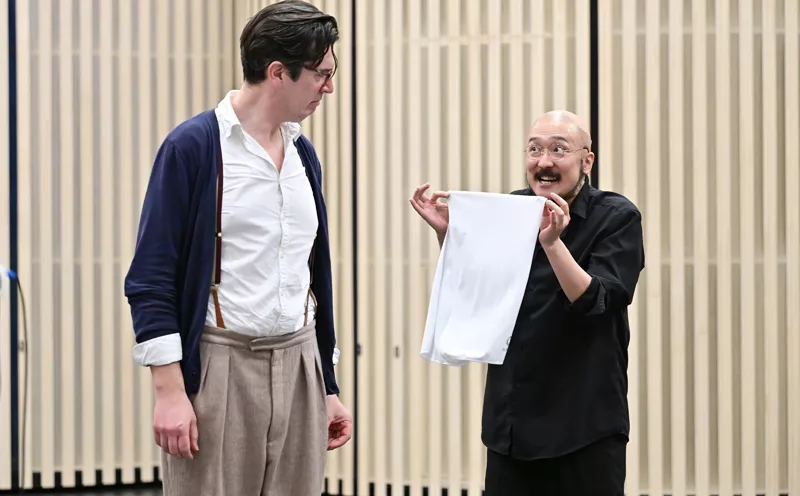
Edward Hawkins and Daisuke Ohyama rehearsing The Great Wave.
Photo credit: Scottish Opera.
“The Great Wave off Kanagawa: Hokusai” read the legend that ran alongside a monochrome depiction of the astonishing image of a huge wave, rising majestically, yet frighteningly, above three boatloads of stricken sailors. The legendary woodblock print “The Great Wave off Kanagawa” – in which the white crest of the ascending water seems to thrust down from the sky like the talons of a hawk in pursuit of its prey – was created in the early 1830s by the extraordinary artist Katsushika Hokusai.
The image appears everywhere these days, from political placards (on which it is used to evoke climate chaos) to mouse mats, crockery and, as we have seen, clothing worn by young supermarket workers. Hokusai’s magnum opus is more ubiquitous even than the output of the leading pop artists of the 20th and 21st centuries, such as Andy Warhol, Jean-Michel Basquiat, Keith Haring and Banksy.
The ubiquity of the picture destroys the fallacious distinction between “high art” and “low art”, making the unarguable case that great art can be popular. It seems somehow appropriate, therefore, that I should spot the image, reproduced on a youngster’s t-shirt, so soon after I interviewed Japanese composer Dai Fujikura about his new opera The Great Wave, which – in his second collaboration with Scottish librettist Harry Ross – he has written for Scottish Opera and Tokyo-based live music company KAJIMOTO.
A five-act opera, sung in English, the piece will be directed by the Japanese stage director Satoshi Miyagi and conducted by Scottish Opera music director Stuart Stratford. It will star Japanese baritone Daisuke Ohyama as Hokusai and soprano Julieth Lozano Rolong as his daughter Ōi. The opera will play in Glasgow and Edinburgh in February 2026.
The piece is Fujikura’s fourth opera. “I like writing operas because you can tell a story, from beginning to end, with just music”, he tells me when we meet in Scottish Opera’s offices on Elmbank Crescent in the Charing Cross area of Glasgow city centre. If he could, Fujikura continues, he would “live in that world”, a place where human narratives unfold entirely musically.
This opera, he explains, is “fast moving”, with many “mood changing, dramatic sequences that are quite direct.” Needless to say – in view of the nature of the artwork that gives this piece its name – audiences should expect an elemental opera that evokes the thunderous storm that causes the great wave.
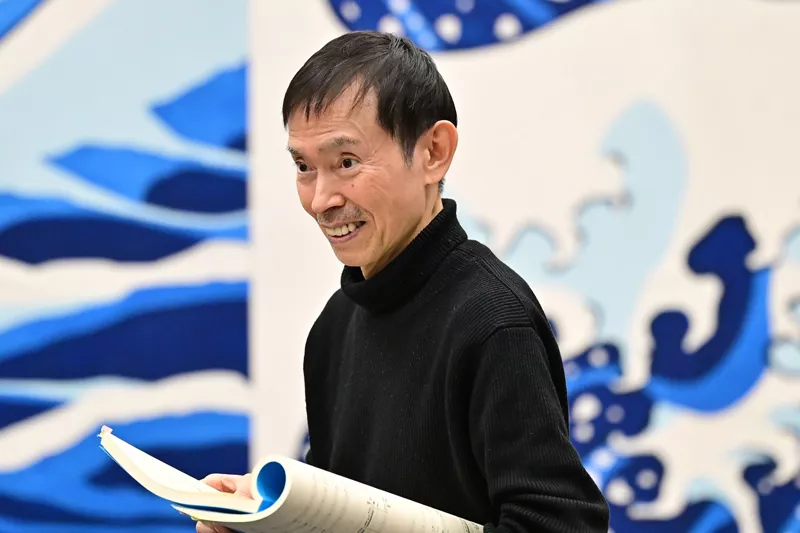
Director Satoshi Miyagi.
Photo credit: Julie Howden.
The composer was born in Osaka, Japan. He moved to the United Kingdom 34 years ago, at the age of 15, and has lived here ever since. “I grew up studying western instruments, even when I was in Japan”, he explains. Surprisingly, perhaps, he first heard Japanese traditional music, not in his homeland, but in Darmstadt in Germany. Subsequent to that, for about the last decade, Fujikura remembers, “Japanese instrumentalists have been contacting me to write music for them, concertos, solo pieces and so on.” Consequently, he says, he is now “really familiar” with Japanese instruments.
The composer feels particularly comfortable creating music for the traditional Japanese bamboo flute known as the shakuhachi, which is distinguished by its deep, soulful sound. The famous flute will feature in The Great Wave.
The orchestra had an early run-through of the score in which they were joined by a young shakuhachi player from London. The composer was, he says, “very happy to hear the reaction from the orchestra [to the shakuhachi music]. She starts playing the shakuhachi and everyone goes ‘Whoah!’ This was exactly what I wanted.” For the public performances of the opera, the composer is delighted that Scottish Opera and KAJIMOTO have secured the services of “superstar Japanese shakuhachi player” Shozan Hasegawa.
Fujikura is enjoying the opera’s combination of the evocation of the timeless forces of nature with the life of a great artist. “The Great Wave is absolutely everywhere”, he says of the ubiquity of Hokusai’s best known creation. However, he adds, “there are 30,000 works that we know of.”
The opera is a composite of established facts and leaps of imagination. It is, the composer believes, a “beautiful thing” that Hokusai’s life invites artistic interpretation. “There are many things that we know [about Hokusai] from history”, he says, “but there are so many things that we don’t know.”
Where the unknowns are concerned, he says, “we had a chance to use our imaginations to make it fantasy.” In relation to the known facts, he adds, “we wanted to stay true to the history.”
For Fujikura and Ross, that history makes for “an opera about father and daughter.” Hokusai’s child, Katsushika Ōi, was an extremely talented artist whose style (her few surviving artworks attest) was distinct from that of her father.
In addition to that, she played an important role in the later period of Hokusai’s career, both as an artist and entrepreneur. Fujikura is fascinated by the story of Ōi. “We know that she was married to an artist, got divorced, then went back to her dad, to work with him”, he tells me.
Together, father and daughter ran “Studio Hokusai” as “a production line”, Fujikura says. Indeed, it is believed that Ōi was the driving force in what was an extremely successful artistic and commercial venture.
Ōi’s success – as a female, divorced artist in 18th and 19th-century Japan – is truly remarkable. Unsurprisingly, The Great Wave is not the first time that her life has been dramatised. Previous dramatic representations of her work and biography include the Japanese television movie The Dazzling Life of Hokusai’s Daughter (2017) and the recent feature film Ōi, oui (2025).
The art and life of Hokusai are fascinating and often surprising. My first serious encounter with the artist’s work was in viewing the major exhibition of his work at the Royal Academy in London in 1991-92. I remember, as a young man, being taken aback by the exhibits, at the end of the show, of bold, pornographic works depicting human beings with exaggerated genitalia engaged in sexual acts (sometimes with animals). They took my breath away, not only with their unexpected content, but also the stark contrast they provided with the vivid pastoralism that characterised most of the works I had seen in the show.
The rich legacy of Hokusai, and of his daughter Ōi, has given continuously to Japanese and global culture. As Scottish audiences seem set to discover, it also offers much to the musical and dramatic art form of opera.
The Great Wave is at the Theatre Royal, Glasgow, 12 & 14 February, and the Festival Theatre, Edinburgh, 19 & 21 February.
Photo as thumbnail and at top of article shows the interviewee, composer Dai Fujikura, with librettist Harry Ross in rehearsals.
Photo credit: Julie Howden.