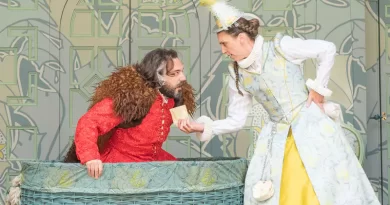
“The Banality of Evil: Hannah Arendt, France, 1940” at Arcola Theatre
David Wootton in East London
★★★★☆
16 October 2026
The political theorist Hannah Arendt is probably best remembered for the controversial concept of “the banality of evil”, which she first introduced in her book, Eichmann in Jerusalem (1963), a report on the trial of one of the key organizers of the Holocaust. As a major intellectual figure who had studied under some distinguished philosophers, and who developed a wide range of searching reflections on the issues of her time, Arendt became frustrated by the degree to which her work was defined by, and reduced to, this single idea.

Mai Weisz (foreground.)
Photo credit: Alex Brenner.
Furthermore, Arendt was not just a distant observer of the Nazis’ destruction of a society and a people. As a German Jew, she lived through the rise of Nazism, and, in 1933, was briefly imprisoned in Berlin for undertaking illegal research into antisemitism. Fleeing to Paris later that year, she then worked for outreach programmes funded by Zionist organizations. In 1940, she was identified as an enemy alien, and interned, as one of 7,000 women, in Camp Gurs in southwest France. Though she succeeded in leaving the camp after nine weeks, taking advantage of confusion during the political division of France, she suffered firsthand experience of “the banality of evil” before managing to migrate to New York.
Julia Pascal’s fascinating new play The Banality of Evil: Hannah Arendt, France, 1940 reconstructs the period of internment, from Arendt’s arrival at the Vélodrome d’Hiver in Paris, where women were initially gathered, to her escape from Gurs. Despite the title, Hannah is just one of three characters upon whom Pascal focusses, the others being the artist Charlotte Salomon and the schoolgirl Eva Daube (who was the aunt of an American cousin of Pascal).
Salomon’s description of “singspiel” for her autobiographical series of paintings Life? or Theatre? seems to have helped inspire the style of presentation. For, during the rehearsals, the work developed into a “play with songs” of a kind comparable to the collaborations between Bertolt Brecht and Kurt Weill. Anja Fahlenkamp, one of the highly talented cast of six, has composed and arranged a beautifully spare a cappella score that accentuates the moving nature of the action. That action is clearly divided into separate scenes across the 90 minutes’ running time, each announced by number and title in an almost Brechtian fashion.

Anja Fahlenkamp, Helen Goldwyn, and Pat Dynowska.
Photo credit. Alex Brenner.
Visually, the production is equally distinctive in creating something out of almost nothing, and so suggesting the meagre way in which those interned at Gurs were forced to live. Carmen Neat’s set design may be described as an example of Teatro Povero, akin to the work of Arte Povera artists, in its expressive use of a few basic, everyday objects. The bare brick wall of the Arcola’s Studio 2 is adorned with some items of clothing, hung from hooks suspended on wires, below which sit seven galvanized steel buckets.
Within the first few scenes, those buckets are employed in several different ways: to stand on and give height, and so suggest a bus; to encircle and confine, and so suggest a cage; to sit on, as a support while playing cards. Then, later, their sonic qualities prove valuable, either to act as an accompanying drum or to conjure up the fall of rain. And sometimes the buckets are just buckets, necessary for washing clothes or catching the discharge of dysentery.
Neats’s set is complemented by Tony Simpson’s lighting, which is economical but effective, helping to create striking images that range from the spotlit to the silhouetted.
From the outset, the narrative is conveyed equally through language and movement. Mai Weisz (as Hannah), Anna Eckhard (as Charlotte), and Ariella Barnett (as Eva) dance deftly onto the stage to the sound of accordion music. Only then do they confirm their individual identities and personalities through monologues based on letters and diaries. Dressed in a black two-piece and a cream jacket (one of the costumes designed by Lesley Lightfoot), Hannah considers the existential issues emphasized by her new experience, as she travels through France by train. Charlotte, in a printed cotton dress and loose light jacket, concentrates on new visual sensations. The thoughts of Eva, in a dark blue dress, are torn between a desire for delicious food and an adherence to the ideals of communism. On arriving at the camp, they shed their outer garments, don headscarves, and face hardship.
Two other characters, both imagined, emerge as individuals. One is the gynaecologist Agathe (Helen Goldwyn), who loses her life while trying to reach the latrines. Her death is simply but powerfully staged through the use of a long sheet of brown material that represents the mud into which she sinks. The other is the outsider Trude (Pat Dynowska), who suffers being raped by a guard and later turns to stealing from Charlotte, which leads to an impromptu trial overseen by Hannah as judge.
There are several urgent, engrossing, sometimes ideological arguments between the women in their hut (the six actors perhaps standing for the 60 who inhabited this space), and there are shared moments of both stress and relief. Their dialogue can be conversational but also intentionally repetitive and rhythmic, allowing speech to turn almost naturally to song, whether solo or communal.
Both as writer and director, Pascal is mistress of her material. In communicating a deeply felt story, she brings her protagonists vividly to life, and allows them to signify strongly as individuals, while also indicating contemporary resonance at a time when many people are still forced by prejudice and conflict to migrate and seek refuge. And she does this movingly and memorably with consummate stagecraft. She is also able to encourage an impressive sense of ensemble, with the result that actors who have only recently been cast appear to have long worked together as a company.
When Hannah, Charlotte, and Eva left Camp Gurs, they went their separate ways, never to meet again. Nevertheless, two epilogues allow Hannah and Eva, both settlers in America, to share a final conversation, and Charlotte, who did not have their luck, to survive through her art. Pascal grants her characters immortality in a play that is the antithesis of banal.